Sign in. It’s quick, free and it’s up to you.
An account is an optional way to support the work we do. Find out more.
Sign in. It’s quick, free and it’s up to you.
An account is an optional way to support the work we do. Find out more.
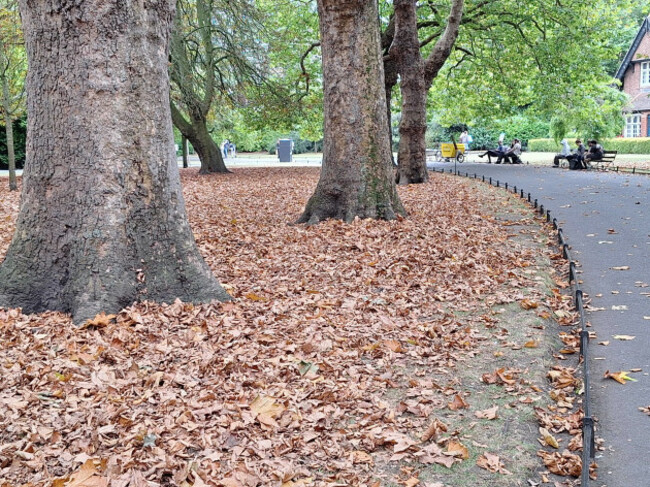
YOU MAY HAVE noticed piles of leaves have already begun gathering on the ground, and the children haven’t even gone back to school yet.
Well, an expert says this ‘false autumn’ is no coincidence; it’s a direct result of extreme weather.
Noeleen Smyth, director of the National Botanic Gardens, told The Journal that it’s time to think differently about what we plant and how we plant it.
Some of the most common trees in Ireland have been particularly affected by the long, hot spells we saw this summer, which are expected to become the norm.
Smyth says horse chestnuts, for example, have been looking “tatty” recently due to a combination of dehydration, pests and fungus, all of which have been brought on by the heat and lack of rain.
Bigger leaves have more surface area, so water is lost quickly.
Dehydration can be seen in the crispy edges of the leaves. Caterpillars (the pests) are living inside the leaves’ tunnels, “munching away” at them. The fungus looks like a white-coloured dust on top.
“It’s a bit of a perfect storm,” said Smyth.
Horse chestnut trees have been producing smaller conkers, because they haven’t been able to develop and photosynthesise.
Smyth said: “It’s like getting sick … [if] you’re run down, other things start pouncing on you as well.”
She explained that when a tree is under stress, it reproduces faster, because “they want to pass on their genes”.
“The quality will not be good. It’ll all be small little fruits or small little conkers or small little acorns. They just don’t have the energy to have the big ones,” said Smyth.
“If we keep having these kinds of extreme summers, our trees will definitely be affected.”
On the flip side, some invasive species like Ailanthus, also known as Tree of Heaven, are now producing flowers and fruit. Smyth said that’s a “worry” for the future as the climate continues to change.
Not only have weather conditions become more extreme, but the seasons are slowly shifting.
Dried blackberries stored by the National Botanic Gardens show that since the 1800s, their season has shifted by about two weeks.
“We’re getting blackberries in the end of July now rather than mid-August,” she said.
The Botanic Gardens do expeditions abroad, to countries such as Georgia, where specialists find trees that cope better in the heat, and that may do well in Ireland as it warms up.
Under the EU Nature Restoration Law, member states are required to increase the share of green space in urban areas to a minimum of 45% by 2030, and the share of tree canopy cover to at least 10%.
Smyth says, when it comes to our urban areas, it’s not just about what we plant, but the way we plant it.
“In our streetscapes, normally we put in one tree, or we put them all in a big line.
“If we plant more trees together in a cluster, then you get a lot more shading.”
She recommends large “tree pits” or basins that can be home to various species of different heights living alongside each other. Higher density not only means more shade, but increased air cooling, which will be important in the hot summers to come.
Smyth also said that planting in high quality soil should be prioritised over “dry builders’ rubble”, if plants are to be given the best chance.
Going forward, planners should choose trees that can withstand drought, she added.

To embed this post, copy the code below on your site












have your say