Sign in. It’s quick, free and it’s up to you.
An account is an optional way to support the work we do. Find out more.
Sign in. It’s quick, free and it’s up to you.
An account is an optional way to support the work we do. Find out more.
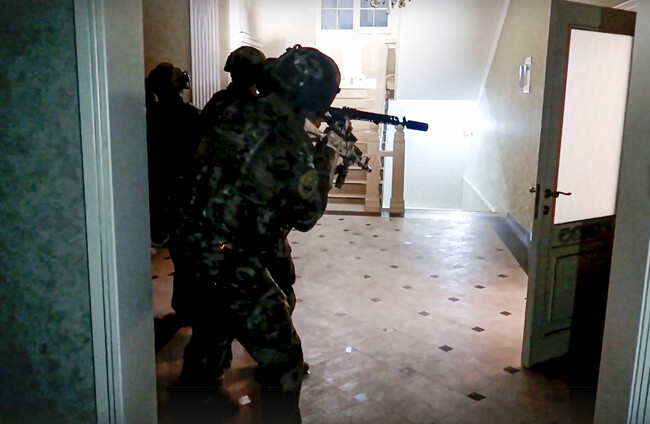
THREE DAYS OF mourning began today in Russia’s southern Republic of Dagestan after gunmen launched a series of attacks against churches and synagogues last night, resulting in shootouts with police that left at least 15 officers and four civilians dead, including an Orthodox priest.
Russian authorities said that five assailants had been “liquidated”.
“As a result of the terrorist attack that took place yesterday in Makhachkala and Derbent, 46 people were injured, among them civilians and law enforcement officials,” Dagestan’s health minister Tatyana Belyayeva said.
“Unfortunately, 20 people had been killed,” she added, updating a previous toll of 19 without specifying if the 20th person was a civilian or police officer.
It remains unclear just how many people were involved in the attacks, which came just three months after members of Islamic State (IS) killed more than 140 people in a massacre at a concert hall in Moscow.
Two Orthodox churches, two synagogues and a police checkpoint were attacked, according to officials and the Russian Jewish Congress.
Among the dead was the Rev Nikolai Kotelnikov, a 66-year-old Russian Orthodox priest at a church in Derbent. The attackers slit his throat before setting fire to the church, according to Shamil Khadulayev, deputy head of a local public oversight body.
The attack came as the Orthodox faithful celebrated Pentecost, also known as Trinity Sunday.
The Kele-Numaz synagogue in Derbent was also set ablaze.
Shortly after the attacks in Derbent, militants fired at a police post in Makhachkala and attacked a Russian Orthodox Church and a synagogue there before being hunted down and killed by special forces.
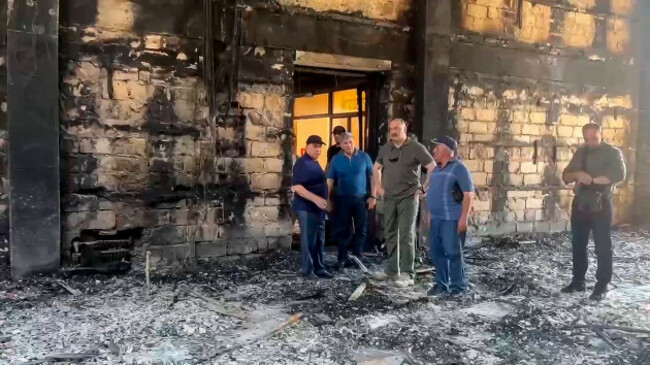
Sunday’s violence in Dagestan’s regional capital of Makhachkala and nearby Derbent has been blamed on Islamic extremists by Russian authorities. The Caucasus area is predominantly Muslim.
The affiliate of the Islamic State group in Afghanistan that claimed responsibility for March’s massacre quickly praised the attacks in Dagestan, saying they were conducted by “brothers in the Caucasus who showed that they are still strong”.
The attacks on Sunday also had echoes of the kind of insurgent violence that plagued the North Caucasus during the 1990s and 2000s but the Kremlin has today dismissed fears of a renewed wave of attacks.
Kremlin spokesman Dmitry Peskov said: “No. Now there is a different Russia. Society is consolidated and such terrorist manifestations are not supported by society in Russia or in Dagestan.”
Russia’s Investigative Committee said it had launched criminal probes over “acts of terror”, while Dagestan Governor Sergei Melikov called the attacks an attempt to “destabilise” his region.
“We know who is behind these terrorist attacks and what objective they are pursuing,” he added, without providing specific details but making references to the conflict in Ukraine.
“We must understand that war comes to our homes too. We felt it but today we face it,” he said.
Russia has been a target for attacks in recent years by IS, which opposes Moscow’s military support for Syrian leader Bashar al-Assad and claims to have set up a “franchise” in Russia’s North Caucasus.
With reporting from AFP and Press Association

To embed this post, copy the code below on your site








have your say