Sign in. It’s quick, free and it’s up to you.
An account is an optional way to support the work we do. Find out more.
Sign in. It’s quick, free and it’s up to you.
An account is an optional way to support the work we do. Find out more.
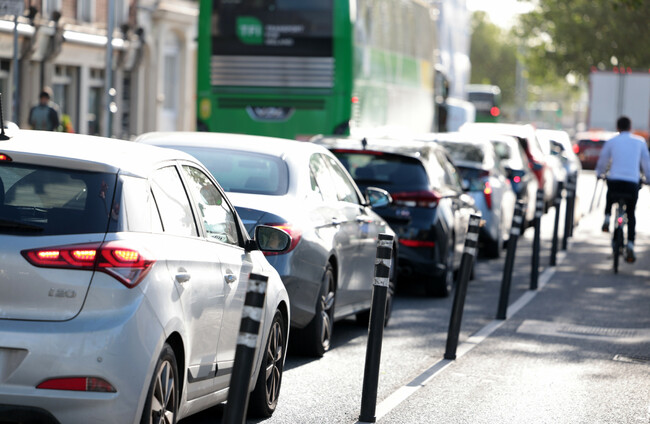
A NEW STUDY has found high levels of air pollution across Dublin’s inner city – with particularly high concentrations of nitrogen dioxide exceeding World Health Organisation guidelines found on several city centre streets.
The study by UCD and DCU found high levels of nitrogen dioxide on Cork Street, along the quays, on O’Connell Street and in the area around Temple Bar, as well as on St John’s Road West.
The data showed that during the sampling period, just under half (49.4%) of days exceeded World Health Organisation (WHO) guidelines of the harmful pollutant, also known as NO2, with peaks during rush hours, especially in winter.
Nitrogen dioxide affects the respiratory system and can decrease the lungs’ defences against bacteria and make them more susceptible to infections.
Poor air quality has been linked with rises in asthma, chronic obstructive airway disease and heart failure.
The study also traced levels of fine particulate matter, which consists of very small particles which can be solid or liquid. Some of these particles occur naturally, and many are man-made.
It is estimated to cause roughly 1,300 premature deaths in Ireland annually, according to the Environmental Protection Agency.
The worst affected areas in Dublin are as follows:
(*Entries 1 and 9 on the table refer to the same area, which registered a high level of pollution twice during the period of the study)
The data was collected over 16 months as part of the Google Air View project, using electric Google Street View cars equipped with air sensors across Dublin city from May 2021 to August 2022.
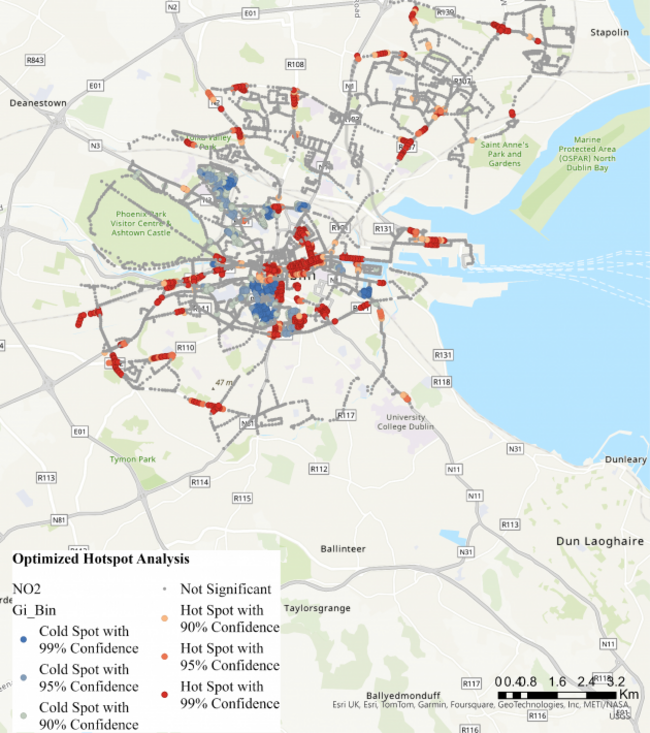
Those behind the study said it highlights the potential for a mobile monitoring approach which could enable real-time information about exposure levels and pollution hotspots.
“We uncovered distinct spatial and temporal patterns in two major pollutants associated with traffic – fine particulate matter and nitrogen dioxide,” researcher Jiayao Chen said.
Researcher David O’Connor said localised air quality data could be particularly useful for high risk and vulnerable areas.

To embed this post, copy the code below on your site













have your say