Sign in. It’s quick, free and it’s up to you.
An account is an optional way to support the work we do. Find out more.
Sign in. It’s quick, free and it’s up to you.
An account is an optional way to support the work we do. Find out more.

In this series, journalist and spoken word artist Cormac Fitzgerald travels to a different town or suburb each week to write about the gigs and cultural experiences you rarely see covered by Irish media outlets.
This week’s subject: Reminiscing about the 1980s at The Teachers’ Club.
*****
“THE PAST IS a foreign country. They do things differently there.”
So states the iconic opening line of L.P. Hartley’s 1953 novel, The Go-Between.
I was thinking of this as I sat in one of the rooms in The Teachers’ Club on Parnell Square and listened to a group of people discussing a place where I have spent most of my life but didn’t really recognise.
The book in question is called Mixtape: Dublin in the 80s, and it was written and compiled by the disabled artist and writer Saoirse Love and her son Finn Waine.
If you didn’t get it from the name, Mixtape is an account of Dublin City in the 1980s given by those who were there. Specifically, it contains 18 interviews with a wide range of people who lived in the city at some stage during the 1980s.
I can claim to be born in the 80s just by the skin of my teeth, but the place described in these pages is strange to me – maybe not foreign, but different enough to give me an uncanny sense of another city, vaguely similar but separate to the place of my youth.
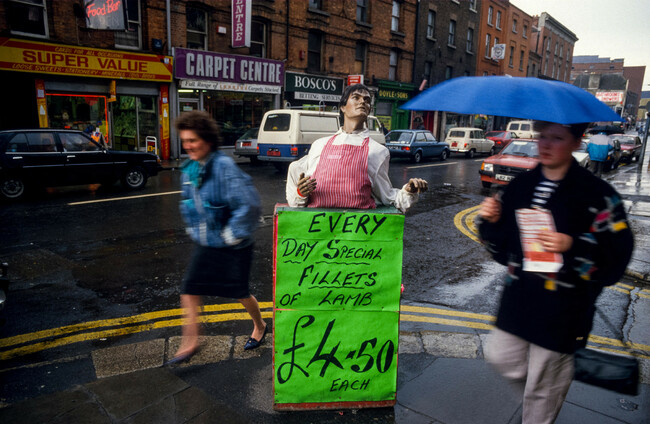
Compared to the Dublin of today though, it seems like a distant a land: a place of crumbling buildings, high unemployment and widespread poverty (okay, maybe it’s not that different), where punks, Cure heads and goths roamed the streets; a conservative society, where contraceptives and homosexuality were still illegal, and people were forced to take to underground spaces to be able to express themselves.
There are a few well-known names and other less-known names among the interviewees.
What links them all together, apart from their connection to the city, is that they were embedded in the counter-cultural scene of the time: musicians, buskers, storytellers, artists, actors, writers, punks and misfits of all sorts.
“I wrote this book with my son Finn because I wanted to tell him what Dublin was like back then but I didn’t think I could do it justice,” Saoirse Love told me.
“I also totally believe in the written word preserving the past.
You know, buildings change and everything keeps changing around us and I think by writing this now we were hoping to preserve some of the people, the characters, the places, the life and what it was like back in the 80s.
The book functions as a record (or a cassette tape) of a particular time and place in Ireland, just as the country was opening up to the world and the future, but was still a lot poorer, more socially conservative and economically closed off than it is today.
Interviews – conducted by Finn Waine – are reproduced almost verbatim, with minimal editing, and inter-cut with lyrics of specific songs from the era, chosen by Love.
There are also images of the interviewees then and now, as well as newspaper clippings, pictures and art from the time. What emerges is an intersecting oral history of Dublin, with accounts crisscrossing and overlapping with each other.
Places evoke the strongest memories: busking on Grafton Street trying to avoid the gardaí; sitting in the Coffee Inn on South Anne Street with no money; hanging around a rundown Temple Bar, before it became the glitzy tourist trap we know today; drinking and dancing in the gay bars of the day.
Open any page of the book at random, and the convenient headings breaking up the interviews allow you to dive into the city as it was back then:
“Everybody looked out for each other in the 80s. If somebody had a job, they’d pay for stuff if someone was short. We all shared everything it was always okay.” – Órla Mc Govern.
“I was down a lot of dodgy back streets, where deals were being done by the people I was with, and I’ve never felt the same level of threat as busking on Grafton St first week of January ’89. I had the guitar like this, and this guy was in my face. He was gonna take my money and beat me up.” – Niall Brosnan.
“Literally hanging out on street corners. We didn’t have money to go anywhere. On Friday or Saturday, we would go canal drinking, down the canal, get a 2-litre bottle of cider and drink it until we got sick. But the punks were from loads of different backgrounds. Some of them came from quite nice neighbourhoods.” – Yvonne O’Doherty.
Mixtape catches the mood of a city rapidly changing, with a vibrant, vocal youth culture demanding to have their voices heard. Ireland was at a low ebb at the time – unemployment and immigration, especially among the young, was huge. A recurring theme throughout the interviews is the lack of money, jobs and prospects that were available.
But, still, the 80s shines bright in the telling as a time of energy, music, community and belief in a better future. You could argue for the first three in today’s youth culture, but it’s hard to find much belief in contemporary Dublin that things will get better.
“We were all very poor. Nobody had a thing. Sometimes you didn’t have food,” Love said.
“But everybody really pulled together because of that and really looked out for each other in a way that I don’t really see happening today.”
“Everyone I talked to about the 80s reminisced fondly and then described a time which I would hate to live in,” said Finn Waine.
I find it fascinating, the contrast. It sounds like everyone was poor broke and miserable. But everyone speaks so fondly of the time and with such love.
The book launch itself in the Teachers’ Club was a lovely mix of choral singing, music, poetry and stories. The poet and actor PJ Brady gave a strong reading of his work, evoking the memory of the time.
The storyteller Órla McGovern gave a small speech, tying the multitude of experiences from the era together.
“For me, this book was like snorting Pop Rocks,” she joked, talking about the memories it evoked.
Near to the end of the night, the interviewees in attendance all sat at the front of the room to answer questions and talk among themselves. There were jokes, reminisces, old stories and friendly but robust disagreements about what life was like back then.
“Would you go back?” A man in the audience asked to cries of “Yes!” “In a heartbeat!” from some, and sober reflections on how hard things were from others.
Another man asked if it was all just nostalgia for youth and being young that made them see the 80s through rose-tinted glasses.
Again, there were agreements and murmurs of dissent. Finally, a woman in the audience took out her phone and waved it around.
“But we didn’t have these flipping things that are destroying society as we know it!”
Everyone was in unanimous agreement on this point. There were no mobile phones, no household internet.
Whether or not the 80s were better as a decade in Ireland, and for many people they were not, at least people talked, met, and interacted with each other face-to-face more.
As the night wound up, I was reminded of my recent trip to The International Bar, thinking of my own old Dublin at the beginning of the last decade – yeah, we didn’t have much money, it could be grimy, there was a recession, no one knew what the future would hold.
But we were together. We were there.
Mixtape: Dublin in the 80s will be available online and in selected bookshops in the coming weeks.

To embed this post, copy the code below on your site














have your say