Sign in. It’s quick, free and it’s up to you.
An account is an optional way to support the work we do. Find out more.
Sign in. It’s quick, free and it’s up to you.
An account is an optional way to support the work we do. Find out more.
LAST UPDATE | 21 Apr
THE ECONOMY IS expected to continue growing, even if the war in the Middle East persists for a long time.
The Tánaiste has briefed Cabinet today on a range of economic scenarios that could develop as a result of the conflict and the global energy supply crisis.
The document, prepared by Department of Finance officials, sets out three economic scenarios that differ depending on factors such as the duration of the conflict.
The scenarios are labelled as follows: baseline, adverse and severe.
Tánaiste and Finance Minister Simon Harris set out that the Irish economy is to continue to grow in all scenarios, albeit at a more moderate pace.
Despite the positive outlook, Harris has stressed the importance of achieving budget surpluses, so that the country can build its financial buffer.
Inflation could reach as high as 6.7% in less than a year, according to the “severe” scenario forecast by the department.
The report also projects an Exchequer deficit of €1.2 billion for this year, and 3.4 billion euro in 2027.
The “severe” scenario is modelled on the event of “pronounced and prolonged disruption to energy supply” with oil at 130 dollars a barrel in 2026, and averaging 125 dollars a barrel in 2027.
The reference scenario was based on energy prices prevailing at mid-March levels and involved headline inflation averaging 3.3% this year, with Modified Domestic Demand (MDD) expanding by just over 2%.
A more adverse scenario involved inflation averaging 3.7%, and a severe scenario had average inflation of 4.6% – peaking at 6.7% in the first quarter of 2027.
Stronger cost controls within government departments will be necessary, ministers were told.
Delivery of projects is also dependent on their department’s ability to adhere to its budget.
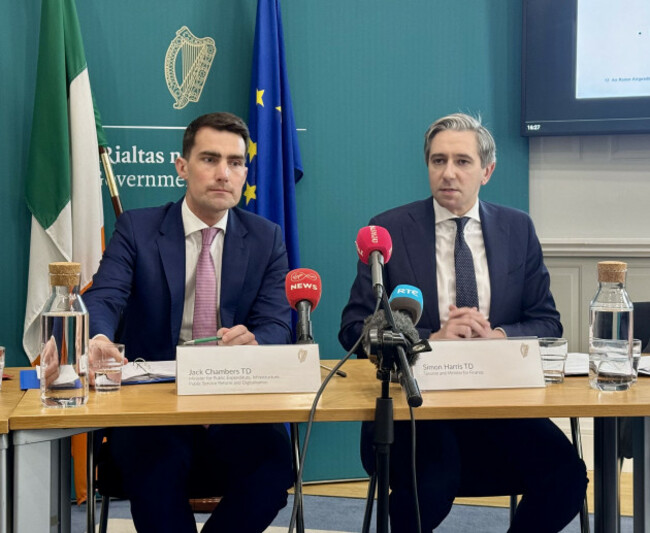
Speaking to reporters earlier today, Harris said “surplus” shouldn’t become a “dirty word”.
“What I do want to say to the Irish people is this, ‘surplus’ can’t become a derogatory term or a dirty word,” he said.
“Thank God the fiscal buffers that we’ve built up in this country over the last number of years are there.”
Harris said when other countries had to borrow to respond to the fuel crisis, Ireland was able to dip into its savings to provide a €750 million package.
It included cuts in excise on petrol and diesel and an extension on the fuel allowance, among other measures.
However, the Tánaiste will still remind ministers that the war in the Middle East has triggered a significant energy price shock that is reverberating across other supply chains.
Public Expenditure Minister Jack Chambers will also talk to Cabinet, and he’s expected to discuss the risk of “stagflation” by a prolonged conflict, where economic growth stays behind higher inflation.
Additional reporting from PA.

To embed this post, copy the code below on your site












have your say