Sign in. It’s quick, free and it’s up to you.
An account is an optional way to support the work we do. Find out more.
Sign in. It’s quick, free and it’s up to you.
An account is an optional way to support the work we do. Find out more.
LAST UPDATE | 18 Mar
GOVERNMENT WILL FINALISE “an appropriate intervention” to rising fuel and energy prices next week, the Tánaiste said.
Simon Harris said measures would be signed off at the next Cabinet meeting on Tuesday.
Speaking in the Dáil, Harris said: “This Government understands the pressures families and businesses are under.
“They are feeling it at the pumps – where the cost of filling a car has risen considerably in the space of a just over a fortnight – and they are seeing it in the cost of a fill of oil.”
The Finance Minister said he had spoken to his officials, the Taoiseach and relevant ministers, and added: “This evening, I want to confirm to this House that we are now finalising what we believe to be an appropriate intervention, for the areas in which there is most acute pressure and challenge.
“The Government’s response will be agreed at the next Cabinet meeting.”
Harris said he strongly believed any intervention should, in the first instance, be “for a short period of time”.
He was speaking during two hours of Dail time dedicated to a Sinn Fein motion on energy and fuel costs.
The party called on the Government to scrap plans to increase carbon tax on home heating oil on 1 May, and to reduce the cost of fuels through emergency legislation on mineral oil taxes.
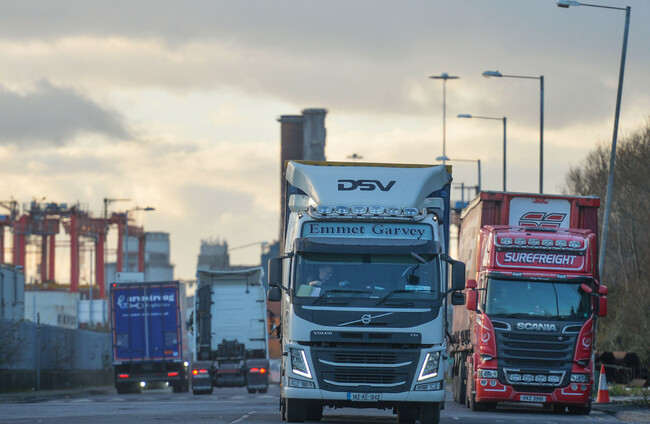
Hauliers earlier warned the government that unless concrete action is taken to assist them with the rising cost of fuel, they will be left with no choice but to launch “immediate protest action”.
Representatives from the Irish Road Haulage Association (IRHA) are due to meet with Transport Minister Darragh O’Brien tomorrow morning, seeking “emergency measures” to reduce fuel costs, which have surged since the US and Israel launched a war against Iran on 28 February.
The IRHA said that without a tax reduction, “many haulage operators will simply not be able to continue absorbing these rising costs”, which would result in empty supermarket shelves.
Today, the price of Brent crude oil rose by another 5% to $108.60 per barrel and the rising costs are being passed on to motorists in Ireland.
On Sunday, Taoiseach Micheál Martin hinted that the government might reduce taxes and levies on fuels while ruling out changes to the carbon tax.
Justice Minister Jim O’Callaghan was challenged in the Dáil today by Sinn Féin leader Mary Lou McDonald, who said it was “blindingly obvious” Government needed to cut taxes on petrol, diesel, and home heating oil.
O’Callaghan said Government would respond to the issue but wouldn’t engage in a “knee-jerk response”, saying deliberations are ongoing and the rising cost of fuel is being felt by consumers around the world, not just in Ireland.
He said the Taoiseach had “indicated” the Government would “look at the issue of excise duties for the purpose of cutting them to take pressure off consumers”, and any measures introduced will be “targeted at individuals who need them the most”.
IRHA president Ger Hyland said today that the hauliers were “ready” to take protest action if the government does not address their concerns.
“Hauliers are looking for decisive action — not warm words — and we will be making that position very clear when we meet the minister tomorrow,” Hyland said.
“When transport costs go up, groceries, clothes, building materials and everything in between goes up in price.
“Hauliers are the people who deliver your milk, bread, fuel and clothes.
“If our industry stopped for just 72 hours, supermarket shelves would empty, hospitals would struggle to operate, petrol stations would run out of fuel and small businesses nationwide would be forced to close.
“If we fail, the consequences for the economy will be catastrophic.”
Additional reporting by Press Association

To embed this post, copy the code below on your site











have your say