Sign in. It’s quick, free and it’s up to you.
An account is an optional way to support the work we do. Find out more.
Sign in. It’s quick, free and it’s up to you.
An account is an optional way to support the work we do. Find out more.
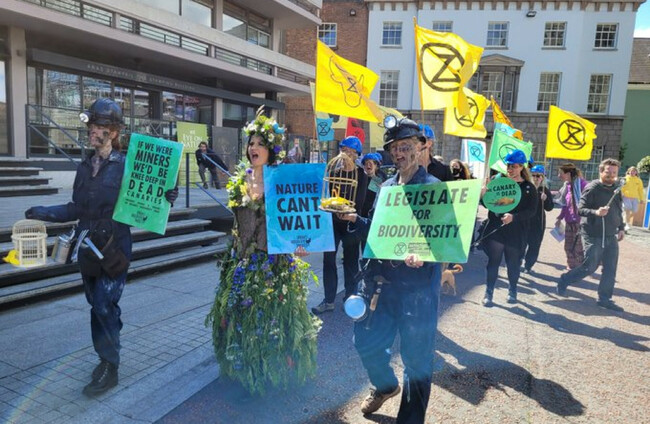
ENVIRONMENTAL ACTIVISTS HAVE held a “dead canaries” protest in Dublin city centre to demand legal protection for Ireland’s biodiversity.
The demonstration was organised by the Irish Wildlife Trust and Extinction Rebellion Ireland and it gathered outside Dublin Castle to coincide with the Government’s National Biodiversity Conference.
The protest featured a range of colourful characters and props including a “nature goddess”, people dressed as coal miners, a “coal mining choir” and fake dead canaries.
The protesters are calling on the Government to introduce legislation in the form of a “Biodiversity Act” to protect Ireland’s wildlife and nature.
Discussing the conference, Irish Wildlife Trust spokesperson Pádraic Fogarty said: “We have to stop just churning out these Biodiversity Action Plans that go nowhere and are completely meaningless words on paper.
We have to move urgently from speeches and conferences to taking meaningful action.
The ecologist added that one of the main points the protesters are making is for the National Biodiversity Action Plan to be put on a legal footing – like the Climate Action Plan – to ensure proper implementation and accountability measures.
A report by the National Parks and Wildlife Service says the most recent assessment of protected habitats and species in Ireland found that 91% of protected habitats have unfavourable conservation status.
The assessment, which was carried out in 2013, found that 14% of species assessed were considered to be endangered.
Minister of State for Heritage Malcolm Noonan said the government has boosted funding to meet the “huge challenges” facing protected habitats.
“There’s no doubt that it has been hugely challenging. But over the last two years, what we’ve been trying to do – and doing very successfully – is increasing the level of funding.
“But also boots on the ground – rangers – really bolstering our scientific unit in the National Parks and Wildlife Service to meet these huge challenges,” Noonan told RTÉ’s Morning Ireland.

To embed this post, copy the code below on your site











have your say