We need your help now

Support from readers like you keeps The Journal open.

You are visiting us because we have something you value. Independent, unbiased news that tells the truth. Advertising revenue goes some way to support our mission, but this year it has not been enough.

If you've seen value in our reporting, please contribute what you can, so we can continue to produce accurate and meaningful journalism. For everyone who needs it.

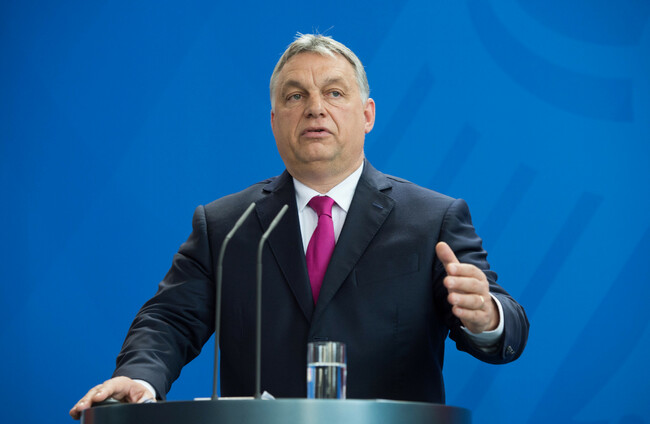
Hungarian prime minister Viktor Orban Alamy

'We don't want another Hungary': European Union grapples with adding new members

The EU has said it will ensure safeguards are in place for new members to stop countries back sliding on the rule of law like Hungary has.

LAST UPDATE | 18 Nov 2025

DELEGATES FROM ACROSS the EU and countries hoping to gain access to the powerful bloc gathered in Brussels today to discuss the challenges and opportunities posed by expanding the borders of the European Union.

Following a review on enlargement published earlier this month, Vice President of the European Commission Kaja Kallas said the process of adding new members to the EU is “moving faster today than in the last 15 years” and that it is a realistic goal to have new members by 2030. 

Expanding the EU is a policy that is being actively pursued by this Commission, with both Kallas and Commission President Ursula von der Leyen framing it as a security matter. 

It comes after a period of stagnation, with no new member added to the bloc since Croatia in 2013. 

On paper, Montenegro, Albania, Ukraine, the Republic of Moldova, Serbia, North Macedonia, Bosnia and Herzegovina, Kosovo, Türkiye and Georgia are currently candidate countries for EU membership.

Some of these countries are much further along than others. For example, accession negotiations with Türkiye have remained at a standstill since 2018.

Speaking at today’s EU enlargement forum, von der Leyen argued that adding new members to the EU is a way of investing in a stable Europe at a time when the global order is shifting.

But member states and citizens do not unanimously share her assessment, and unanimity among the 27 member states is a requirement for the admission of a new member.

For a number of member states, there is a fear around letting in new countries, with concerns about democracy, the rule of law and corruption.

Denmark’s Minister for European Affairs, Marie Bjerre, perhaps summed up these concerns best today when she said: 

“Well, I have to be honest, that’s the question I get every time I am at a public political meeting talking about enlargement… Do we want a new Hungary in the EU? And I am sorry to be so frank, but that is what people are asking.

“If we look at Hungary, that is the most corrupt country in EU. We have a problem with freedom of media, independent judiciary. How do we tackle that?”

These concerns about Hungary, which joined the bloc in 2004, are widely shared across the EU, given Prime Minister Viktor Orban’s crackdown on civil liberties and flagrant disregard for EU values and international law. 

In 2025, for a third year in a row, Hungary was ranked the most corrupt country in the EU by Transparency International‘s corruption perception index.

Bjerre noted that candidate countries are also struggling with corruption, giving Ukraine as an example.

“They are even higher on the barometer. That is something we have to address and to be serious about…We need countries to reform in order to be members of the EU,” she said. 

Bjerre was speaking on a panel alongside Irish Minister of State for European Affairs Thomas Byrne, who put forward a different perspective and argued that where countries that are putting in place anti-corruption structures in an effort to join the EU, it shouldn’t be a surprise if they find corruption.

“In the process of rooting it out, you’re going to find some, so we don’t need to panic every time something bad is found in accession countries, because that, surely, to some extent, is a sign processes are starting to work,” Byrne said. 

Where things stand

Becoming a member of the EU takes years of negotiations and major reforms.

At the moment, it looks as though Montenegro will become the 28th member of the European Union. 

Close behind is Albania, which is on track to close the beginning of negotiations in 2027.

Meanwhile, Ukraine and Moldova have each made important strides after lodging their applications in 2022. However, while Ukraine is continuing to progress through the required reforms for EU membership, Hungary’s Russia-friendly Orban has essentially blocked the bid.

Orban argues that adding Ukraine to the EU would “bring war to Europe and take Hungarian money to Ukraine”. 

EU leaders are hoping that elections next year in Hungary may change the current trajectory of events.

In its recent review of expansion, the European Commission praised Kyiv for pressing on with critical reforms despite Russia’s ongoing war and Hungary’s opposition to membership.

However, Brussels also warned against “backsliding” on anti-corruption efforts.

European Commission for EU expansion, Marta Kos, has said that Brussels will seek to impose “stronger safeguards” in any future accession treaties signed with new countries to ensure they do not slide away from democracy once they are members.

This is a direct response to the lesson the EU has learnt from countries such as Hungary.

Readers like you are keeping these stories free for everyone...
A mix of advertising and supporting contributions helps keep paywalls away from valuable information like this article. Over 5,000 readers like you have already stepped up and support us with a monthly payment or a once-off donation.

Close
91 Comments
This is YOUR comments community. Stay civil, stay constructive, stay on topic. Please familiarise yourself with our comments policy here before taking part.
Leave a Comment
    Submit a report
    Please help us understand how this comment violates our community guidelines.
    Thank you for the feedback
    Your feedback has been sent to our team for review.

    Leave a commentcancel

     
    JournalTv
    News in 60 seconds