Sign in. It’s quick, free and it’s up to you.
An account is an optional way to support the work we do. Find out more.
Sign in. It’s quick, free and it’s up to you.
An account is an optional way to support the work we do. Find out more.
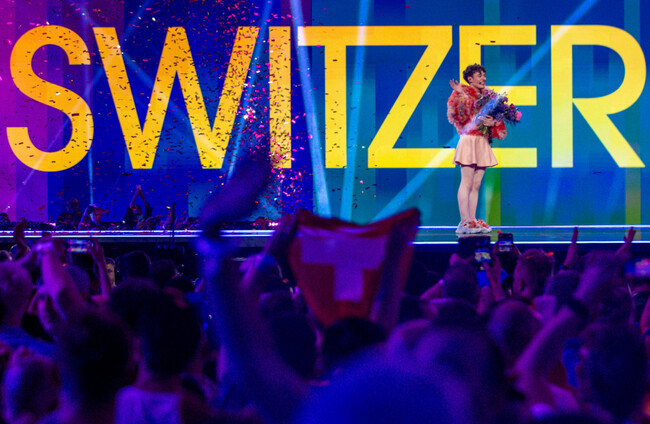
THE EUROPEAN UNION has criticised the Eurovision Song Contest organisers for their “incoherence” in banning its flag from the concert hall during the final.
In an unusually sharp letter, EU Commission vice president Margaritis Schinas wrote to the Swiss-based European Broadcast Union, which organises the contest, saying its ban contributes to “discrediting a symbol that brings together all Europeans”.
In a contest already full of controversy, the European Commission said it plans “a very lively discussion” with the organisers over the ban.
The EU’s letter comes after Dorin Frasineanu, policy officer with the Alliance of Liberals and Democrats for Europe (ALDE) Party, said in a post on X on Saturday evening that he was denied entry to the Eurovision with the EU flag.
He said he was told by security that it was “political” and “not allowed”.
We were just denied entry to @Eurovision with the EU 🇪🇺 flag. We were told by security it’s “political” and “not allowed”. How could the @EBU_HQ ban the EU flag at Europe’s biggest event? #Eurovision
— Dorin Frăsîneanu (@DorinFrasineanu) May 11, 2024
Even though the 27-nation EU did not compete as such, many of its member states did, and the star-spangled blue flag is often seen as a unifier for all involved.
Schinas wrote that “such actions have cast a shadow over what is meant to be a joyous occasion for peoples across Europe and the world to come together in celebration”.
The flag is on show at countless events and across the EU nations and often flies alongside the national colours from tiny city halls to massive governmental buildings.
“The incoherence in the EBU’s stance has left myself and many millions of your viewers wondering for what and for whom the Eurovision Song Contest stands,” Schinas said.
In a statement to the BBC, the EBU said the flag policy had been agreed with SVT, the Swedish national public television broadcaster and host of this year’s Eurovision contest.
It stressed in the statement that this did not feature an explicit provision to ban EU flags.
“As in previous years such as 2023, SVT’s policy was to allow the flags of the participating countries and rainbow flags,” the EBU said.
“There has never been an express ban on the EU flag in the written policy,” it said.
“Due to heightened geopolitical tensions, the flag policy was more rigorously enforced by security at this year’s event.”
Guy Verhofstadt, MEP and former Belgian Prime Minister, said in a post on X: “As the EU flag is banned from Eurovision, people risk being beaten to demand a European path for Georgia.
“Freedom, democracy can never be taken for granted.”
During the week-long contest, organisers were already roiled by the protests linked to the conflict in Gaza and Israel’s participation in the event on top of the controversial disqualification of the Dutch participant over an incident which was never fully explained.
Ahead of the final, a spokesperson for the European Broadcasting Union said ticket holders are only allowed to bring and display flags representing participating countries, as well as the rainbow-coloured flag which is a symbol for LGBTQ+ communities.
Swiss singer Nemo won the 68th Eurovision Song Contest on Saturday night with The Code, an operatic pop-rap ode to the singer’s journey toward embracing a non-gender identity.
Includes reporting by Press Association

To embed this post, copy the code below on your site











have your say