Sign in. It’s quick, free and it’s up to you.
An account is an optional way to support the work we do. Find out more.
Sign in. It’s quick, free and it’s up to you.
An account is an optional way to support the work we do. Find out more.
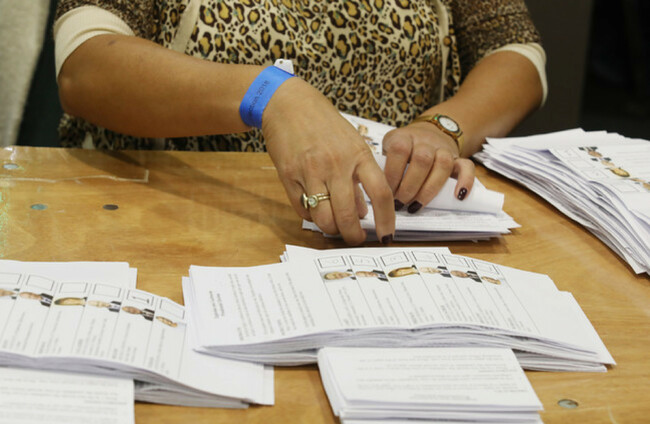
HERE WE GO. The campaigning is over, the votes have been cast, and soon it will be time for the counting to begin.
Tomorrow morning, ballot boxes will be opened in centres up and down the country as ballots are sorted and the count for the local elections gets underway. On Sunday morning, the counting will begin for the European elections.
Oh, and don’t forget the votes for a directly elected mayor in Limerick! That’s due to start on Monday.
In the European elections, 73 candidates were on the ballot to contest 14 seats across three constituencies. In the local elections, a whopping 949 seats are up for grabs across the 166 electoral areas that make up the 31 Local Government Authorities in Ireland.
So, as you can see, there is a lot of counting to be done. But how does it all work? Where are the count centres? And when will we have the first (and last) results?
Read on to find out how the next days (possibly weeks!) will play out.
Before we get into the counting, a quick note on Ireland’s much loved, frequently discussed, jealously guarded, at times head-scratchingly arcane, PR-STV voting system.
You’ve already voted, so we won’t get into the weeds on this, but if you want to know whether you should or should not have voted all the way down the ballot sheet, read this very handy explainer:
And for a more specific outline of how PR-STV works, you can read this explainer from all the way back in 2013. First things first, the European and local election ballots are separated, then brought to the respective count centres where they will be counted.
Then, all the ballot papers are mixed and then sorted according to first preferences. Spoiled votes are removed. And then, based on the number of valid votes, the quota (the minimum number of valid votes each candidate must get to be elected) is calculated.
If a candidate receives more than the quota on any count, they are elected, and the surplus votes are transferred to the remaining candidates in proportion to the next available preferences indicated by voters.
If no one gets elected on a count, the person with the lowest number of votes at that time is eliminated, and their votes redistributed.
Counting continues until all the seats are filled, either by candidates reaching the quota, or by the remaining number of candidates matching the remaining seats available. Simple, right?
Constituencies and count centres
So, with that out of the way, let’s start with the European elections. As we’ve said already, Ireland will send 14 MEPs to Europe from its three big constituencies. The constituency breakdown is as follows:
Polls closed at 10pm. As you can imagine, given the large geographic spread and the amount of voters in each constituency, there is a significant amount of work involved in getting the ballots in order to even begin counting.
Tomorrow, the votes will be sorted and separated from the local ballots and will be transported from polling stations around the country to eventually end up in the three primary count centres:
Each constituency has a Returning Officer whose job it is to oversee the election.
When will we have the first results?
Counting will begin Sunday morning at 9am. However, counting on the European elections can be a long and arduous process, with days often passing before the final results are in.
The results of the elections cannot be officially announced until all voting in all EU countries is completed, in order to prevent the outcome in one country influencing voters in another. Some countries won’t vote until Sunday, with final polls closing in all countries by 10pm.
So, while the first count may be completed Sunday afternoon or evening at some stage, the first results will not be announced until after 10pm. That’s only for the first count, and it’s likely that no one will be elected at this point (or that all the votes will be even counted by then).
Back in 2019, Fine Gael’s Marian Harkin was the first MEP elected in the Midlands North West constituency on the Monday afternoon following the vote. Think days, not hours.
The count in Dublin wound up on the Tuesday evening, with Clare Daly and Fianna Fáil’s Barry Andrews taking the final seats. Midlands North West didn’t finish up until late on the Wednesday evening.
Ireland South was another matter entirely. Just 300 votes separated Sinn Féin’s Liadh Ní Riada from Green Party’s Grace O’Sullivan. This prompted Sinn Féin to call for a full recount, which was ordered and could have taken weeks.
Ní Riada eventually bowed out, however, the final two MEPs were elected the following Wednesday 5 June. The election itself took place on Friday, 24 May.
Again, it will take days or longer before everything is decided.
With all that said, according to Euronews, services of the European Parliament will publish their first estimations at 18:15 CET (5.15pm Irish time) on Sunday, and the first projection of all seats at 20:15 CET (7.15pm Irish time).
The projections will be based on estimated votes and pre-election opinion polls. This means that by Sunday evening we’ll have a shape of what’s the come, and you may see people conceding or admitting it wasn’t their day around this time. But nothing is guaranteed at this stage.
The exit polls back in 2019 overestimated the ‘Green Wave’ that was due to sweep the nation. While the Greens did have a good day out, it wasn’t at the level predicted, so caution is always advised.
All in all, barring any recounts or big controversies, it will likely be mid-week or later before all the seats are filled.
The count centres
The local elections are both simpler and more complex. Simpler because we don’t have to wait for the rest of Europe before the counting can begin. The first boxes will be opened at 9am on Saturday. More complex because there are A LOT more councillors to elect. Each local authority will have its own count centre.
Across the four Dublin local authorities, for example, the count centres will be:
In Cork City, the counts will take place in City Hall.
In County Cork, counts will take place in:
The Count
First, the votes will have to be sorted and separated, and counting will likely begin in earnest in the afternoon, though it could be later in some areas.
As counters separate out the votes for the European, local, and (in Limerick) directly elected mayor elections, they will have to make sure that the total votes for each matches the total number of ballots cast (as per the polling station official’s count).
After that, the counting can begin and you can expect to start seeing some seats filled and announced fairly quickly, though it will still take a few days before the final seats are filled. Counting and coverage will likely continue long into the night.
TheJournal‘s liveblog from 2019 didn’t wind up until after 3am.
By that time, about 200 seats had been filled.
While the majority of seats will be filled by Monday, last around it took six days before the full composition of each local authority was known.
Counting for the Limerick mayoral election won’t kick off until Monday, following the local election count.
So, one again, settle in and enjoy it. It’s a marathon and not a sprint.
TheJournal will bring you dedicated coverage across the weekend with reporters at all the major count centres, live candidate tracking and updates over the next few days.

To embed this post, copy the code below on your site











have your say