Sign in. It’s quick, free and it’s up to you.
An account is an optional way to support the work we do. Find out more.
Sign in. It’s quick, free and it’s up to you.
An account is an optional way to support the work we do. Find out more.

LAST UPDATE | 20 Apr
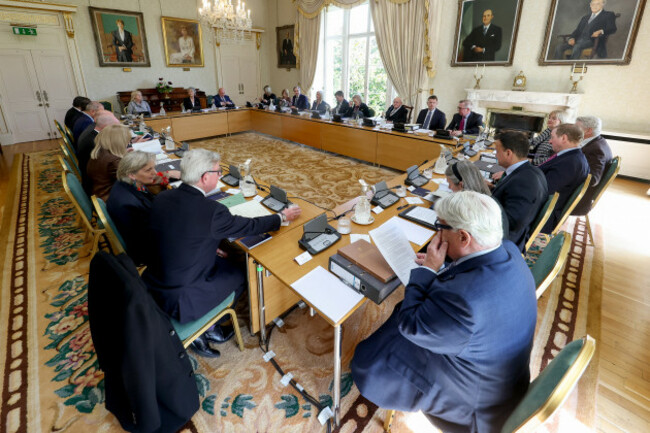
PRESIDENT CATHERINE CONNOLLY’S meeting of the Council of State to discuss the constitutionality of the International Protection Bill 2026 has concluded.
The meeting, which began at Áras an Uachtaráin at 2.30pm, was convened to examine the Bill and determine whether the council believes the president should refer the Bill to Supreme Court.
It was the first convening of the Council of State under Article 26 of the Constitution since Connolly took office in November last year.
In a statement shorly before 7pm, Áras an Uachtaráin confirmed that the meeting had concluded.
“The President will now consider the views of the members of the Council before making a decision as to whether to sign the Bill or to refer it to the Supreme Court for a decision on the question as to whether the Bill or any specified provision or provisions thereof are repugnant to the Constitution or to any provision thereof.”
The Council of State has been convened 30 times since the Constitutional provision was instituted in 1937, with four meetings across the two terms of Michael D Higgins.
Upon receiving the advice, Connolly will make the executive decision on whether she will refer the Bill.
The Bill, which was passed through the Houses of the Oireachtas by government last week, will reform Irish asylum laws and aims to implement the new EU Migration and Asylum Pact.
However, the Irish Human Rights and Equality Commission (IHREC) cautioned that the Bill contains “significant human rights concerns”.
IHREC said a number of important amendments were made to the Bill during Oireachtas debates, but said it remained concerned.
It said concerning aspects of the Bill, include new powers to detain applicants in order to establish elements of their claims, the absence of legal advice and representation at first instance, and amendments to family reunification.
Before the meeting today, Taoiseach Micheál Martin said he was “satisfied” the goverrnment’s Bill was constitutionally sound.
He said he had discussed the Bill with Justice Minister Jim O’Callaghan and Attorney General Rossa Fanning and said they were satisfied that it was within the constitution, and that it was fair and reasonable.
“It’s fully within the President’s rights under the constitution to refer any bill to the Council of State to seek advice on whether a particular legislative act should be referred to the Supreme Court,” he said.
“I welcome that, and I’m looking forward to the Council of State today, I was at a previous one under president Higgins and I found it a very interesting experience and worthwhile experience.
“We’re satisfied that the Bill is constitutional, is well balanced and is reasonable and will give effect to the European Migration and Asylum Pact.”
The three branches of members of the Council of State are supposed to represent a measured balance of the Irish public and the appointed members are also symbolic of areas that the president wishes to prioritise and represent throughout their mandate.
There are three categories of members: Ex Officio, former office holders, and appointed members.
Ex Officio includes the Taoiseach, Tánaiste, Chief Justice, President of the Court of Appeal, President of the High Court, the Ceann Comhairle, Cathaoirleach of the Seanad, and the Attorney General. Essentially, if you hold one of those roles, you’re on the council.
Former holders of the office of President, Taoiseach, and Chief Justice are also on the council, as are seven members appointed by the President.
Legislation has been referred to the Supreme Court by an Irish president 16 times in 88 years; on nine occasions, the legislation was upheld and on seven occasions, it was found to be unconstitutional.
The Judicial Appointments Commission Bill was the first time that former president Michael D Higgins referred a Bill to the Supreme Court under Article 26 of the Constitution over the course of his terms of office.

To embed this post, copy the code below on your site













have your say