Sign in. It’s quick, free and it’s up to you.
An account is an optional way to support the work we do. Find out more.
Sign in. It’s quick, free and it’s up to you.
An account is an optional way to support the work we do. Find out more.
LAST UPDATE | 9 Nov 2025
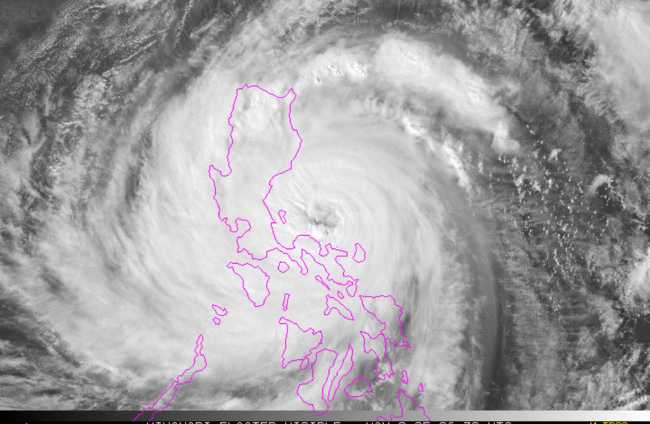
SUPER TYPHOON FUNG-WONG slammed into the Philippines’ eastern seaboard this afternoon, the national weather service said, after killing at least two people and forcing more than a million to evacuate their homes.
The storm, with a radius spanning nearly the whole of the Philippines, made landfall in Aurora province on the main island of Luzon at 9:10 pm (1310 GMT), the state forecaster reported, only days after another typhoon ravaged the country.
With a radius spanning nearly the whole of the Philippines, Fung-wong is expected to bring wind and heavy rain to broad swathes of the archipelago nation, which last week saw more than 220 people killed by Typhoon Kalmaegi.
Schools and government offices are ordered to remain closed on Monday across the main island of Luzon, including the capital Manila, where nearly 300 flights have so far been cancelled.

Catanduanes, a small island the state weather service said could take a “direct hit”, was being lashed by wind and rain early today, with storm surges sending waves hurtling over streets along the coast and floodwaters rising in some areas.
“As we speak, they are feeling the impact of the typhoon, especially in Catanduanes, because the storm’s eye is closest there,” civil defence deputy administrator Rafaelito Alejandro said at a press briefing, adding that 916,863 people had been evacuated nationwide.
“The waves started roaring around 7am. When the waves hit the seawall, it felt like the ground was shaking,” Edson Casarino, 33, a resident of Catanduanes’ Virac town, told AFP.
“Heavy rain is pouring now, and I can hear the wind whistling.”
Video verified by AFP showed a church in the town surrounded by floodwaters that reached halfway up its entrance.
Flooding was also reported in southern Luzon’s Bicol region, Alejandro said, adding officials had anticipated water would “rise in the Bicol River basin”.
In Guinobatan, a town of about 80,000 in that region’s Albay province, verified video showed streets that had become a raging torrent of floodwaters.
Typhoon Fung-wong is expected to bring about eight inches or more rain in many places, according to government meteorologists.
Scientists warn that storms are becoming more powerful due to human-driven climate change.
Warmer oceans allow typhoons to strengthen rapidly, and a warmer atmosphere holds more moisture, meaning heavier rainfall.
Yesterday, Catanduanes rushed to prepare for the onslaught, with residents tying down their houses with ropes and putting weights on their roofs.
“They decided to do our tradition of strapping down the roofs with big ropes and anchoring them on the ground, so they won’t be blown away by the wind,” provincial rescue official Roberto Monterola told AFP.
In Sorsogon, a city in southern Luzon, some sought refuge in a church.
“I’m here because the waves near my house are now huge. I live near the shore, and the winds there are now very strong,” Maxine Dugan told AFP on yesterday evening.
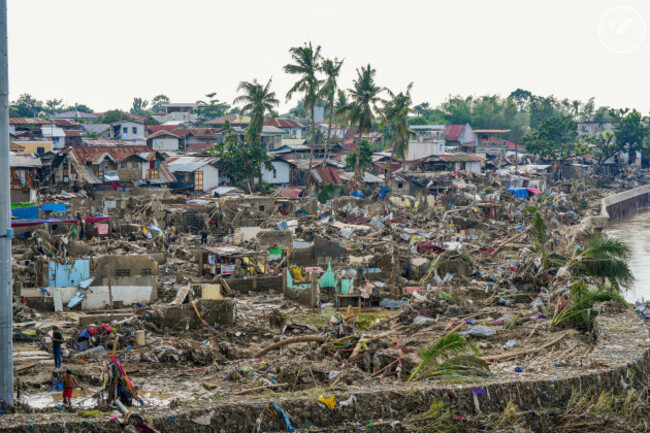
Only days earlier, Typhoon Kalmaegi sent floodwaters rushing through the towns and cities of Cebu and Negros islands, sweeping away cars, riverside shanties and massive shipping containers.
The typhoon, the deadliest of 2025 according to disaster database EM-DAT, killed at least 224 people and left 109 missing, according to government figures updated this morning.
Yesterday, rescue official Myrra Daven told AFP the approaching super typhoon had forced the suspension of search and rescue activities in Cebu, home to the majority of Kalmaegi’s deaths.
“We cannot risk the safety of our rescuers. We don’t want them to be the next casualties,” she said.

To embed this post, copy the code below on your site














have your say