Sign in. It’s quick, free and it’s up to you.
An account is an optional way to support the work we do. Find out more.
Sign in. It’s quick, free and it’s up to you.
An account is an optional way to support the work we do. Find out more.
LAST UPDATE | 18 Jun 2024
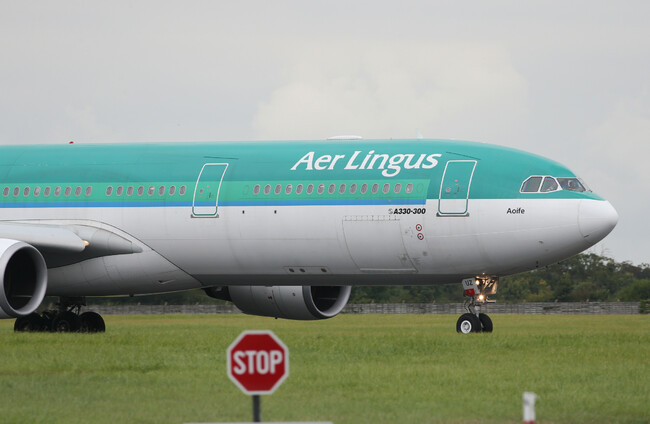
AER LINGUS PILOTS have announced that they will begin an indefinite work-to-rule against their employer from 26 June amid an ongoing row over pay.
Members of the Irish Airline Pilots’ Association (IALPA) confirmed this evening that the industrial action will include a refusal to work overtime or any out of hours duties requested by management.
Yesterday, the union voted 98.82% in favour of taking industrial action, up to and including full withdrawal of labour. Turnout for the ballot was 89%.
It was the second time that IALPA members had voted in favour of strike action, with a ballot last week securing 98% support.
Aer Lingus has said that the decision taken by the union was “entirely unnecessary” and will “inevitably result in significant disruption to our customers and to other employees”.
Let’s take a look at how people planning to travel might be affected.
Aer Lingus pilots who are members of the union are seeking a pay rise of 23.8% over three years, which would be similar to what British Airlines – a sister airline of Aer Lingus – awarded pilots in 2019.
Members have already rejected a Labour Court recommendation that they should receive a pay increase agreement of 9.25% in the near term.
The IALPA said the 23.8% increase it is seeking is “clearly reasonable and affordable for a profitable company such as Aer Lingus.”
It noted that in 2023, Aer Lingus had a full year operating profit of €225 million. This was a 400% increase on 2022, when a full year operating profit of €45 million was recorded.
A spokesperson for Aer Lingus has said that IALPA has “rejected the outcomes of two independent processes which have sought to resolve the issue”.
They said that Aer Lingus pilots are “rightfully well paid for the work that they do” and “more than fairly compensated compared to the market”.
Speaking to The Journal after pilots voted in favour of strike action yesterday, travel commentator Eoghan Corry said that people should not panic.
“The airline is under contract to get you to where you’re supposed to go. There’s not much point fretting about it,” he said.
“It’s between the airline and the union, and if the strike does go ahead, you won’t be out of pocket. They will use Iberia, British Airways, whatever means they can, to get you to where you’re supposed to go.”
Under EU regulations, consumers have certain rights when flights are delayed or cancelled. That could include when there is a strike at the airline involved.
These rights may include compensation for delayed or cancelled flights, as well as care and assistance while passengers wait.
These rights apply when travelling through airports in any EU country or Norway, on board flights departing from these countries, and on flights arriving into any of these countries if you are travelling with an EU airline.
A spokesperson for the Competition and Consumer Protection Commission (CCPC) told The Journal: “Strikes by baggage handlers or other groups external to the airline may be considered extraordinary circumstances, but strikes by airline staff – referred to as internal strikes – are not considered extraordinary circumstances and so any compensation due under EU regulations must be paid.”
Where a passenger’s flight is cancelled, they are entitled to either:
They may also be entitled to compensation.
The CCPC spokesperson added that consumers who have trouble accessing compensation can lodge a complaint through the Irish Aviation Authority (IAA), which is responsible for enforcing these rights in Ireland.
In this case, Aer Lingus had requested that a minimum of 15 days notice be given by IALPA if they intended to strike in order to minimise disruption for passengers.
A passenger is not entitled to compensation if they have received at least two weeks notice that their flight has been cancelled.
A spokesperson for IALPA told The Journal yesterday that it was considering the airline’s request. However, the union has now decided to give Aer Lingus the legally required notice period of seven days.
Any passengers who have their flights significantly delayed or cancelled will be entitled to compensation once they are given less than 14 days notice.
The level of compensation will depend on the distance of the flight in question:
Passengers may also be entitled to compensation if they arrive at their destination 3 hours or more after the scheduled arrival time. Again, the level of compensation will depend on the distance of the flight.
If the airline can prove that the delay was caused by an extraordinary circumstance which could not have been avoided, no compensation is payable. But as stated above, the CCPC has said that strikes by airline staff are not considered extraordinary circumstances.
Some travel insurance policies will cover travel disruption in the event of a strike, according to Irish Travel Agents Association (ITAA) CEO Clare Dunne.
“If they have travel disruption cover or industrial action cover in place, then they may be able to claim something back,” Dunne told The Journal yesterday.
However, if passengers attempt to take out the travel insurance now, it’s unlikely to cover them at this point.
“What we’re hearing from some of the insurance companies is that now that the event has been declared, even though it hasn’t been quantified, the underwriters are still saying that they’re not prepared to cover it because it’s been announced.”
Dunne advised anyone who has booked with a travel agent to speak to them about their options.
“The travel agents will assist them to get the best alternatives, whether they want to go on a later or earlier flight or whatever it is, to get them where they need to be.”
The planned work-to-rule will take effect from one minute past midnight on 26 June and will last indefinitely. A potential strike also remains an option.
However, speaking to The Journal yesterday, Eoghan Corry said that he believes an all-out strike won’t happen.
“My strong instinct is there will not be a strike. They will go back into negotiations and there will be a deal, but it will be later rather than sooner,” he said.
“The reason is that the airline is now hemmed in a corner. The union have them where they want,” he said.
“They’re already hitting the forward bookings for Aer Lingus, because people who were thinking of booking Aer Lingus are going elsewhere for summer bookings.”
If a full strike does go ahead, it will mean Aer Lingus will have to reschedule flights and bring passengers where they’re supposed to go, and if IALPA give less than two weeks’ notice, Aer Lingus will have to pay compensation.
“There’s probably a lot of talking to be done before there’s a deal. The reason is that the union are moving from a position of strength,” Corry said.
“They could wait until the day of the strike and then strike the deal at four o’clock in the morning. We’ve seen that happen in the past.
“There’s nothing to be gained by striking the deal in advance. The more you scare the passengers, the more you damage Aer Lingus and that’s what they’re setting out to do.”
This article was originally published at 7pm on 17 June. It has been updated to reflect the most up-to-date information.

To embed this post, copy the code below on your site











have your say