Sign in. It’s quick, free and it’s up to you.
An account is an optional way to support the work we do. Find out more.
Sign in. It’s quick, free and it’s up to you.
An account is an optional way to support the work we do. Find out more.
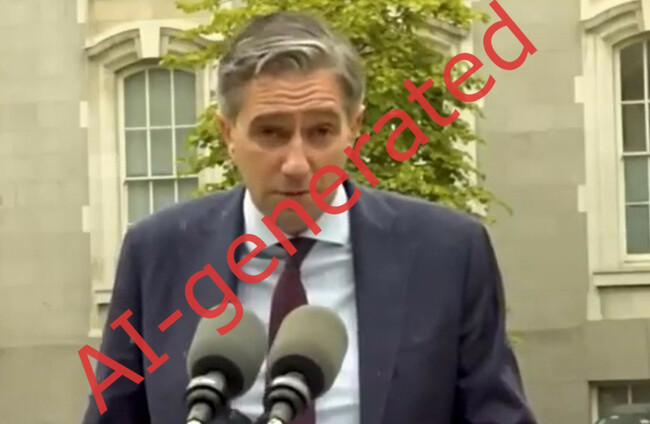
AN AI-GENERATED video ad fraudulently promoting a financial scheme features faked, though convincing, images of journalists Sharon Ní Bheoláin and Fintan O’Toole, as well as Tánaiste Simon Harris.
“In the nation’s best interests, we’ve carried out a full investigation to make sure it’s not a scam,” the AI-generated Harris appears to say in the scam ad shown on YouTube.
“This is your chance to change your life. All it takes is one small step: invest €250 and start earning today,” the deepfaked figure tells a press conference.
The vocalisations appear to be successful clones of Harris and Ní Bheoláin’s actual voices; they are almost indistinguishable most of the time. At one point, however, Ní Bheoláin introduces Harris as the “Tao-ee-see-ak” — presumably the text-to-speech system used was not familiar with the term Taoiseach (who is currently Micheál Martin, not Harris).
O’Toole’s voice, while showing some signs of being based on the real journalist, has a distinctly American quality.
Numbers on YouTube indicate that the video has been viewed more than 184,000 times since being posted on 16 October.
Clicking on the ad led users to a fake version of The Irish Times website, where the main photo shows Simon Harris and Donald Trump jointly encouraging people to invest in the scheme.
The fake site also includes a second AI-generated video of Harris, where he talks more casually, but also far more un-Harris-like.
“Fair play to ya! I’m proud to say that every Irish lad and lass that hops on board this project will be getting a guaranteed income of €20,000 a month,” he says.
The site encourages people to submit their contact information so that a “manager” can get in touch about an “initial deposit of €250″.
There is little accessible information on or about the site to indicate who is behind it.
In 2023, Micheál Martin had successfully brought High Court proceedings against Google in which he sought information about those behind “fake adverts” he says were used to defame him.
The Fianna Fáil leader claimed the ads that appeared on legitimate websites had wrongly used his image and contained links to false “pseudo-newspaper articles” associating him with a cryptocurrency scam.
The newscaster whose image featured in the video featuring Harris that was promoted on YouTube, Sharon Ní Bheoláin, was also recently deepfaked into another clip. That supposedly showed Catherine Connolly withdrawing from the presidential race (Connolly did not withdraw and subsequently won the election).
That video was viewed 160,000 times before it was taken down from Facebook.
The fraudulent use of images of politicians and celebrities on the internet is common, though recent improvements in generative AI technology has allowed scammers to create realistic videos featuring real people, as well as cloning their voices.
The ad featuring fake images of the Tánaiste appears to mirror another AI-generated video that spread in July, featuring deepfakes of actor Brendan Gleeson, RTÉ newsreader Sharon Tobin, and scientist Luke O’Neill, and which encouraged people to provide their financial information.
Google, which owns YouTube, has an Ad Transparency Centre, but searches for this new ad did not show any record of it in the centre.
Google has been contacted, though no response has been received at the time of writing.
The Journal has previously debunked hoax ads targeting Irish people featuring deepfake celebrities, including AI-generated videos featuring Michael, O’Leary, as well as an interview between Elon Musk and Irish BBC newsreader Tadhg Enright.
Less sophisticated scam ads debunked by The Journal have featured images of politicians Leo Varadkar, Micheál Martin and Enda Kenny, as well as television presenters such as Pat Kenny, Anne Doyle, Bláthnaid Ní Chofaigh, Maura Derrane, Ryan Tubridy, Colette Fitzpatrick, Ciara Doherty, Brian Dowling, and Alan Hughes.
Images of comedian Dara Ó Brain, political strategist Alastair Campbell on the Late Late Show with Patrick Kielty, a fake interview of Eamon Ryan on the Tommy Tiernan Show, and fake photos of presenter Tommy Bowe being escorted by PSNI officers have also been featured on fake ads debunked by The Journal.
The Journal’s FactCheck is a signatory to the International Fact-Checking Network’s Code of Principles. You can read it here. For information on how FactCheck works, what the verdicts mean, and how you can take part, check out our Reader’s Guide here. You can read about the team of editors and reporters who work on the factchecks here.

To embed this post, copy the code below on your site












have your say