Sign in. It’s quick, free and it’s up to you.
An account is an optional way to support the work we do. Find out more.
Sign in. It’s quick, free and it’s up to you.
An account is an optional way to support the work we do. Find out more.
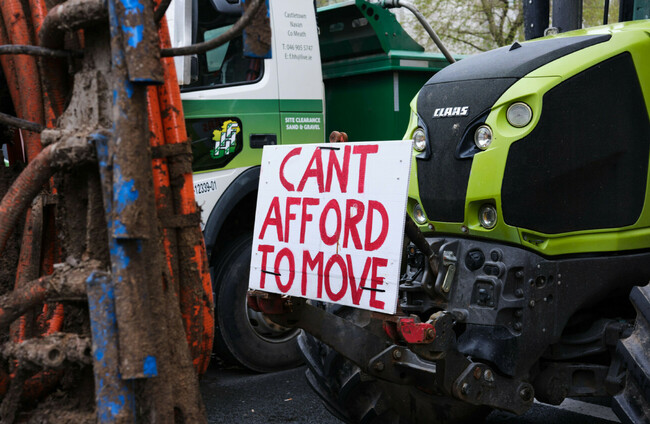
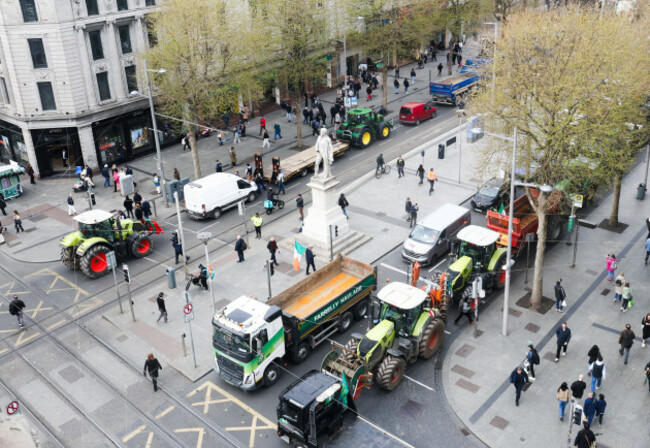
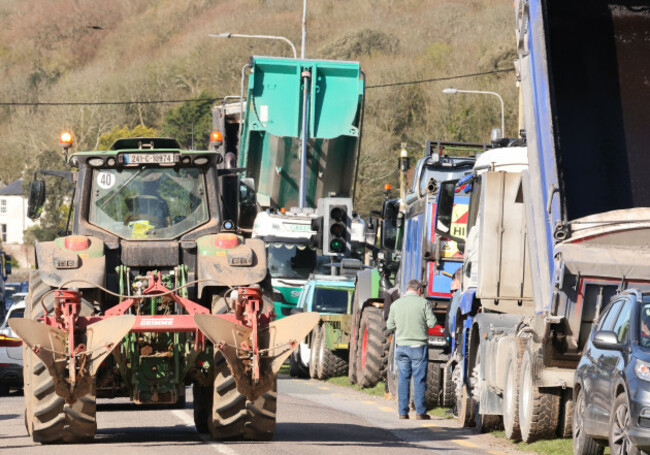
LAST WEEK’S FUEL protests brought the nation to a standstill, but they came as part of a broader pattern of large-scale, fiery demonstrations by farmers and their supporters over a raft of issues – and it’s unlikely that the anger driving those actions is going away any time soon.
In the past six months alone, Ireland has seen major gatherings and protests over the EU nitrates exemption for Irish farmers, the Mercosur trade deal and a sit-in protest at Bord Bia.
Some of these have resulted in major wins for the farming lobby, coming at a time when the government relied on the support of rural TDs.
Could the shock resignation of junior agriculture minister Michael Healy-Rae from the government signal even more action from a rural movement?
Questions have arisen too over whether senior politicians and established representative organisations still speak for the majority, given last week’s protests were led by a newly formed but loose alliance of farmers, agricultural contractors and hauliers.
Despite the government’s €500 million fuel support package, announced on Sunday evening, a number of farmers we spoke to – including ones who were wary of the protests – expressed a belief it may not end up being enough for the sectors.
Co Limerick dairy farmer Louise Crowley views it as a starting point for further negotiations if there are more price shocks due to the US-Israel war with Iran.
She expects a “regrouping period” for the farmers involved, “but if another issue comes along it will spark it again and all get rolled into one big issue” against the government.
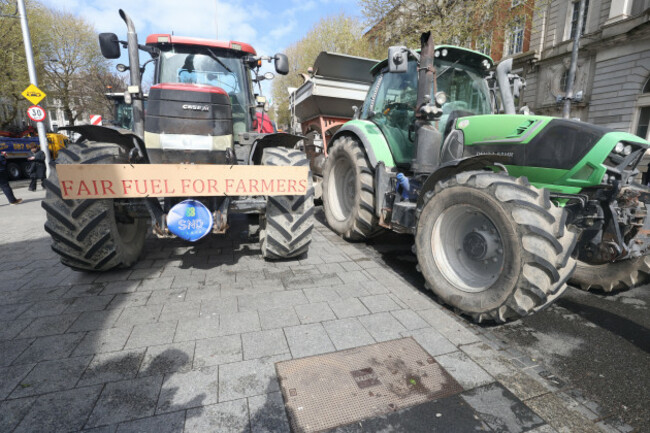
Crowley, who heads up the Limerick branch of the Irish Farmers Association (IFA), said there has been a “splintering” among protesters following the standing down of last week’s blockades of critical infrastructure.
“Everything is so unpredictable,” she told The Journal.
“What control was there has now dissipated and there are lots of people doing their own thing.”
This has made it “impossible” for farming sector leaders, she added.
At 70,000 members, the IFA is by far the largest representative group in Irish farming.
However, it has faced criticism over the past week for not being more present for its members and for negotiating with the government to end last week’s protest.
Gerald Howlin, a former government adviser to Bertie Ahern’s Fianna Fáil-led governments, warned on RTÉ radio last weekend that there had been a “collapse” of the IFA’s standing among farmers, making it harder to find a way out of disputes.
According to Tom Duffy, a Co Cavan dairy farmer who is a commentator on rural politics, the association has faced significant struggles from social media.
Same as everywhere else, social media is amplifying voices that don’t have to be accountable to anyone. If the IFA were to stand up and say something outrageous, they’ll get called out for it.
However, newly created groups “don’t have to worry about donations, income, staff, or the long-term reputation” of the organisation.
Crowley, the Limerick IFA chair, said she has seen the organisation’s stances weakened due to what she calls “misinformation” spread online.
As somebody who sits in the negotiation rooms from time to time, you come out of a meeting and see a TikTok from somebody who isn’t in the same county, gets thousand of views, and are trying to portray that they know what’s going on.
“Then you have people trying to go through channels correctly facing the brunt of something that was completely wrong to start with.”
Duffy added that the past week has granted fuel protest spokesmen like Chris Duffy a “new audience who weren’t aware of him” and a chance to capitalise on that further.
Both he and Crowley, who are in their 30s, have seen how this has created a febrile atmosphere making it harder for the IFA, but another view levelled at the organisation is that it is only truly at its strongest when representing larger farmers.
Daniel Long, a part-time beef farmer in Tipperary who was previously involved in smaller splinter groups, pointed to last December’s retention of the nitrates derogation as something that was greeted as a major win at the time.
But this only strengthened the view in some quarters, Long outlined, that the IFA and the government “don’t represent the majority of the farmers”.
“So there’s about 120,000 farmers in the country, but only 7,500 would have needed the nitrates derogation. Those are generally bigger farms, so the view for many is that they represent a cohort that is generally operating at scale,” Long said.
On the other hand, the IFA’s Limerick chair Crowley believes that the past half a year of protests by farmers have been because they don’t believe the government has been quick enough to address their frustrations.
“It seems to be one thing after another that’s coming to a head. We got the nitrates derogation extension but farmers wanted a renewal, not an extension,” she said.
The risks to water quality have long been highlighted by the Environmental Protection Agency, with one report last year finding that chemicals from agriculture were going in the wrong direction and jumped by 16% this year.
A number of those we spoke to traced some of the current anger and mobilisation of farmers and contractors back to blockades held outside meat factories in 2019.
That came on the back of what was known as the Beef Plan movement, which had sought to gain a more profitable price for farmers following a financially fallow period.
Where it initially was able to garner thousands at cattle marts across the country who were angered by the low cost for their beef, the movement disintegrated under pressure and resulted in deflated and fractured membership by the end of the year.
A series of splinter groups had failed to garner success from holding weeks-long pickets of meat factories at the time.
Crucially though, according to Duffy, it did break new ground for unhappiness at farm leaders, with “massive vitriol” directed at the IFA over the course of the campaign.
Even now, there is a dispute among farmers over the Beef Plan movement, which at its core wanted to secure better prices for beef by holding direct talks with meat processing plants.
Where Long remembers it as a “brilliant” movement for its ability to “mobilise more than 20,000 members”, Duffy said it suffered from the start for making “promises nobody could keep”.
Irish Farmers Journal news editor Pat O’Toole also likens the past few months of ongoing protest to 2019, but even he was “amazed” at the public support last week’s fuel protesters received.
“It’s an indication of how unpopular the government is,” he said.
“Even when they brought Dublin to a standstill, people seemed to still go ‘it’s about time someone took on the government’.”
He noted that people involved with the sector would have been familiar with the tactics of last week’s protest.
While many of the rest of the public may have forgotten, farmers citing unhappiness over prices have previously sought to use their machinery to block the M50, Dublin Port and, all the way back in 2009, a Musgrave distribution centre for supermarkets in Kilcock.
O’Toole, who has been covering packed meetings on the ground in marts and community halls over recent years, has witnessed how official organisations are facing increased pressure from unaffiliated protesters who are gaining more traction.
This had led the likes of the IFA, in O’Toole’s view, to “waste political capital”, like when it organised a sit-in of Bord Bia’s offices over its chair Larry Murnin’s company importing a small portion of Brazilian beef.
“If you look at the last 12 months, we’ve had the nitrates directive renewal and the Mercosur issue, and the government held the line for farmers on both those issues. And yet the IFA were staging a protest which turned into an occupation of Bord Bia,” O’Toole said.
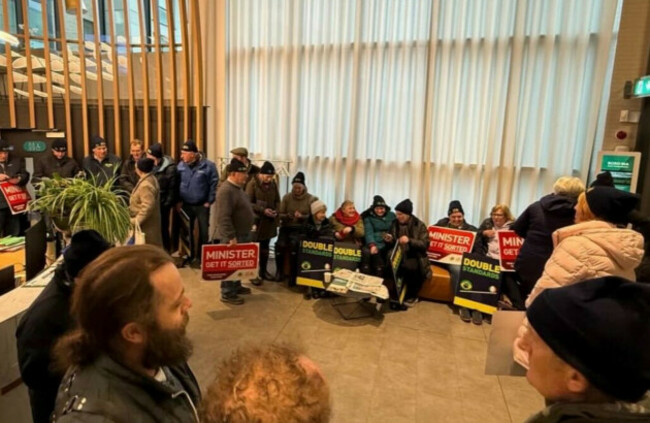
He described it as a “disastrous” attempt by the IFA to outflank a smaller rival organisation called Beef Plan, which had originally broken the news of the Bord Bia’s chairman using Brazilian beef to fulfil a contract with sandwich chain Subway.
Essentially, he believes some of the IFA’s recent moves have been to try and reassure farmers on the “issues that matter to them, emotionally as well as financially”.
The government was “lagging” on resolving nitrates and the Mercosur trade deal with South America until other political parties started moving on the turf, Crowley said.
“Anger has been building a long time,” she said.
“When we got the backing of the likes of Independent Ireland, people realised this was going to be an issue, but farm organisations knew about it for two decades,” Crowley added.
“It wasn’t seen as a priority for the government until quite close to the end of it.”
The core view among those we spoke to was that Michael Healy-Rae’s resignation was a sign that he “senses what way the wind is blowing” from rural communities on issues that are hurting the government.
“His ability to defend the government, especially on rural issues was important,” O’Toole said.
“But he provided cover for all of those rural TDs who backed the government. Now the third leg of the stool is gone and the stool’s looking wobbly.”
All of those we spoke to believe there may be further trouble with more fuel price shocks.
“The issue has not gone away,” said the Co Cavan farmer Duffy, who pointed to the costs facing the wider sector if the price of fuel remains as high as it is.
“I look at the agricultural contractors I work with, and their budgets were stress-tested at €1.40 diesel a litre – we’re now well above that,” he said.
Duffy does not believe that the protests will lead to more support for far-right groups, as he pointed to strong results for the Repeal and same-sex marriage referendums of the past decade, but he warned that alliances are being attempted.
Long shared a similar view: “Farmers are looking for hope wherever they can grab it and so the far right takes them with open arms.”
But rural Ireland is still too splintered, agreed Duffy and Long, for any one party – or a far-right movement – to truly gain traction.
“When I look around at my friends, they’re maybe a soft-left type of voter if they’re engaged. They generally just want services like public transport, not motorways,” Duffy said.
This places a party like the Social Democrats as favourable, Duffy said, but he added that restrictions on environmental goals remain a key red line for most farmers.
Duffy noted that a protest attended by thousands in Athlone last January against Mercosur was the first he could remember where farm groups attended one organised by a political party, that being Independent Ireland.
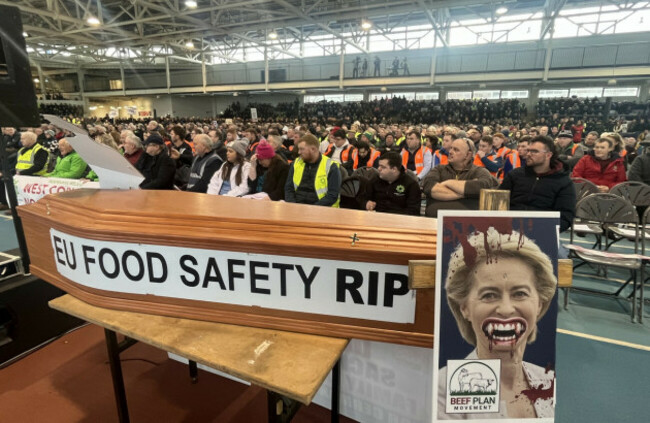
Duffy reckons Sinn Féin is doing reasonably well among some farmers, particularly those who skew younger.
“But they’re not going to be saying that at home as mammy and daddy will hang them for it.”
After the beef protests of 2019, attention turned for some time to environmental regulations and these came to a head in some respects when the Green Party lost out at a series of elections in 2024.
The next battleground may well be negotiations for the Common Agricultural Policy (CAP) budget that funds much of Irish farming, which has proposed a 22% cut to farming across the EU as the bloc prioritises boosting defence spending.
Tipperary farmer and IFA chair Darragh Scott believes there will be “some aggro” from those talks.
“There is consternation over it. If I lived on the eastern side of Poland, maybe I’d have a different opinion of it,” he said.
Instead, there is a belief that the Mercosur deal may be used as a way to fill the gap in European markets for food.
“Customers expect food to be produced cheaper and if CAP can’t make up the difference, so you’re wondering if there is a desire in the EU to import it from a cheaper country,” Scott said.
Crowley’s fear is that farmers may struggle to “keep public opinion on side” during such a debate after last week’s protests.
And for O’Toole, he believes that the anger about fuel will pale in significance to the rows over CAP if cuts happen.
“That’s the big one,” he said.

To embed this post, copy the code below on your site















have your say