Sign in. It’s quick, free and it’s up to you.
An account is an optional way to support the work we do. Find out more.
Sign in. It’s quick, free and it’s up to you.
An account is an optional way to support the work we do. Find out more.
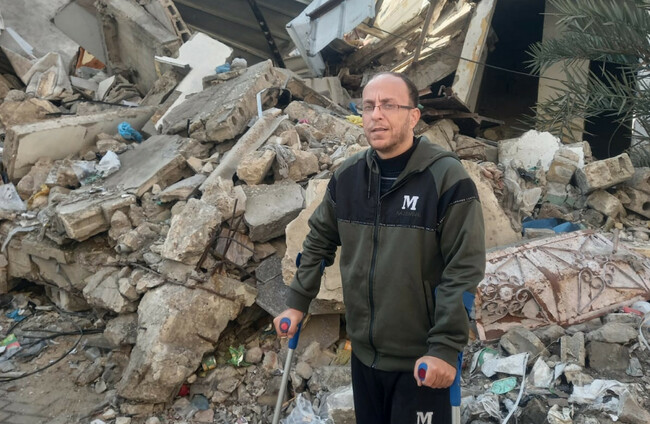
“WITHOUT THE SOCKS, the prosthetic slips off,” says Rabee Abu Jahl, adjusting the artificial leg he waited nearly a year to receive in Gaza.
Each morning, the 42-year-old father of five pulls on one sock, then another, sometimes a third, stuffing them into the hollow space between his shrinking stump and the oversized prosthetic socket.
“I keep adding socks until it fits,” he says quietly. “Otherwise, it could slip off while I’m moving.”
It is a makeshift solution to a problem that should have been resolved through routine medical adjustments – replacements the rehabilitation centre can no longer provide because of severe shortages in materials and equipment, while hundreds of other war amputees are still waiting to receive their first artificial limb.
Rabee’s struggle reflects a much wider crisis unfolding in Gaza, where thousands of war-wounded patients are trapped in a collapsing rehabilitation system strained by mass casualties, supply shortages, and long delays in prosthetic care.
In most places, adjusting a prosthetic limb is considered a routine part of rehabilitation, as the shape of the residual limb changes over time, affecting the prosthetic’s fit and the patient’s ability to move comfortably. In Gaza, however, where war and shortages have devastated the healthcare system, even basic modifications can take months.
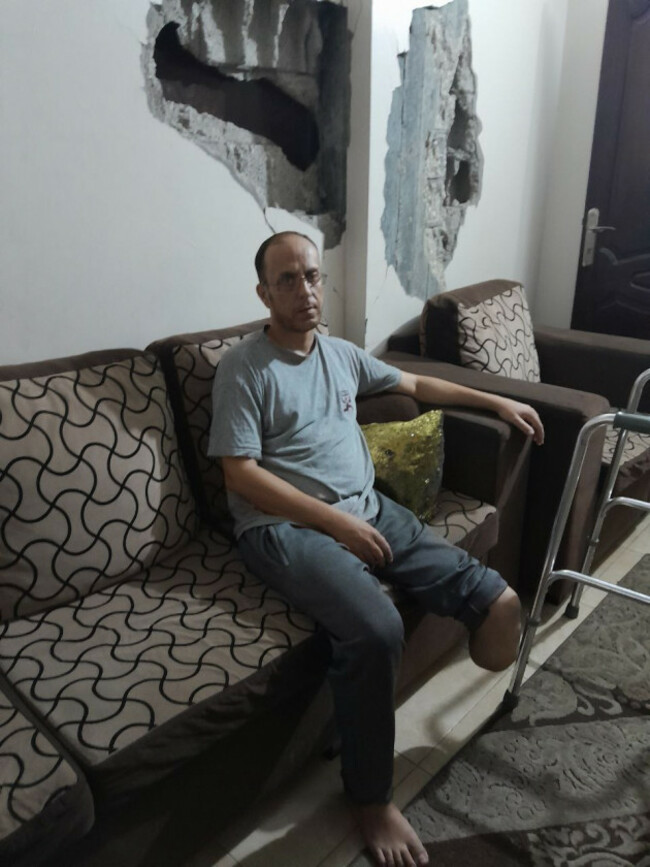
Rabee lost his leg after an Israeli strike hit house beginning of the war in December 2023 in Shuja’iyya, eastern Gaza City, while his wife and four children survived.
Before the war, he worked as an accountant for a private company and spent his evenings at home with his wife and five children. Then, one night shortly after midnight, everything changed.
Rabee says he was asleep beside his family when an Israeli missile tore through the roof of the house and landed directly above his bed.
“The explosion shattered my leg into pieces,” he recalls. “By the time I reached the hospital, doctors had no choice but to amputate it to save my life.”
“The second missile landed in the living room, but it didn’t explode,” he says. “If it had exploded, my whole family would have been gone.”
At the time, Israeli forces were advancing towards the area around Al-Ahli Baptist Hospital, the nearest hospital to Shujaiya. Medical teams evacuated the hospital overnight despite dozens of wounded people still inside.
Only hours after the amputation, Rabee found himself displaced again — this time inside crowded shelters at Al-Azhar University, surrounded by shortages of food, medical care and basic services.
“The months afterwards were the hardest of my life,” he says.
It was not only the loss of his leg. His home had also been partially destroyed. Months later, he returned with friends to remove the remains of an unexploded missile from the building.
“The house was almost destroyed,” he says. “But it still felt more merciful than living displaced in overcrowded schools and shelters.”
Rabee’s struggle reflects a wider rehabilitation crisis across Gaza.
Since the war began in October 2023, UN and humanitarian agencies have reported tens of thousands of injuries, including thousands of amputations and other wounds likely to cause permanent disability.
The World Health Organization estimated in May that around 43,000 of the 172,000 people injured in Gaza since October 2023 war had sustained what it described as “life-changing injuries”, including amputations, spinal cord injuries and severe mobility impairments.
WHO says rehabilitation services across Gaza remain critically overstretched, with no rehabilitation facility currently fully functional. Access to prosthetic limbs, wheelchairs and rehabilitation equipment has also been severely restricted. According to the agency, no rehabilitation equipment entered Gaza between May 2024 and mid-April 2026, while shipments of prosthetics and assistive devices faced delays of between 130 and 520 days awaiting clearance.
The shortages are felt daily inside Gaza’s Prosthetics and Polio Centre – the territory’s main national facility for prosthetics manufacturing and rehabilitation services for amputees and patients with severe mobility injuries.
Alongside Hamad Hospital for Rehabilitation and Prosthetics, the centre remains one of the few specialised rehabilitation facilities still operating in Gaza after months of war and destruction.
Before the war, staff at the centre handled between 20 and 30 patients a day, including physiotherapy sessions, prosthetic fittings, rehabilitation assessments and follow-up care for amputees. Today, they say, the number has risen to between 70 and 80 daily cases as waves of amputees and patients with spinal cord and mobility injuries continue seeking treatment.
Inside overcrowded treatment rooms, patients wait for prosthetic fittings, repairs and rehabilitation sessions while technicians work with dwindling supplies and ageing equipment. According to the centre’s administration, around 130 new patients requiring prosthetic limbs or mobility devices now register every month, alongside hundreds of others waiting for repairs or adjustments to damaged prosthetics already in use.
But the centre is struggling to cope.
Husni Mhanna, the centre’s director of public relations and media, says severe shortages of raw materials and technical components have disrupted nearly every stage of rehabilitation.
“Many patients need repeated adjustments as their wounds heal and the shape of the amputated limb changes,” he says. “But because of shortages in materials and technical components, even routine procedures can now take months.”
He says the centre has not received essential raw materials needed for upper-limb prosthetics since the war began. Restrictions on items such as silicone liners, knee joints, metal pipes and prosthetic components have further slowed production, leaving many patients waiting months for fittings, repairs or replacements.
Rabee’s experience is echoed across Gaza among amputees struggling not only with physical injuries but also with the psychological toll of prolonged war and displacement.
In February 2024, at the height of the hunger crisis in northern Gaza, 35-year-old Bassem Al-Faham stood at Al-Nabulsi junction west of Gaza City, waiting for a truck carrying flour aid.
Like hundreds of others, he spent hours hoping to return home with a bag of flour for his three children after northern Gaza had been largely cut off from the south during the war.
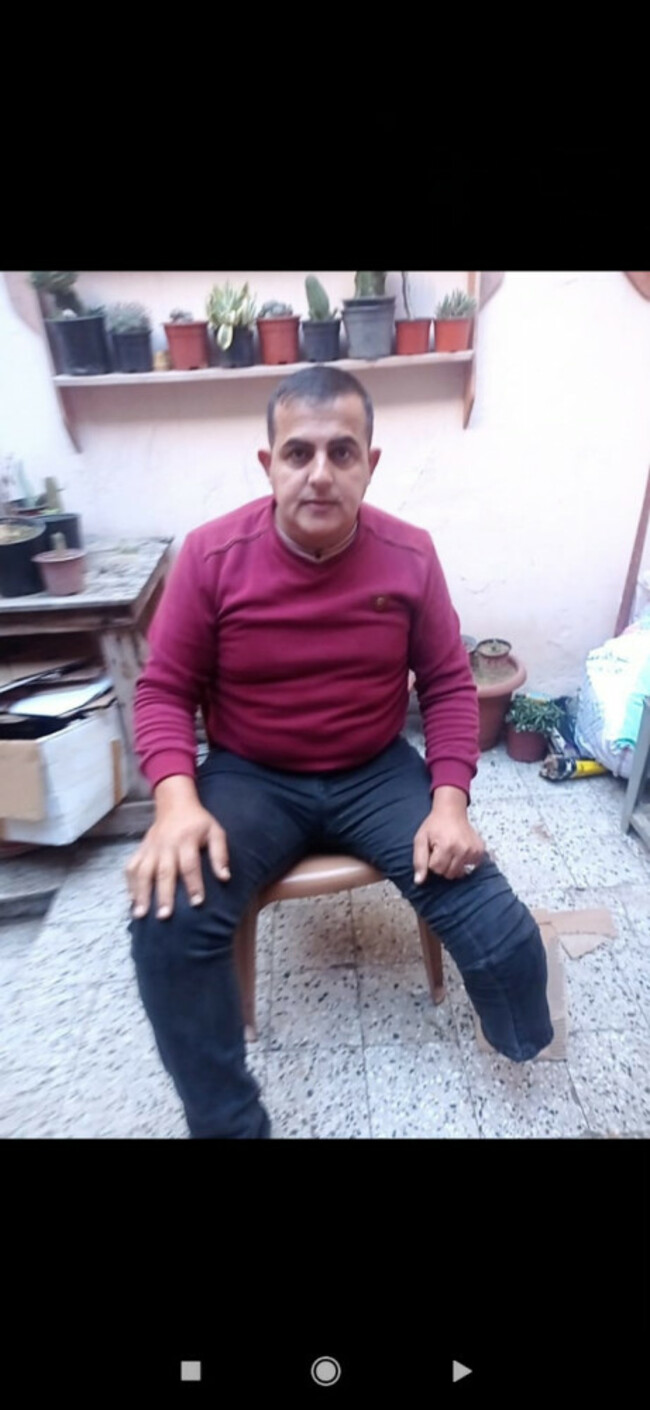
Instead, he says, a tank shell struck nearby, leaving him with catastrophic injuries that led to the amputation of part of his leg.
Bassem says he was discharged from hospital after only around 20 days — before completing treatment — because of the overwhelming pressure on Gaza’s healthcare system. His family later relied on a private doctor to continue treating him at home.
More than a year later, he has returned to work at a small shawarma shop in Gaza City.
But life, he says, no longer resembles what it once was.
Before the injury, he spent long hours standing, preparing shawarma, chopping salads, serving customers and moving constantly around the shop.
Now, he says, he can only remain on his feet for limited periods.
“I work four or five hours at most,” he says. “Most of the time I prepare sandwiches while sitting down.”
The prosthetic limb he received has, in his words, become “unfit for walking”.
The locking mechanism that keeps it attached has loosened, while parts of the inner silicone lining have torn and worn away, making the prosthetic unstable despite repeated attempts to repair it.
“Sometimes while I’m walking, it suddenly slips off,” he says.
As he increasingly relies on his remaining leg, pain and exhaustion has begun spreading there too, caused by the strain of imbalance and difficulty standing upright.
His wife, Enas, who cares for their three children, says her husband tries to hide his exhaustion from the family.
“When we walk together and the prosthetic starts slipping, he holds onto my shoulder for support so he can keep walking or stop and fix it again,” she says softly. “Sometimes I feel he is trying to appear strong in front of people, when he can barely stay standing.”
Then her voice lowers further.
“I feel more sorry for him when I’m not with him,” she says. “I’m afraid the prosthetic will suddenly slip off and nobody will be there to support him, and he will fall to the ground alone.”
Enas says her husband also struggled psychologically after the injury.
“He used to listen to music all day,” she says. “At night, he cried a lot.”
But she says something later changed in him after his nephew was killed during the war and his cousin’s daughter lost both her hands.
“He started saying: ‘Thank God… at least I still have my hands. I can still take care of myself and go to the bathroom alone.’ When he sees the suffering of others, his own suffering feels smaller.”
Elsewhere in Gaza City, Rabee Abu Jahl – another amputee injured during the war – reflects on his own survival in similar terms.
“Maybe the injury happened for a reason we don’t understand,” he says. “Maybe if I had gone myself to collect flour aid, I would have been killed. My friends brought flour home for me because I was injured.”
He pauses before adding:
“Sometimes God tests us with one hardship to protect us from something even worse.”

To embed this post, copy the code below on your site












have your say