Sign in. It’s quick, free and it’s up to you.
An account is an optional way to support the work we do. Find out more.
Sign in. It’s quick, free and it’s up to you.
An account is an optional way to support the work we do. Find out more.
LAST UPDATE | 26 Aug
SCENES THAT LEAVE YOU COLD
— Rahul Shivshankar (@RShivshankar) August 26, 2026
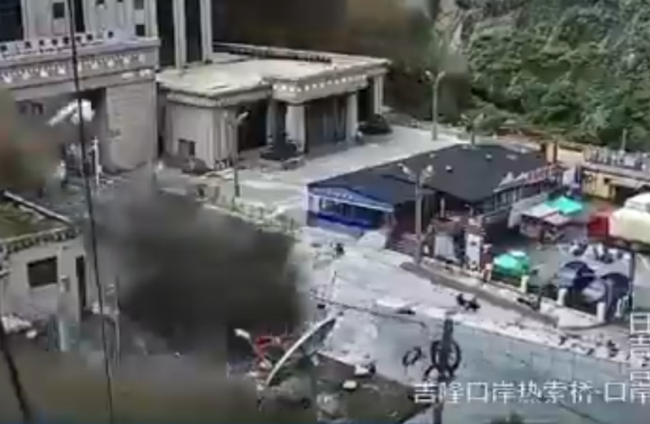
Chinese government immigration office at Rasuwagadhi border crossing in CHINESE OCCUPIED TIBET swept away.
Chinese President Xi Jinping has ordered all-out efforts to search and rescue people who are missing after the "mudslide" in China controlled… pic.twitter.com/EiXvyVtqBo
TWO IRISH TOURISTS are among hundreds of people believed missing after a devastating flood tore through the Tibetan border region of Nepal today and left at least 160 people dead.
Officials said the sudden torrent was likely caused by a flood involving a glacier and resulting landslide.
CCTV footage showed a deluge of muddy water washing violently through a border crossing. Other footage showed floodwater surging through a river in Nepal, sweeping away houses in its path.
Nepali police said they had recovered 157 bodies after the flood tore through the Tibet border region, taking the overall death toll to at least 160, with several hundred missing.
The police issued an operational update detailing the 157 dead.
Over 380 tourists, mostly foreigners, are missing.
Alpine Eco Trek, which offers guided tours and expeditions in Nepal, said that two Irish nationals were among the people believed missing in the Rasuwa region, where they had been on an excursion.
Speaking to the Press Association from the affected area, Ram Kumar Adhikari, the manager of Alpine Eco Trek, said there was “not much info to share at the moment”.
There are also 12 British and four South African nationals believed missing, the company said.
Nepal’s disaster management authority has said an initial analysis of satellite images “indicates that a glacier-inclusive flood occurred in the Lhende River due to a snow-rock landslide that took place on the Nepal-China border”.
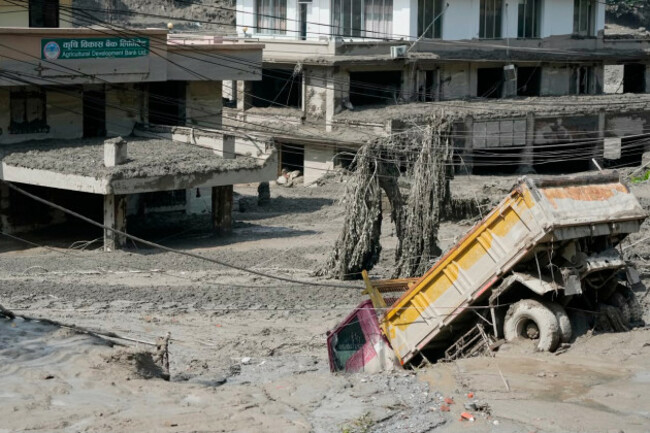
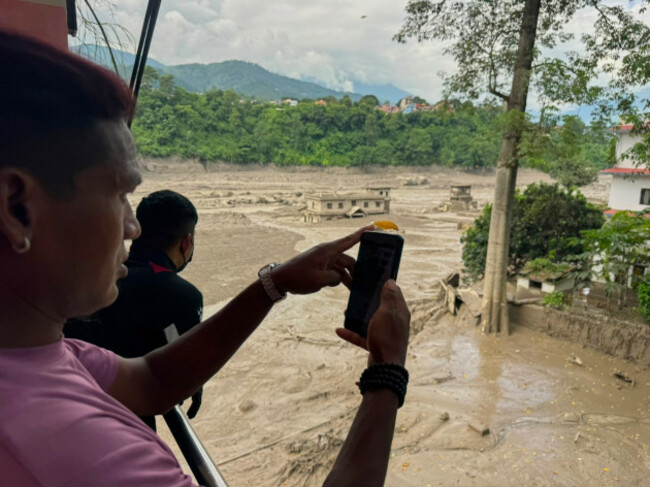
The Bhotekoshi River flooded at around 9am on Wednesday, destroying several villages as well as roads and hydropower projects, officials said.
भोटेकोसी नदी रसुवामा तिब्बत तर्फबाट ठुलो बाढी प्रवेश गरेकोले अर्को सूचना नआउँदासम्म त्रीशुली नदीको तटिय क्षेत्रका जिल्लाहरु नुवाकोट, धादिङ, चितवन, गोरखा लगायतका स्थानहरूमा उच्च सतर्कता सहित सुरक्षित स्थानमा रहन अनुरोध छ। pic.twitter.com/Zun6icZZCM
— Nepal Police (@NepalPoliceHQ) August 26, 2026
The Nepalese Tourism Board said an initial report from tourism and travel companies identified 384 travellers, including 291 foreign nationals and 93 Nepali nationals were missing, noting authorities were working to verify the travellers’ whereabouts.
The embassies of Australia, Finland, France, Norway, Switzerland and United Kingdom and the Delegation of the European Union in Nepal have released a joint statement encouraging people to follow the guidance of local authorities.
“We are deeply saddened by the devastating flooding in Rasuwa and Nuwakot districts and surrounding areas,”they said.
“Our thoughts are with all those affected by this disaster. We express our solidarity with the people of Nepal during this difficult time.”
The Irish Department of Foreign Affairs has not yet confirmed if any Irish people are among those killed by the flooding, though a spokesperson said they are “closely monitoring the situation”.
“The Department, including the Embassy of Ireland to India which covers Nepal, will provide consular assistance to impacted Irish citizens and their families,” the spokesperson added.
Foreign Affairs Minister Helen McEntee said in a statement that she was “shocked” to see the flooding in Nepal.
“Our condolences go to all who have lost loved ones,” McEntee added.
European Commission president Ursula von der Leyen said the EU’s Copernicus satellite was being used to assist in mapping the affected areas.
“We stand ready to mobilise further European assistance,” she said.
Nepal’s Prime Minister Balendra Shah urged his citizens to stand together during the crisis.
“Please be patient. The government takes full responsibility for your rescue, treatment, food and shelter. In times of such a disaster, we all need to stand together,” Shah said in a statement, posted on social media.
The flood hit Syabrubesi, the starting point to the popular Langtang trek as well as other areas used by travellers for Hindu pilgrimage to Kailash Mansarovar.
A police spokesman told AFP earlier that authorities did not know the extent of the damage but said they had “alerted people who are staying near the riverside to relocate”.
Officials issued warnings to residents of several of Nepal’s districts and asked them to stay away from the banks of Bhotekoshi, Trishuli and Narayani rivers.
“We have asked both India and China to help us with the rescue efforts,” said Sasmit Pokharel, a spokesman for the Nepali government.
Planet Labs को स्याटेलाइट तस्बिरको विश्लेषणका आधारमा गरिएको प्रारम्भिक अध्ययनबाट नेपाल-चीन रसुवागढी नाकाबाट करिब २० किलोमिटर उत्तरपूर्व नेपाल-चीन सिमानामा गएको हिम-चट्टान पहिरोका कारण ल्हेन्दे खोलामा गेग्य्रानसहितको बाढी आएको देखिएको छ। pic.twitter.com/kCAo9O1Zb0
— NDRRMA (@NDRRMA_Nepal) August 26, 2026
Indian prime minister Narendra Modi said his government was assisting with the rescue effort.
“In this difficult time, the people of India stand in solidarity with their sisters and brothers in Nepal,” he said in a post on X.
“India is prepared to provide Nepal with all possible types of humanitarian assistance.
“Our teams are closely coordinating on rescue and relief efforts.”
Chinese state media reported “major casualties” from a mudslide at a Tibet trade hub on China’s side of its border with Nepal, and President Xi Jinping ordered an “all-out” rescue effort.
China has governed Tibet since it annexed the region in 1951.
The worst affected area, Rasuwa district, witnessed similar flash floods to those in August last year, when a glacial lake in neighbouring Tibet overflowed as a result of high temperatures in the mountain region.
Climate experts at the Kathmandu-based International Centre for Integrated Mountain Development say an avalanche from a glacier likely caused Wednesday’s flash flood.
The Lhende Khola River, a tributary of the Bhotekoshi River, witnessed maximum flooding on Wednesday, they said.
“The Lhende Khola has flooded twice in 14 months, this time triggered by an ice rock avalanche from a glacier on the Nepal side that blocked the river and released a sudden surge downstream,” said Saswata Sanyal, a disaster risk reduction specialist at the climate research group.
“In a warming Himalaya, early warning is the first line of adaptation,” he added.
The Himalayan region, which crosses Nepal and several nearby countries including India, is especially vulnerable to heavy rains, floods and landslides because the area is warming up faster than the rest of the world because of human-caused climate change.
With reporting from AFP and Press Association

To embed this post, copy the code below on your site












have your say