Sign in. It’s quick, free and it’s up to you.
An account is an optional way to support the work we do. Find out more.
Sign in. It’s quick, free and it’s up to you.
An account is an optional way to support the work we do. Find out more.
LAST UPDATE | 4 Oct 2022
FORMER PROFESSIONAL RUGBY player Damian Browne has completed his gruelling challenge of rowing from New York to Galway, becoming the first person ever to do so.
He arrived in Galway for an official homecoming this afternoon, with hundreds of spectators waiting at the port to cheer him on.
Browne waved a flare as he was driven into the port to a hero’s welcome after 112 days at sea.
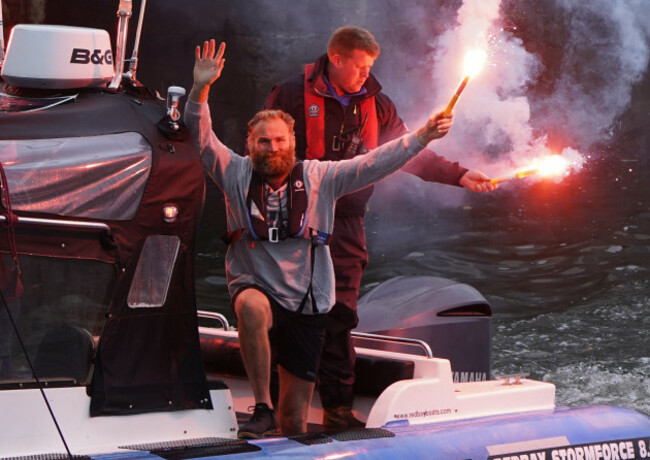
Browne’s journey began at Chelsea Piers in Manhattan on Tuesday, 14 June, and Browne rowed over 3,450 nautical miles.
His epic journey ended last night in rather precarious circumstances shortly before 1 am when he was forced ashore on the rocks at Furbo Beach, just short of the Port of Galway.
He said in an Instagram video today that, as he was passing Inis Oirr, he was hit by “the ferocity of the wind that was blowing between that island and the County Clare coastline.
“No matter how much I fought, I could not get the boat to stay in a westerly approach to Galway Bay.”
He said he thought he could change course and land at the coastal town of Spiddal instead, but quickly realised this wouldn’t be possible either.
He then broke an oar and started to drift towards rocks.
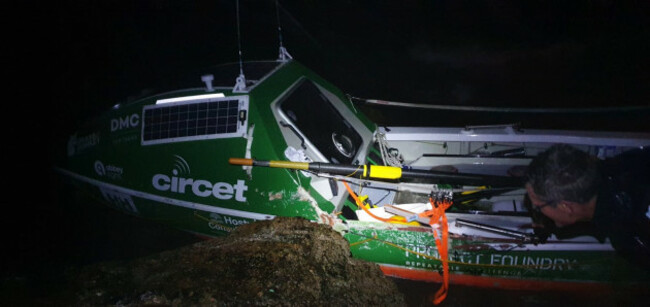
Browne contacted the Project Empower land support officer Chris Martin, who in turn contacted the relevant emergency services who mobilised immediately.
First on the scene were Garda Micheál Ó Ráinne, Garda Vincent Kelly, and Garda Eoin O’Malley.
They found Browne on the rocks and helped him to safety.
Browne and The Project Empower team have expressed their gratitude to the Gardaí and the Emergency First Responders.
Those wishing to donate can do so by following this link.
It’s not the first time Browne has completed a mammoth rowing feat, with the former rugby player previously undertaking an epic solo row across the Atlantic.

To embed this post, copy the code below on your site















have your say