Take part in our latest brand partnership survey

We need your help now

Support from readers like you keeps The Journal open.

You are visiting us because we have something you value. Independent, unbiased news that tells the truth. Advertising revenue goes some way to support our mission, but this year it has not been enough.

If you've seen value in our reporting, please contribute what you can, so we can continue to produce accurate and meaningful journalism. For everyone who needs it.

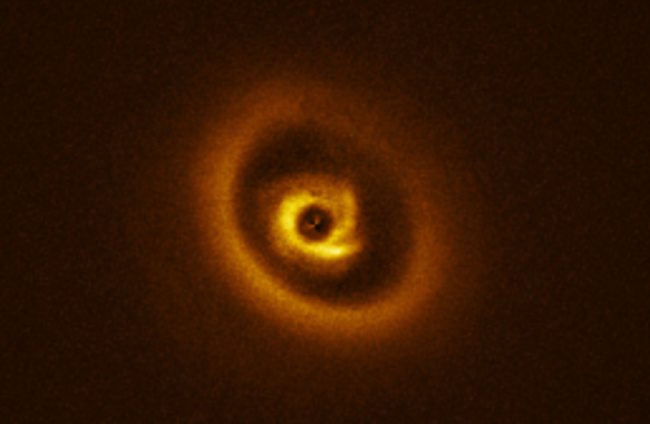
The 2MASS1612 system consisting of a disk made of dust particles University of Galway

Galway astronomers have discovered a new giant planet formation

The phenomenon is taking place 430 light years from Earth.

A UNIVERSITY OF Galway researcher has led a groundbreaking study that discovered the site of a planet in formation, a finding that could help physicists understand how our solar system was built.

The work was conducted by an international team of researchers from Ireland, the UK, Germany, Australia, USA, Netherlands, Italy, Chile, France and Japan.

It concluded that the new planet is a giant gas planet multiple times the mass of Jupiter.

Planet formation system The 2MASS1612 system planet formation as seen using through a telescope in Chile. University of Galway University of Galway

Using the Very Large Telescope (VLT) belonging to the European Southern Observatory in Chile, the team captured images of a structured disk system known as 2MASS1612, identifiable by scattered infrared light.

The disk made up of dust particles stretches 130 astronomical units from the parent planet, with one astronomical unit equalling the distance between the Earth and the Sun.

Inside the gap between the planet and disk is a system of spiral arms measuring 40 astronomical units that could swallow all of the planets in our own solar system.

The planet is seen as a bright dot in the above simulation that circles the central star within the gap of the disk. The planet drives the spiral arms seen in the disk centre. 

The study, published in the international journal Astronomy and Astrophysics, was led by Dr Christian Ginski from the Centre for Astronomy in the School of Natural Sciences at University of Galway and was co-authored by three postgraduate students from the college.

Describing the planet’s formation structure as “exceptionally beautiful”, Dr Ginski said the team’s research could be revolutionary.

“Detections like this bring us one step closer to understand how planets form in general and how our solar system might have formed in the distant past.”

Readers like you are keeping these stories free for everyone...
A mix of advertising and supporting contributions helps keep paywalls away from valuable information like this article. Over 5,000 readers like you have already stepped up and support us with a monthly payment or a once-off donation.

View 26 comments
Close
26 Comments
This is YOUR comments community. Stay civil, stay constructive, stay on topic. Please familiarise yourself with our comments policy here before taking part.
Leave a Comment
    Submit a report
    Please help us understand how this comment violates our community guidelines.
    Thank you for the feedback
    Your feedback has been sent to our team for review.

    Leave a commentcancel

     
    JournalTv
    News in 60 seconds