Sign in. It’s quick, free and it’s up to you.
An account is an optional way to support the work we do. Find out more.
Sign in. It’s quick, free and it’s up to you.
An account is an optional way to support the work we do. Find out more.
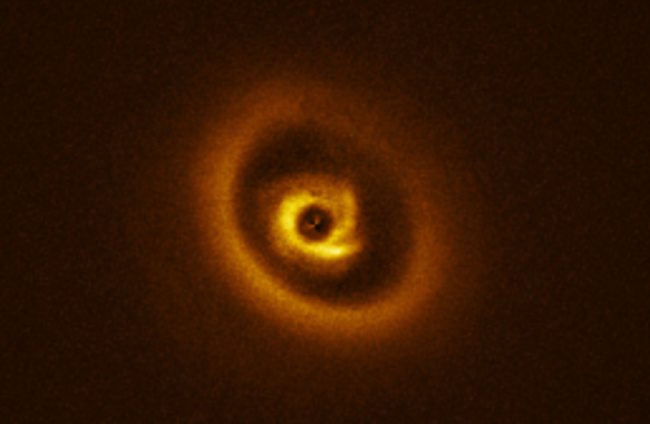
A UNIVERSITY OF Galway researcher has led a groundbreaking study that discovered the site of a planet in formation, a finding that could help physicists understand how our solar system was built.
The work was conducted by an international team of researchers from Ireland, the UK, Germany, Australia, USA, Netherlands, Italy, Chile, France and Japan.
It concluded that the new planet is a giant gas planet multiple times the mass of Jupiter.

Using the Very Large Telescope (VLT) belonging to the European Southern Observatory in Chile, the team captured images of a structured disk system known as 2MASS1612, identifiable by scattered infrared light.
The disk made up of dust particles stretches 130 astronomical units from the parent planet, with one astronomical unit equalling the distance between the Earth and the Sun.
Inside the gap between the planet and disk is a system of spiral arms measuring 40 astronomical units that could swallow all of the planets in our own solar system.
The planet is seen as a bright dot in the above simulation that circles the central star within the gap of the disk. The planet drives the spiral arms seen in the disk centre.
The study, published in the international journal Astronomy and Astrophysics, was led by Dr Christian Ginski from the Centre for Astronomy in the School of Natural Sciences at University of Galway and was co-authored by three postgraduate students from the college.
Describing the planet’s formation structure as “exceptionally beautiful”, Dr Ginski said the team’s research could be revolutionary.
“Detections like this bring us one step closer to understand how planets form in general and how our solar system might have formed in the distant past.”
To embed this post, copy the code below on your site
















have your say