We need your help now

Support from readers like you keeps The Journal open.

You are visiting us because we have something you value. Independent, unbiased news that tells the truth. Advertising revenue goes some way to support our mission, but this year it has not been enough.

If you've seen value in our reporting, please contribute what you can, so we can continue to produce accurate and meaningful journalism. For everyone who needs it.

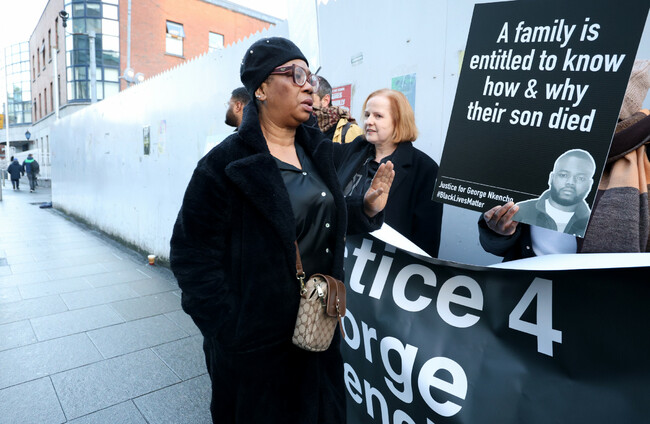
Blessing Nkencho, the Mother of George arriving at the Coroner’s Court, Store Street for the inquest into the death of George Nkencho. Leah Farrell/RollingNews.ie

Taser deployed four times before fatal shooting of George Nkencho, inquest hears

George Nkencho (27) died after suffering fatal gunshot wounds in the incident outside his family home at Manorfields Drive, Clonee, Co Dublin on 30 December, 2020

A DETECTIVE HAS told an inquest that he could not believe how George Nkencho was still able to continue to swing a knife at armed gardaí after several shots had been fired at him at close range.

Detective Garda Brendan O’Hora told a sitting of Dublin District Coroner’s Court that he had drawn his own firearm after thinking the deceased had stabbed a member of the Garda Armed Support Unit (ASU) with his knife.

O’Hora said he believed there was an immediate threat to life as he feared the deceased had made contact with the ASU member known only as Garda A.

The jury of five women and four men also heard that tasers were deployed on four occasions over the space of 21 seconds before the fatal shooting.

The deceased (27) died after suffering fatal gunshot wounds in the incident outside his family home at Manorfields Drive, Clonee, Co Dublin on 30 December, 2020 shortly after he had been involved in a disturbance at a nearby supermarket.

The young man, the eldest of five siblings whose family originally come from Nigeria, was pronounced dead a short time later at Connolly Hospital Blanchardstown.

The inquest previously heard evidence that the deceased had carried out an unprovoked assault on a manager at the Eurospar store in Hartstown as well as threatening staff with a knife shortly before the fatal incident.

The deceased’s family claim the level of force used against him was disproportionate. However, the DPP directed that no prosecution should arise over the circumstances of the death following an investigation by Fiosrú, (formerly known as the Garda Síochána Ombudsman Commission).

O’Hora gave evidence that he had removed his own firearm from its holster when he feared Garda A would fall to the ground and that the deceased would turn on other gardaí at the scene.

He told the coroner, Myra Cullinane, that he “genuinely believed” the deceased was going to kill the ASU officer.

’Hora outlined how he first came across the deceased walking on a green area near his home a short time earlier.

He said the deceased continued to walk towards him and other gardaí in a determined manner, despite being instructed to stop.

The witness said he tried to engage with the deceased but he would not drop his knife.

O’Hora said he kept a safe distance away from the deceased while shouting at passers-by to get out of the way as gardaí created “a moving cordon” around him.

He described how he asked the deceased who he was and to stop and talk but got no response.

O’Hora said he stood at the entrance to the driveway of the deceased’s home after the ASU members had arrived at the scene and called on him to drop his knife.

He recalled how the deceased continued to lash out even after falling to the ground after a taser had been deployed.

At that point, he remembered screaming at people who had come to the front door of the house to go back inside out of fear for their safety.

O’Hora said the deceased was “still slashing” even after shots were fired at him.

“I couldn’t understand how he was still going,” he added.

The witness said Garda A had only discharged his firearm after issuing repeated warnings to the deceased to drop his knife.

O’Hora said he heard four shots with a distinct pause between each one.

In reply to questions from counsel for the deceased’s family, Eanna Molloy, the witness said he had noticed the people at the door of the house were black.

Asked if he had not recognised that they might be relatives of the deceased, O’Hora said he could not “put two and two together at that stage.”

He said he did not hear them saying the deceased was their brother who had mental health issues.

O’Hora said he was focused on removing them “from the threat area” as they might also be possible targets for the deceased.

The seventh day of the inquest heard evidence from several other gardaí at the scene of the fatal incident.

A member of a second ASU to arrive shortly after the fatal incident, Garda Stephen P Walsh said he counted four gunshot wounds to the centre of the deceased’s chest with a possible fifth wound close to the nipple area.

He noted that both Garda A and his colleague, known as Garda B, were in shock.

The former head of the firearms training unit at the Garda College in Templemore, Co Tipperary, Sergeant James Ryan, provided detailed analysis of the deployment of tasers by the two ASU officers.

Data downloaded from the devices showed Garda B first activated his taser for five seconds at 12:35:13 and twice more over the next 21 seconds.

It also revealed that Garda A – who fired the fatal shots with a Heckler & Koch MP7 firearm – had deployed his taser for seven seconds at 12:35:18.

It was the second of four attempts to apply an electric shock to the deceased in an attempt to disarm him from a knife he was using to threaten gardaí.

Evidence was heard earlier this week that the first use of the taser knocked the deceased to the ground for a brief period while the other uses appeared to have had no effect on him after he got back on his feet.

Ryan gave evidence that tasers were “very unlikely” to have an effect if the target was wearing bulky clothing

In reply to questions from Cullinane, he said gardaí should consider resorting to other resources “depending on the level of threat,” if tasers were proving ineffective.

Ryan said tasers were visibly effective if “a good connection” was made with a target when they would be expected to fall to the ground.

The witness said he could not comment on the effectiveness of the pepper spray used during the incident which the inquest heard was past its use-by date.

Ryan told the hearing that bullets used with the MP7 firearm were designed to go through body armour but to stop within a target’s body.

The inquest heard that four of the six bullets fired at the deceased had exit wounds from his body.

Readers like you are keeping these stories free for everyone...
A mix of advertising and supporting contributions helps keep paywalls away from valuable information like this article. Over 5,000 readers like you have already stepped up and support us with a monthly payment or a once-off donation.

Close
JournalTv
News in 60 seconds