Sign in. It’s quick, free and it’s up to you.
An account is an optional way to support the work we do. Find out more.
Sign in. It’s quick, free and it’s up to you.
An account is an optional way to support the work we do. Find out more.
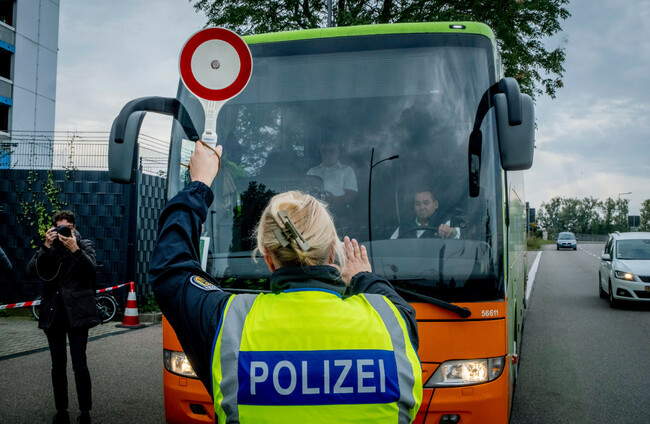
GERMANY HAS BEGUN random checks at land borders it shares with five Western European nations as it seeks to crack down on irregular migration, expanding a system of controls that are already in place at four other borders.
The police controls began at the borders with France, the Netherlands, Belgium, Luxembourg and Denmark this morning and are due to continue for six months.
Germany has already been carrying out the checks at its borders with Poland, the Czech Republic, Austria and Switzerland since last year.
Chancellor Olaf Scholz has angered neighbouring countries with the new restrictions on movement. Polish Prime Minister Donald Tusk recently described the checks as a “de facto suspension of the Schengen Agreement on a large scale”. The government of Austria has also voiced its displeasure with the new arrangements.
According to the EU, member states are allowed to temporarily reintroduce controls at the EU’s so-called internal borders in case of a serious threat, such as one to internal security.
But it also says border controls should be applied as a last resort in exceptional situations and must be time-limited.
Such limitations are often put in place during major sporting events, including the recent Olympic Games in Paris and the European football championship.
The move is a stark departure from former chancellor Angela Merkel’s 2015 pledge to take in roughly one million asylum seekers.
Scholz’s government has pointed to recent extremist attacks in Germany as the reason for the crackdown. Meanwhile, a recent local election saw the far-right, anti-immigration AfD party win a historic victory.
Last month, a knife attack blamed on a Syrian asylum seeker in Solingen killed three people.
The suspect claimed to be inspired by the so-called Islamic State group.
In June, a knife attack attributed to an Afghan immigrant left a police officer dead and four other people wounded.
The border controls are testing European unity because they represent as a step away from the spirit of the EU’s free travel arrangement.
In a statement last week, Amnesty International’s German branch said: “The current debate about an alleged emergency and the rejection of asylum seekers at German borders is endangering European cohesion.”
“Asylum policy challenges can only be solved jointly and at a European level. The German government must not sever the umbilical cord to Europe by going it alone at national level and throwing European legal requirements overboard. Anyone who undermines the European foundation will later be left with the ruins.”
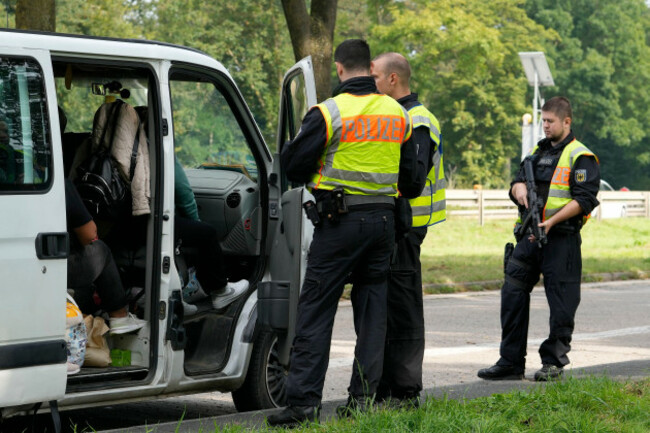
German police say the expanded checks pose a major challenge while some unions have expressed concern over the possible impacts on trade.
Andreas Rosskopf, the head of Germany’s Federal Police Union, said anyone crossing the border into Germany should now expect to be checked.
But he also acknowledged that given the length of the country’s borders, police realistically will not be able to stop and check every vehicle.
Rosskopf noted that Germany has 1,400 kilometres on its western border, in addition to the 2,400 kilometres along its eastern and southern borders where the checks were already taking place.
With reporting from Press Association

To embed this post, copy the code below on your site













have your say