Sign in. It’s quick, free and it’s up to you.
An account is an optional way to support the work we do. Find out more.
Sign in. It’s quick, free and it’s up to you.
An account is an optional way to support the work we do. Find out more.
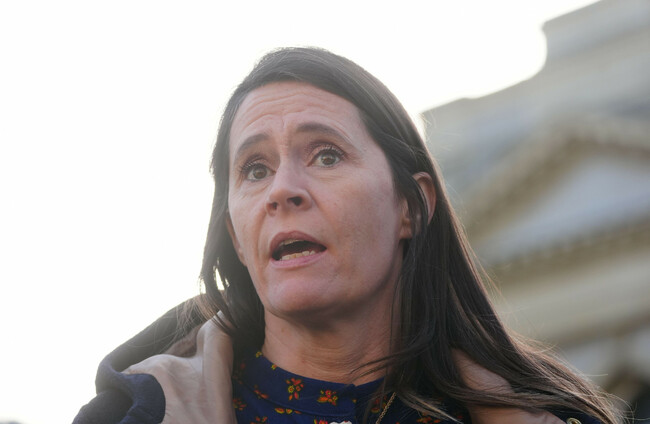
SOCIAL DEMOCRATS TD Sinéad Gibney has accused the government of undermining the UN, the principle of multilateralism and Irish neutrality with its plan to reform the mechanism that governs the deployment of Irish troops overseas.
Speaking on RTÉ Radio’s Today with Claire Byrne, Gibney challenged the government’s position, which she said has changed in recent years, particularly in the case of Fianna Fáil. She also said neutrality should be enshrined in the constitution.
“It’s just simply the case that both the Taoiseach and the Tánaiste, so the two government parties, have moved from a point where they say that the triple lock is fundamental to our neutrality to a point now where they’re saying that it is not,” Gibney said.
The triple lock system dictates that Irish troops in groups of more than 12 cannot be deployed abroad without approval from Cabinet, the Dáil and a resolution from the United Nations Security Council.
Gibney was interviewed alongside Fianna Fáil TD Malcolm Byrne, who argued that the Security Council requirement could prevent Ireland from sending soldiers to take part in a potential post-war peacekeeping mission in Ukraine.
The UN Security Council has five permanent members, Russia, China, the US, France and the UK, all of whom wield veto power. The veto allows any of those countries to scupper resolutions proposed at the council.
“If one of those exercise the veto, it would prevent Ireland from taking part in a peacekeeping mission,” Byrne said.
“I believe that if a peacekeeping mission is to be considered for Ukraine, or for the Middle East, that Ireland should be allowed to participate, and we shouldn’t have our sovereign decision to do that challenged by a potential veto in the case of Russian with Ukraine or the United States in the Middle East.”
But Gibney countered that Ireland should seek to help reform the UN’s mechanisms, rather than undermine them at a time when the organisation and its institutions are under attack.
“As Malcolm has highlighted, there are issues there, and we don’t deny that there are issues there,” she said.
“We support broader UN reform. But it’s about engaging with the UN and explaining and negotiating as to a better process by which this can happen.”
She said that if decision-making is brought back to just the domestic level, rather than the multilateral arena of the UN, “then essentially we are retreating back to the regional blocks that existed before World War Two, and allowing those global standards and those structures to really fall apart around us”.
“And that, for me, is the issue. The multilateralism is a fundamental part of our neutrality, and the removal of the triple lock threatens that multilateralism.”
It was also put to Byrne by both Gibney and host Claire Byrne that Fianna Fáil leader and current Taoiseach Micheál Martin has previously stated that the triple lock system was at the core of Irish neutrality.
Byrne said that Ireland remains committed to multilateralism and support for the UN, but argued that the Russian invasion of Ukraine in particular had changed the global security picture, which he said therefore necessitates a different approach.
He also said that removing the UN Security Council approval requirement from the triple lock would not undermine Ireland’s military neutrality, which the government defines as not being a member of a military alliance, like Nato.
“I welcome government spokespeople telling us that they hold neutrality dear, that they recognise the mandate of the Irish people and its commitment to neutrality,” said Gibney.
“But unfortunately, behind the scenes, we are seeing movements that really undermine that,” she added, making specific mention of arms moving through Irish airspace.

To embed this post, copy the code below on your site











have your say