Sign in. It’s quick, free and it’s up to you.
An account is an optional way to support the work we do. Find out more.
Sign in. It’s quick, free and it’s up to you.
An account is an optional way to support the work we do. Find out more.
LAST UPDATE | 31 Dec 1899
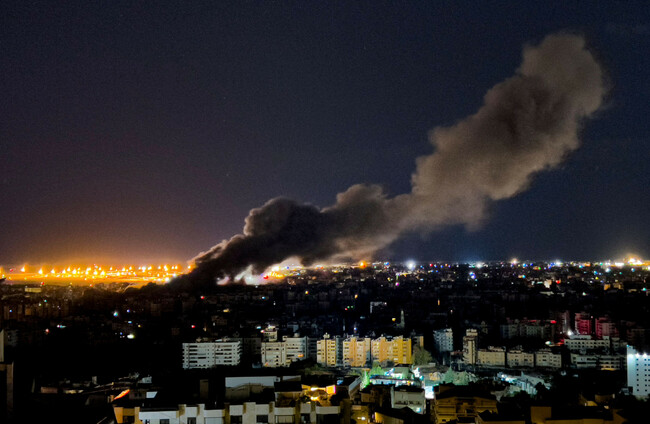
ISRAELI TROOPS HAVE crossed the border into Lebanon and raided nearby villages.
The Israeli military said its troops have started “targeted ground raids” in villages in southern Lebanon.
Airstrikes and artillery bombardments preceded the attack.
The incursions are targeting Hezbollah close to the border, an Israeli military statement said.
Not long later, Syrian state media said three civilians were killed in Israeli airstrikes on Damascus, citing a military source. Nine others were wounded.
“The Israeli enemy launched an air aggression with warplanes and drones from the direction of the occupied Syrian Golan, targeting several points in Damascus,” the official SANA news agency said, adding that “three civilians were killed and nine others injured”.
According to Haaretz’s reporter Yaniv Kubovich, writing about Lebanon:
“The IDF announced that it has begun a targeted ground incursion against Hezbollah in southern Lebanon. The army’s announcement said that the operation began a few hours ago and is targeting several villages that pose a threat to Israel’s northern communities.”
Earlier today, the US State Department confirmed that Israel was “currently conducting” limited incursions across its northern border.
Those were essentially recon missions laying the ground for escalation.
Israel earlier declared three areas along its northern border off limits to the pubic ahead of possible ground operations.
“The areas of Metula, Misgav Am, and Kfar Giladi in northern Israel have been declared a closed military zone. Entry to this area is prohibited,” the military said in a statement.
An Israeli military spokesperson later added on social media: “You are located near interests and facilities belonging to the terrorist Hezbollah group and therefore the IDF will act against them forcefully.”
Sources within the Lebanese military said troops were “repositioning and regrouping forces” in response to threats from Israel.
People across the region and in Lebanon are growing increasingly fearful of a deadly conflict, as Israeli strikes on Beirut – said to be targeting Hezbollah targets – have killed citizens and destroyed civilian houses.
United Nations peacekeepers in the region with UNIFIL are currently unable to patrol “given the intensity of the rockets going back and forth”, according to United Nations Secretary-General Antonio Guterres’s spokesman Stephane Dujarric.
Earlier today, Lebanon’s Prime Minister called on Israel for a ceasefire in his country, as Israeli fighter jets continued to bomb the capital Beirut, and tanks amass across the southern border.
Israel has warned that it will use all of its might to hit Hezbollah, even after the Israeli Defence Forces killed its leader, while the Iran-backed militant group say its fighters are ready to face a ground invasion.
US President Joe Biden, whose country is Israel’s main weapons supplier, has called for a ceasefire in Lebanon and indicated that he would oppose an Israeli ground operation. The call was supported by French authorities a short while later.
French Foreign Minister Jean-Noel Barrot, the first high-level diplomat to visit Beirut since the Israeli strikes intensified, said on Monday his government sought “an immediate halt” in the violence.
“There is still hope” for a ceasefire, he said, “but there is little time”.
Speaking during a meeting with Barrot in Beirut, Mikati said that and end to “Israeli aggression” was key to “revive the appeal launched by the United States and France in favour of a ceasefire”.
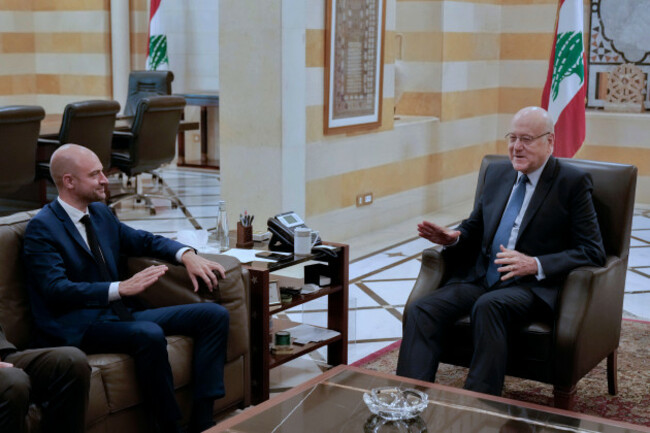
He added that the “priority” of the United Nations Security Council should be to enact the same resolution which ended the 2006 war between Israel and Hezbollah.
US Secretary of State Antony Blinken said diplomacy was the best path forward for the region and said Washington will “continue to work” to bring about a diplomatic resolution to put an end to the growing conflict and civilian suffering.
According to Lebanon’s Health Minister Firass Abiad, over 1,000 people have been killed since fighting and shelling intensified on 17 September. The UN’s refugee agency’s chief has also said that “well over 200,000 people are displaced” inside of Lebanon.
More than 100,000 others have fled to neighbouring Syria, Filippo Grandi has said.
With reporting from Steven Fox, Muiris O’Cearbhaill and © AFP 2024

To embed this post, copy the code below on your site







have your say