We need your help now

Support from readers like you keeps The Journal open.

You are visiting us because we have something you value. Independent, unbiased news that tells the truth. Advertising revenue goes some way to support our mission, but this year it has not been enough.

If you've seen value in our reporting, please contribute what you can, so we can continue to produce accurate and meaningful journalism. For everyone who needs it.

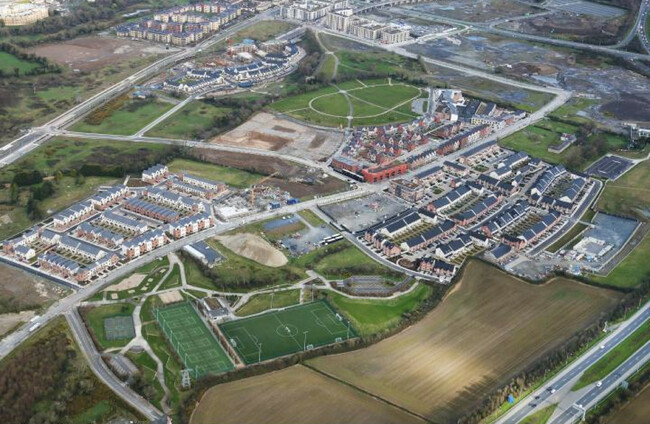
Development at Cherrywood, south Dublin. Dun Laoghaire County Council

The Housing Essay: Who pays for the pipes?

Before we get to building houses, we need to be very clear how the infrastructure for them gets funded in Ireland.

The Housing Essay is a new weekly deepdive from a rotating variety of voices into issues impacting the property crisis in Ireland. Are there potential solutions that may be currently overlooked or traditionally ignored by policymakers?  

TO BUILD NEW housing, a builder needs a few things. They need land. They need development rights; in other words, they have to be allowed to build something. They need access to cash, debt or equity. They need a market: people have to want to buy houses. It also needs infrastructure: it needs pipes, drains, electricity connections, roads, and so on.

A housing system, in its idealised form, should be able to give developers what they need to get building when people need stuff built. When prices rise, land should be rezoned, development rights should be plentiful, and crucially, finance should be flowing. Land supply and finance supply should be elastic.

To do all of this, you need a system that provides infrastructure for housing. I have been looking into solutions from around the world on how this is done. But in the course of that research, I noticed that nowhere is there a summary of how infrastructure gets paid for in Ireland.

It turns out that Ireland’s system of funding infrastructure for housing is quite complicated.

One interesting feature of the Irish system is that there is no single prescribed way to fund housing-enabling infrastructure. This may be a good thing in that there are lots of opportunities for innovation. But it makes for a complex system.

In this piece, I will explain how infrastructure for housing gets paid for. In the course of that explanation, I will try to explain the system, its benefits, and its drawbacks. In a later piece, I will tell you about some alternatives to Ireland’s system.

Development contributions

The first way that infrastructure is paid for is through council development contributions. These are levied by councils under the Planning and Development Act 2000, section 48. These are being replaced on a phased basis by the development-contribution provisions in Part 20 of the Planning and Development Act 2024.

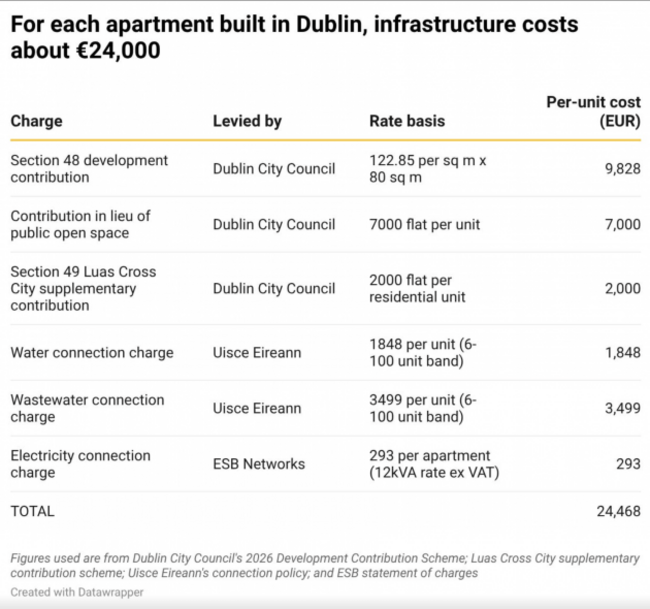
They are calculated on a per square metre of floorspace basis for residential and commercial development with the rates being proposed as €122.85 per sqm (which is set to be a 5 per cent increase over 2025 levels) and €128.10 per sqm respectively in Dublin City Council’s proposed development contribution scheme.

These are paid in cash to the council, retained by the council, and fund council-controlled infrastructure (roads, lighting, surface-water drainage, parks). Though, I do not believe there are restrictions on spending from development contributions. These are essentially unhypothecated income for the council (but there are also some exceptions to this).

There is another kind of development contribution, namely, a s. 49 supplementary contribution. These may be tied to a specific major project (e.g. a Luas line). They are paid to councils usually but can have bespoke elements to them. These are calculated on a per unit basis– for the Luas it was set at €2,000 per unit.

There are also contributions in lieu for public open space or parks. These occur when a developer can’t or won’t build, for example, a park on their own land, instead they pay the council per unit for them to build a park. In Dublin, this is set to come in at €7,000 per unit (it was €5,000 last year).

Then there are water and wastewater connection agreements, set by a Connection Charging Policy approved by the Commission for the Regulation of Utilities (CRU). Sometimes these pipes are built by Uisce Éireann (UE) themselves or a contractor thereof, other times the developer issues a security, builds the pipes, and they are vested in UE upon quality assurance. If the developer is building pipes and drains that could serve many developments, they fall under the Shared Quotable Rebate scheme (which basically means they get some of the money back, as new developers connect to the network).

There are then electricity connection charges which operate in a similar way.

In a standard apartment development, you could expect to see charges on the order of €24,000 per new home (if you assume the new apartment will be an 80sqm two-bed) in infrastructure costs (though there are instances where the contributions alone have exceeded €30,000 per new home).

Development contributions briefly went away (but were ultimately funded by the central government), as did connection charges to UE which were refundable for a period. I’ll come back to this below.

All of the funding mechanisms I have described apply to most major residential developments (with some caveats, for example, some of the charges depend on whether you build the pipes and drains and public park yourself). But there is a still more complex case of delivering infrastructure for housing and that is large-scale development in Strategic Development Zones (SDZs) and soon to be Urban Development Zones (UDZs).

Big projects

Next up are big projects which differ from one-off developments in that they usually incur unusually high infrastructure costs.

I am going to discuss the example of Clonburris SDZ. If I had chosen Cherrywood, another SDZ as an example, it would look quite different. What makes this topic complex is that even within the category of big projects (like SDZs), there is no single way that infrastructure gets funded. But I’ll stick to Clonburris here for brevity’s sake.

In a SDZ, the same obligations apply as before. In addition to those, two more kinds of infrastructure spending apply. These were split into two tracks in the Clonburris SDZ.

First, is strategic infrastructure. These are things like the main roads, bridges, and so on. These were delivered through a Special Purpose Vehicle, Clonburris Infrastructure Ltd, which is jointly owned and controlled by South Dublin Council, Cairn Homes, Evara, and Quintain (Kelland). The landowners have voting rights in the SPV.

The way infrastructure is paid for is through a development agreement between the parties in the SPV. This agreement sets the terms of who builds what, by when, who pays for what, and by when. The agreement also stipulates how much land gets transferred to the local authority at the end of the process and at what price.

The first way strategic infrastructure is paid for is by the central government through the Urban Regeneration and Development Fund or URDF. The funding from the URDF is generally supposed to have 75/25 split between the URDF and other funding streams. The URDF put €186 million into Clonburris. Other national money came from the National Transport Authority, which put about €18 million into the SDZ, for non-URDF projects like active travel.

Landowners have to put money into the pot too. For strategic infrastructure, landowners put about €30 million into it.

Second, is standard infrastructure on private lands. These are the minor roads around the new developments, for example. These are paid for by the developer and “taken in charge” by the local authority at an agreed price in the Development Agreement.

It all led to HISCo

One feature of all of the preceding means of paying for infrastructure is that they require lots of cash upfront.

HISCo (Housing Infrastructure Services Company) was created to solve that problem. It is a commercial joint venture between the Ireland Strategic Investment Fund (ISIF) and Cork County Council to build supporting infrastructure for housing.

The basic model of HISCo is that a developer signs an infrastructure agreement with them, HISCo builds the infrastructure, and is repaid by a fee placed on the sale of each unit. So, it solves the upfront capital issue by deferring the repayment.

HISCo started in Cork but is now offering their service to sites around the country, for example this one in Louth.

Is all of this stuff working?

But what are the benefits of this system, and what are the drawbacks?

An ideal system would have a few features. Most obviously, it would pay for the infrastructure required to build more homes. It would, as much as possible, not disincentivise development by, for example, requiring too much upfront cash or making an entire project unviable.

Another feature of a successful system is that it is self-sustaining. At a high level, you want growth to pay for growth.

Put differently, you want the new homes to pay for the infrastructure. There are two reasons for this.

The first is that if new housing doesn’t pay for itself then someone else has to pay for it. This has two negative consequences, one political, the other fiscal. The political consequence is that people will be less supportive of new housing if it is associated with higher public spending and higher taxes. The fiscal consequence is that it means Ireland’s housing system will be entirely dependent on the health of the public accounts. If there is a fiscal contraction, the money will slow down or stop.

Neither consequence is desirable. Ideally, new housing creates value. And some of that value can go towards paying for infrastructure.

The second reason is more local. Growth has concentrated costs. People have to put up with stuff like disruption, congestion, and loss of amenity. In a perfect system – one that actually supports long-term growth – growth pays for itself and comes with local benefits.

But if new development is seen as a net burden on new areas, for example as strain on local infrastructure, then locals will not support it enthusiastically.

Ideally, you want to be benefit locals like the French do. French nuclear plants benefited locals directly and were popular as a result. You want to fund infrastructure efficiently like the Japanese do: their trains are partly funded through land value capture.

Does the Irish system have these features?

First, the Irish system does manage to pay for infrastructure. That is mainly because tax revenues have been quite high. But it is a slow system which has required a dedicated body called the Housing Activation Office to make sure the new housing isn’t overly delayed by infrastructure. That body is overseeing the €1 billion Housing Infrastructure Investment Fund to make sure infrastructure gets built at speed. No one could say that housing-enabling infrastructure is underfunded in Ireland right now though funding infrastructure and delivering it are not the same thing.

What about disincentivising development?

In principle, things like development contributions shouldn’t disincentivise development. But Ireland is an outlier in development costs, meaning that even in high value areas, large scale development is often not viable. When development contributions were waived (along with Uisce Eireann’s connection charges by way of a refund), commencements doubled as developers tried to take advantage of the time-bound waiver.

Given how high development costs are, it is fair to say that any additional costs disincentivise development. The government seems to have taken this position since its latest housing plan commits to a review of development contributions, specifically looking at viability.

Does the Irish system require a lot of upfront cash?

As before, the answer is straightforward: yes. Even in places where the State is paying for a lot of infrastructure, developers still pay on the order of €20,000 per home for infrastructure. HISCo can play a bigger role in bringing projects forward but it retains the marginal disincentive mentioned above.

Is it self-sustaining? I don’t think it is.

The way Ireland funds infrastructure is extremely costly to the taxpayer (which is distinct from saying that that spending was unwarranted).

It also doesn’t encourage locals to support more growth. These two problems jointly make Ireland’s current model unsustainable. It is, in short, neither fiscally nor politically sustainable.

At one level, you might say development contributions have fiscally and politically-self-sustaining features.

On the fiscal-side, new development does come with money for infrastructure. Some of it goes directly to pay for that infrastructure. But as we have seen, the central government and general taxation pays for most of it.

On the political side, councils, who control development rights, get money. The more they permit, the more cash they get. This means that councils are incentivised to permit more housing since it generates revenue for them. This basic feature has led lots of people to defend development contributions (sometimes called impact fees in the US).

But the Irish system doesn’t exactly achieve this desired effect. It does raise money for councils and this is good. But the above argument assumes the relevant veto-players are the council. In other words, it assumes that buying off the council is sufficient to incentivise development. Technically the council is the planning authority and the de jure veto-player. But residents are de facto veto players and act through the council (councils are very responsive to the views of local residents).

Development contributions don’t target the right veto players.

Locals still feel all of the downside of development and the diffuse benefits of increased council revenue won’t do much to make NIMBYs into YIMBYs.

This is because development contributions go into general funds. The benefits are not seen locally (though they can be, sometimes).

There are exceptions to this, where locals do get direct benefits. Supplemental development contributions actually do benefit local residents often. This is one area where the Infrastructure Action Plan’s idea for a “benefits realisation framework” may actually have a positive effect since it isn’t obvious to people on the ground that the money for, eg the LUAS, was partly coming from supplemental development contributions. The same could go for various planning conditions, like a condition to build a park, improve public space, or build a community centre.

In large-scale developments, most of the heavy lifting is coming from the central government through schemes like the URDF, the Local Infrastructure Housing Activation Fund (LIHAF), or now the Housing Infrastructure Investment Fund.

So where does that leave us?

The system is supposed to make growth pay for growth. In practice, the central government pays for most of it. For a while, the central government even paid councils not to collect the growth charges.

The problem is with the design of how infrastructure is paid for: charges are upfront hitting cash flow, they push marginal schemes under, and they often give locals nothing they can see. On top of that, the government is increasing spending to get housing moving despite the poorly designed system.

What system could replace it and solve these problems? A good system would pass these four tests. Does it fix the timing? Does it protect viability? Does it give locals a reason to say yes? And is it fiscally sustainable?

Keep an eye out for my next piece, when I’ll go through some replacements that could pass all four tests.

Seán O’Neill McPartlin is housing policy director at Progress Ireland, a think tank researching policies and implementation of actions to support improved housing, infrastructure and innovation in Ireland. You can read more work like this on their Substack here.

Close