Sign in. It’s quick, free and it’s up to you.
An account is an optional way to support the work we do. Find out more.
Sign in. It’s quick, free and it’s up to you.
An account is an optional way to support the work we do. Find out more.


THE BOSSES OF some of the biggest construction companies in the country are claiming there’s been been significant delays to major housing and infrastructure projects in Ireland because of uncertainty and indecision from within government departments.
Multiple chief executives sounded the alarm on whether the government could deliver the key infrastructural projects that the economy is dependent upon during the Construction Industry Federation (CIF) annual conference at Croke Park today.
The construction executives were speaking during a panel looking at Ireland’s ability to manage its construction industry and provide a steadier stream of work in the industry.
Tackling infrastructure systems such as water supply has been one of the major goals of the coalition government in its bid to try and fix the backlogs and wait times for housing across the country.
The Central Bank expects 32,500 homes will be built in 2025, having scaled down an earlier projection by 5,000 houses.
According to JJ Rhatigan chief executive Ger Ronayne, it’s unlikely to get better anytime soon as uncertainty over projects is leading Ireland to “export our expertise around Europe and the UK”, rather than enticing the workforce to stay in the country.
He was backed by executive director of BAM UK and Ireland Alasdair Henderson, who said that this was harming efforts to build up the domestic construction industry.
“You can’t build strategy on the handful of work that is coming in,” Henderson told the conference in Croke Park.
Ronayne claimed that the government’s procurement system, E-Tenders, has “never been quieter” in terms of projects.
“Everyone in the room will have seen that,” Ronayne insisted.
Addressing the conference earlier this morning, Taoiseach Micheál Martin said that the government understands the importance of providing “certainty, predictability and a clear vision” of what it aims to achieve.
He pointed to a revised National Development Plan, published in July, that he said represents that “step-change” needed in the approach to infrastructure delivery in the years ahead.
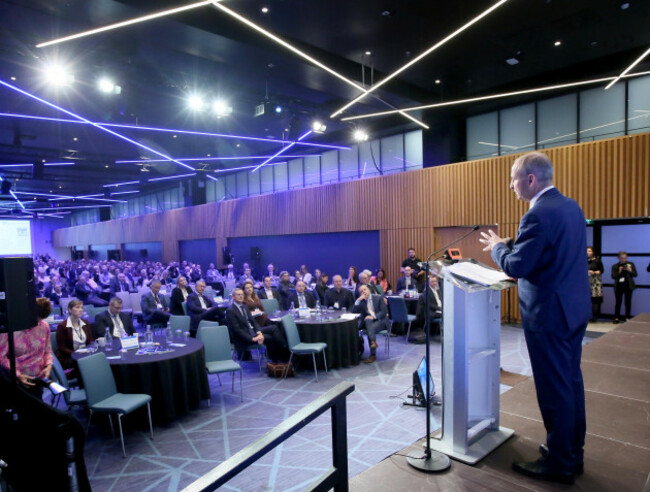
The Fianna Fáil leader said it would be the largest ever capital investment in the history of the State, at a total investment of €275.4 billion. It includes €24 billion invested in key transport programmes such as MetroLink and over €12 billion for water and wastewater services
We are releasing funds from many and varied sources because we understand the need and know that now is the time to invest in our future.
JJ Rhatigan, which employs 346 people directly, recently took legal action against the Department of Housing over the government’s decision to suddenly halt almost 500 social homes over rising costs.
While Ronayne did not specifically discuss the project today, he did warn that the company was increasingly seeing projects stall after getting approved following a competition for the State contract.
“There’s a lot of talk about infrastructure being the blocker. Many, many shovel ready projects which we have tendered that are not getting approved and not getting the go ahead – the funding seems to be there. This is after the tender has been selected.”
Ronayne said this was resulting in a “constant” see-saw where the industry veers between being busy with projects to then a “fall-off-a-cliff” period where work dries up.
He added that he believes “costs will come down” if a more regular pipeline of work is created, adding that this should “create efficiency” in the sector.
Gillian Murtagh, whose Shay Murtagh concrete company employs over 150 people in Westmeath, echoed the concerns.
Murtagh said companies are “sitting and waiting”, wondering “are we going to be there in six months” or if the work will cease at the same time.
Paul Sheridan, director of contracting services for CIF, told The Journal afterwards that companies can’t sustain their investment without a guarantee of multiannual funding.
“With all that uncertainty, we’re seeing teams getting on flights at Dublin Airport on a Monday morning and heading to the UK and Europe for work,” Sheridan said.
“Over 60% of the top 50 contractors – who are key for building the major infrastructure here – are actually exporting their teams. So the capacity is there, but we need to see the pipeline and the multiannual funding.”
Department response
When contacted, a spokesperson for the Department of Public Expenditure and Reform said that reviewed National Development Plan (NDP) published in July seeks to provide certainty sought by the construction sector.
The levels agreed for the next 10 years total €275 billion of capital investment.
Departments will be tasked with setting out initial 5-year NDP sectoral plans to provide clarity to the sector and the public around priority projects for delivery up to 2030, with details on when the projects will likely go to tender and commence construction. These plans are to be published in November.
However, the spokesperson added that any final decisions on when to issue tenders and approve projects to go to construction still sit with the relevant minister and their departments and agencies.

To embed this post, copy the code below on your site















have your say