Sign in. It’s quick, free and it’s up to you.
An account is an optional way to support the work we do. Find out more.
Sign in. It’s quick, free and it’s up to you.
An account is an optional way to support the work we do. Find out more.
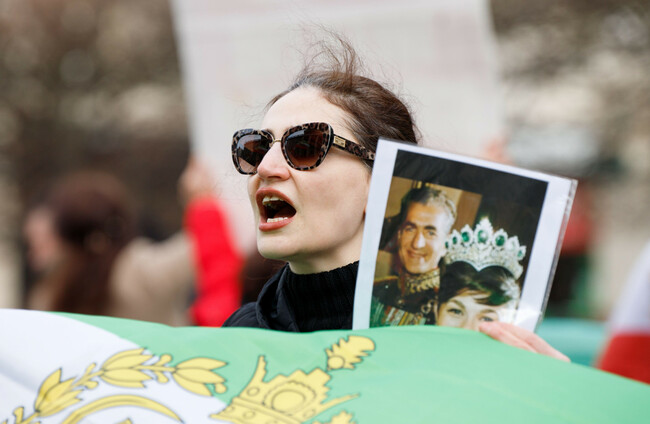
WHEN THE NEWS broke on Saturday that Iran’s supreme leader Ayatollah Ali Khamenei had been killed during attacks launched by the United States and Israel, it was met with a mix of relief, trepidation and joy by members of the Iranian diaspora living in Ireland.
The US and Israel’s massive aerial assault on Iran has set off a chain reaction of violence across the Middle East and Khamenei’s death was met with both celebration and mourning in the capital Tehran and around the country.
Iranians in Ireland have told The Journal they welcome Khamenei’s death and are hopeful the brutally oppressive regime of the Islamic Republic might be about to fall.
“It felt like one of the happiest moments in all these years, knowing that the one responsible for so much pain and loss was finally gone,” said Shahrzad, who used a pseudonym to protect her identity.
“Because of this long history of suffering, the reaction to the recent attacks was not fear, but relief for many,” she said.
“For a large number of Iranians, the continuation of this regime would be far worse and far more destructive than war itself.”
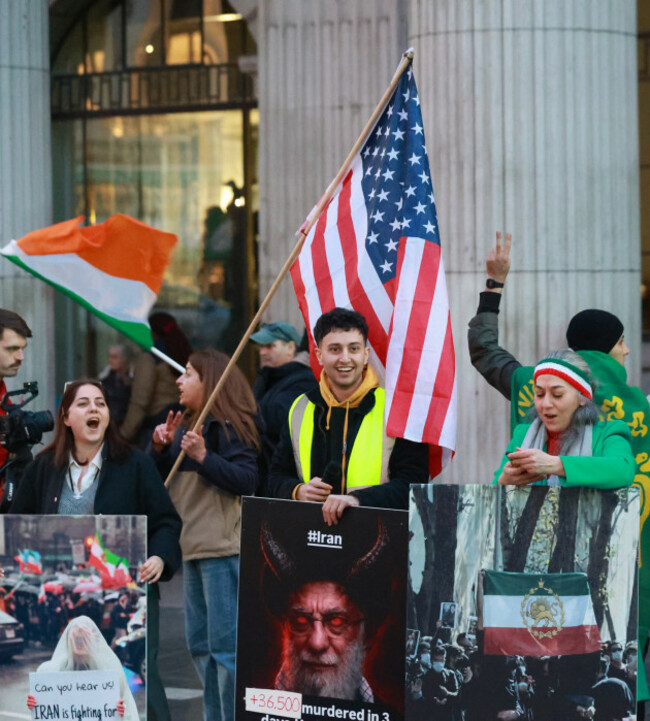
Others are not so bouyed by the US and Israeli attacks on their country though.
Samieh Hezari, an accountant and author of the book Trapped in Iran who has lived in Ireland almost 30 years, said she felt “no celebration, but I did feel relief” when Khamenei died.
“I also felt anger. There was no true justice,” she said.
As for the wider war on her country, she said:
“I felt deep grief for the risks ordinary people would face, but also a grim understanding that the international community ignored the regime’s internal violence for so long that external intervention became the only remaining lever.”
So far, the Iranian Red Crescent has reported that 787 people have been killed in the US-Israeli assault. Strikes have hit 153 cities and more than 500 locations across Iran in more than 1,000 attacks, the organisation said.
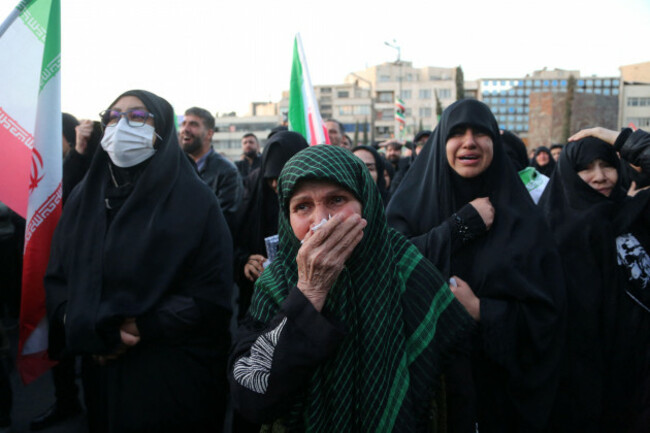
Roshin Farahani, an activist organiser who also works as an accountant in Ireland, said she felt that someone outside of Iran “finally took decisive action”.
“For decades, this regime has suppressed its own people — imprisoning, torturing, and murdering protesters whenever they demand basic freedoms,” she said.
“Many of us felt abandoned while the world appeased the rulers responsible for our suffering.”
The hopes of the Iranian diaspora in Ireland had been raised in January when mass anti-government demonstrations broke out across the country, only to be violently repressed by the government, whose forces reportedly killed tens of thousands of its own citizens.
“How can unarmed civilians deal with a regime that murders peaceful protesters?” Roshin asked.
Communications with people inside Iran remain extremely limited, with the government cutting off access to the internet.
Still, those who spoke to The Journal said they had managed to speak briefly with their loved ones.
“They are alive, and for that I am grateful,” Roshin said, adding that her friends and family “know that the regime’s grip is weakening”.
“Like many Iranians, they hope this is the beginning of the end of the IRGC (Islamic Revolutionary Guards Corps) and the ruling clerical establishment.”
Shahrzad said she had been in contact with a few relatives, “and they are all doing well”.
“Sometimes the internet works for a short time, and they can make calls from their mobile phones occasionally.”
Hezari said this kind of uncertainty “is something Iranians inside and outside the country live with constantly, not knowing if loved ones are safe, detained, injured, or worse.
“Silence itself becomes a form of psychological violence.”
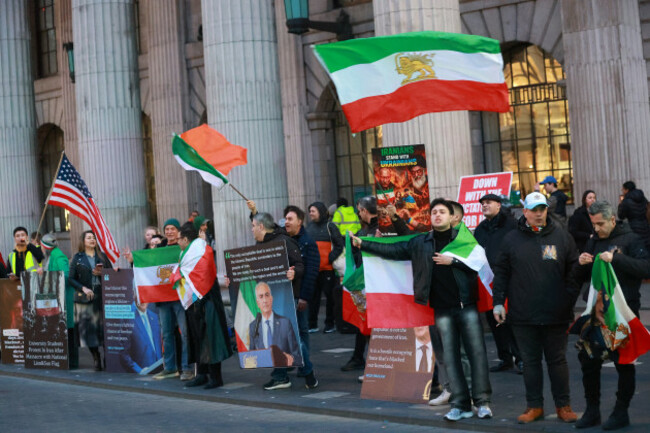
The Iranians who spoke to The Journal said the future of Iran should be secular democracy, although most argue that this should come through a transitional process led by the son of the country’s last monarch, Reza Pahlavi, who has been in exile for decades.
Pahlavi’s father, the shah, was an authoritarian dictator but the dynasty still has many supporters in Iran and abroad.
Pahlavi played a prominent role in calling for the protests in January, urging people to take to the streets.
He has broken with traditional monarchists and said he does not seek to reestablish his family’s rule, expressing a wish to hold a referendum that would allow Iranians to determine the form of a future government.
Iran was once a democracy, after president Mohammad Mosaddegh was elected following the forced adication of the shah. But Mosaddegh’s government was overthrown in a US and British orchestrated coup in 1953 that led to the return of the shah.
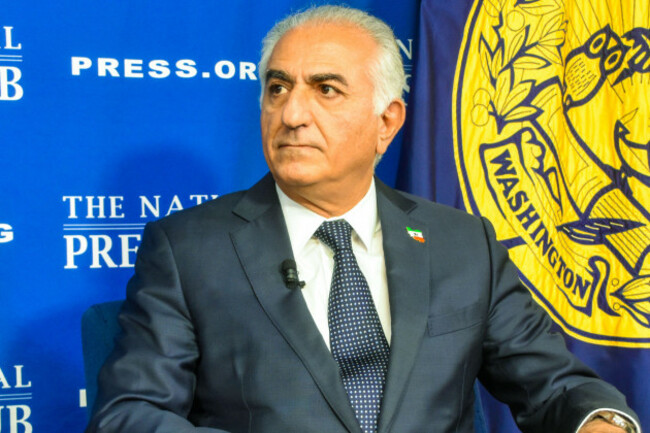
Speaking about the exiled Pahlavi, Shahrzad said: “Many of us look to him as a symbol of hope, wishing for a future where he can help lead Iran towards freedom and democracy.”
Roshin is also open to the idea.
“Whether through a constitutional monarchy or another democratic system chosen by the people, I support a transition that restores national pride, stability, and prosperity. Iran belongs to its people, not to an Islamist regime,” she said.
Hezari lamented what she sees as decades of fruitless engagement with the Islamic Republic regime, but she now hopes things have changed.
“For decades, world leaders negotiated with our executioners and torturers, and ordinary Iranians paid the price. We want that chapter to end. We want Iran to be run by Iranians, with leaders chosen by its people.”
Despite the ongoing US-Israeli attacks, most see this moment as the first glimmer of hope that they might be able to return home.
“I miss Iran enormously,” said Hezari.
“For many in the Iranian diaspora, including myself, this felt like the first moment in decades where returning home might be possible.
“I lost my parents in exile. My only wish is to go back freely, to grieve at their graves, to hug my people, and to begin healing the pain and trauma that this regime injected into our lives for generations.”

To embed this post, copy the code below on your site











have your say