We need your help now

Support from readers like you keeps The Journal open.

You are visiting us because we have something you value. Independent, unbiased news that tells the truth. Advertising revenue goes some way to support our mission, but this year it has not been enough.

If you've seen value in our reporting, please contribute what you can, so we can continue to produce accurate and meaningful journalism. For everyone who needs it.

At the Rafah crossing, McEntee sees wheelchairs and kids' games among the aid blocked by Israel

Helen McEntee said that she will not “rush” the Occupied Territories Bill in its current form when the ceasefire in Gaza is “so fragile”.

IN A HOSPITAL room in Al Arish Hospital, Rafah, Egypt, a girl from Gaza who could not have been much older than 6 or 7 told Helen McEntee that she wants to be a plastic surgeon when she is “big”.

She stood next to her father, a medical evacuee from Gaza who has an autoimmunine disease. Along with her mother, they fled Gaza for Egypt to secure life-saving treatment for him.

Though the move has saved his life, it has also broken their family apart. The girl’s siblings are still on the other side of the nearby border. Communication is difficult, and there is no guarantee for when or where they will be reunited; the Rafah border crossing has been closed since May 2024. 

“Do you miss your brothers and sisters?” McEntee asked the girl. “Of course!,” she replied, giving the minister a tooth-gapped smile.

Visibly moved, McEntee asked if she could give her a hug. Mid-embrace, the girl politely told her “Thank you for your visit”.

From his hospital bed, her father watched on proudly.

Though it was a sweet moment, every adult in the crammed room – including a governor, doctors, diplomats, and a cameraman – was briefly thinking the same thing: In what kind of world does a girl of this age dream of becoming a plastic surgeon?

The stories from the doctors in the hospital made the answer to that question clear: the surgeons there have put Palestinians who have been left mutilated by the violence in Gaza and strikes by the Israel Defence Forces (IDF) back together again.

They are treating hundreds of patients who either had serious illnesses and no access to care, or those who were left with broken bones, serious wounds, and in some cases paralysis, as a result of explosions.

It’s a reality no child should be aware of, but this girl’s family is just one of tens of thousands that have been ripped apart by the genocide in Gaza.

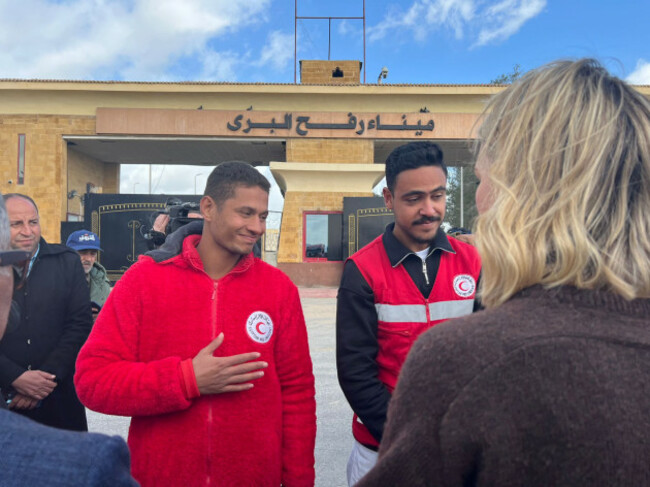
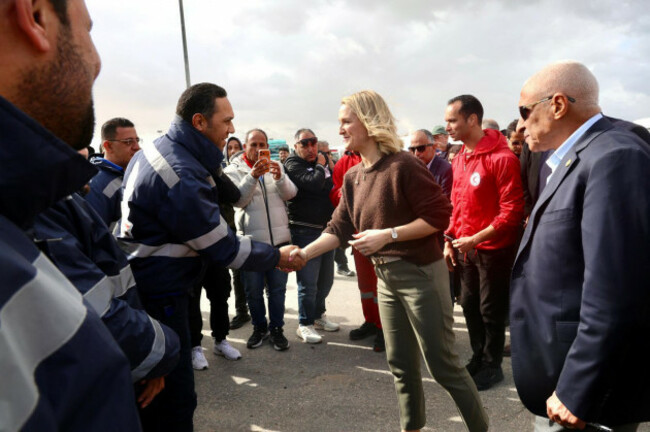
WhatsApp Image 2026-01-13 at 17.21.08 (1) Helen McEntee thanks Egyptian Red Crescent aid volunteers for their hard work at the Rafah Border Crossing.

Although Trump’s peace plan has had a rocky start, things are supposed to have gotten somewhat better. After hundreds died from starvation prior to the ceasefire, aid is now being let in at varying intervals.

During meetings with the Red Crescent and UNRWA yesterday the Minister for Foreign Affairs was told that aid is not being let in at the rate it was during the previous ceasefire, and items are still being turned away at the border for seemingly arbitrary reasons. 

Aid is still being blocked

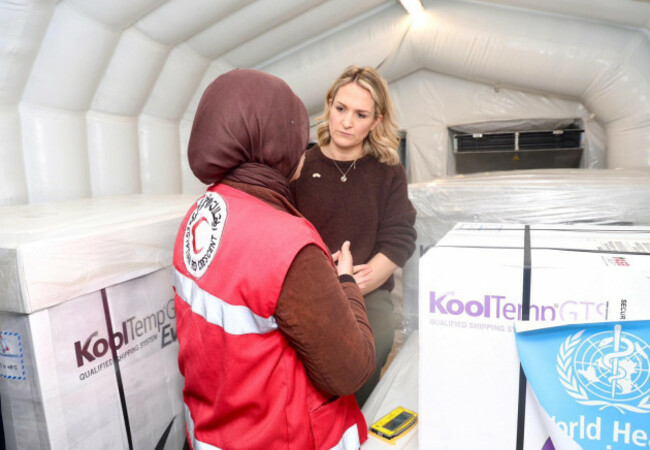
WhatsApp Image 2026-01-13 at 13.05.39 Minister McEntee views the medical supplies waiting to cross into Gaza which have to be stored in large cold containers. Phil Behan / DFAT Phil Behan / DFAT / DFAT

“It’s pretty clear that they are putting obstacles in the way that don’t need to be there. I’m pretty appalled at what I have seen, at the decisions that Israel has taken. I’m appalled to see a children’s snakes and ladder playboard among the items that couldn’t get in. 

“It makes no sense and we have to call it out,” she said. 

At the Red Crescent centre McEntee met Egyptian and Gazan volunteers among the 2,500 strong workforce that work 24/7 to check, process and load aid onto trucks that then depart for the Rafah border crossing. 

Mostafa Refaat, the Head of Operations, explained to her that there is an extremely detailed process for checking the aid donated by Egyptian organisations, international donors and other countries. 

The Red Crescent has a complex tracking system that sees each unit of humanitarian aid labelled with a QR code which explains the contents, expiry dates for food or medication, and its origin point. 

This enables them to feed information back to other countries and their partners about what has happened to the aid they’ve donated, as many want to know. 

In one warehouse Mostafa showed McEntee all of the aid that has been rejected. 

It included wheelchairs cast aside at the border for containing metal, oxygen canisters, children’s games, USB solar lights, spades, a printer, crutches, and many other items. 

Due to an agreement in place with Israeli authorities, we were not able to photograph these items.

The Governor of North Sinai informed her that some time ago French President Emmanuel Macron stood here, and saw that a box of aid from his own country had been rejected; he demanded to know why. 

He said he would phone Netanyahu that night and get it fixed, but no, aid is still being rejected for the same reasons,” Governor Khaled Megawatt said. 

He added that sometimes medical equipment is rejected multiple times, but the Egyptian authorities and the NGOs working in Rafah keep attempting to send it back “because every box represents hope for a Palestinian family”. 

The aid in these boxes had fallen under Israel’s definition of ‘dual use’ (meaning that some element of the food item or medical equipment could in the view of their authorities be used by Hamas for threatening purposes). 

McEntee, speaking back in Cairo yesterday before flying to Amman in Jordan for the last leg of her tour of the Middle East, said that some of the reasons being given by Israeli authorities to refuse aid are “not credible” and “not realistic”. 

WhatsApp Image 2026-01-13 at 14.18.44 McEntee meets with medical services staff working at the Rafah Border crossing. Phil Behan / DFAT Phil Behan / DFAT / DFAT

She had time to speak to Red Crescent volunteers at the centre, and express her condolences over the killing of their colleagues who were stationed in Gaza. 

“It’s completely unacceptable, I know you’ve lost many colleagues. It’s incredibly wrong that you’ve faced such criticism, we need to support you and stand up for you, and the many people you have working on the ground. 

I’m extremely concerned by the fact that people are dying because they cannot get access to this lifesaving aid, there are blockages being put in your way and stopping you from doing what you need to do.”

McEntee said that it is plainly wrong that Israel has labelled volunteers like these ones as having “domestic terrorists” in their ranks, when they are operating in “unimaginable circumstances” in their efforts to help people. 

The Red Crescent told the Minister that it has the capacity to send thousands more aid trucks over the border, but the Israeli authorities will not let those numbers through. 

Similarly, the staff in Al Arish hospital said that they wanted to treat more patients in the hundreds, but medical evacuees are not being let out.

When they are, sometimes it’s in back-to-back ambulance journeys to the border. Sometimes, people who should be in ambulances have to walk before they eventually are put in one on the Egyptian side. 

Egypt has consistently called for an increase in the numbers of injured Palestinians being allowed through the Rafah crossing. 

During her visit to Al Arish hospital McEntee met four patients currently being treated there – it’s first and foremost and emergency response hospital, so often people are transferred to other facilities as soon as possible. 

Two were women with cancer. One of the women had her son with her. 

“She lost her three other boys though,” McEntee said afterwards, becoming emotional as she reflected on the meeting. 

“That last family I spoke to, the mum was a maths teacher and she had three wonderful children with her, who want to do all kinds of great things in the future. They are optimistic about phase two of the peace plan, they want it to work,” the Minister said.  

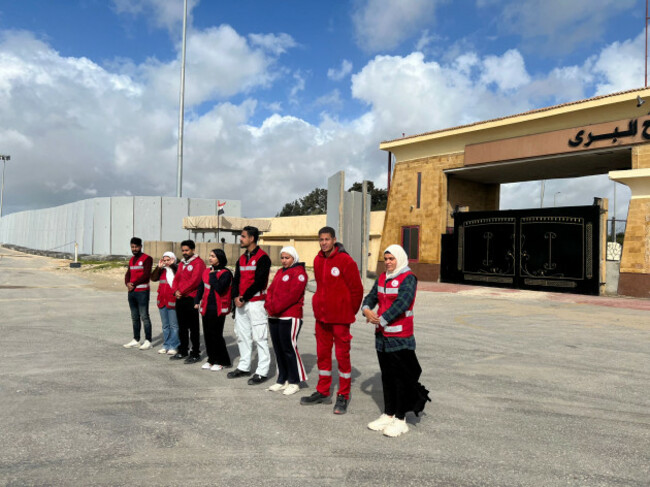
WhatsApp Image 2026-01-13 at 17.21.08 Egyptian Red Crescent volunteers, pictured here at the Rafah Border Crossing, said vital aid is still being turned away by Israeli authorities.

Ireland has announced a further €42 million to aid humanitarian efforts to help Palestinians this week, but yesterday McEntee also vowed to advocate once again for her European colleagues to make the visits she has on this trip, and to use their collective voice to talk to Israel, and “bring Israel to the table”. 

McEntee stressed that in order to do that, Europe also has to work closely with the US. 

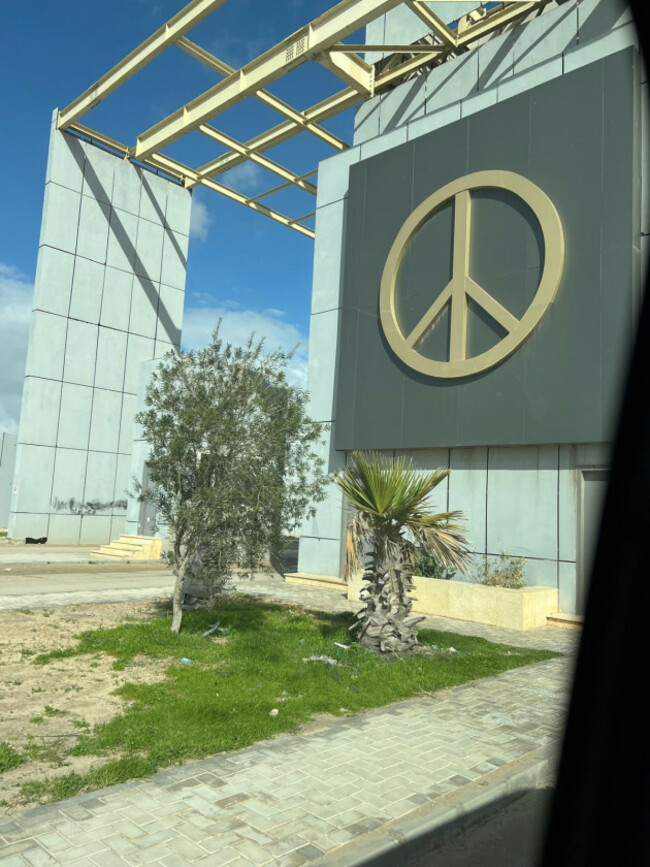
There is a massive peace sign erected on the Egyptian side of the Rafah crossing, and when you get to the gates there is a sea of aid trucks lined up to go over the border.

WhatsApp Image 2026-01-14 at 00.43.17 (1) The peace sign on the Egyptian side of the Rafah Border Crossing.

McEntee said that it’s vital that the crossing itself now opens up, as well as other vital entry points into Gaza. 

The Minister had requested to go to Gaza on this trip, but the request was refused by Israeli authorities, as is usually the case, based on their analysis of the level of security threat. 

“The focus needs to be on what can we do to get us to stage two of the plan for peace, it’s hopefully going to be announced soon,” she said. 

On the Occupied Territories Bill, the Minister said that she received updated legal advice on the inclusion of services as well as goods in the bill which is being considered, but that she is not going to “rush into something” that she’s not clear “will do good and that may cause more harm”. 

She also said that giving a timeline isn’t possible at this point. 

McEntee added that the situation in Gaza could “change in an instant”. 

“I think what is in place at the moment, in terms of the ceasefire, is so unbelievably fragile that it has the potential to fall apart and to collapse. And everything that we’ve done… all of that has been to get to a ceasefire. We’re there now. So we have to be certain that anything we do helps to get it to the next stage,” she added. 

Readers like you are keeping these stories free for everyone...
A mix of advertising and supporting contributions helps keep paywalls away from valuable information like this article. Over 5,000 readers like you have already stepped up and support us with a monthly payment or a once-off donation.

Close
89 Comments
This is YOUR comments community. Stay civil, stay constructive, stay on topic. Please familiarise yourself with our comments policy here before taking part.
Leave a Comment
    Submit a report
    Please help us understand how this comment violates our community guidelines.
    Thank you for the feedback
    Your feedback has been sent to our team for review.

    Leave a commentcancel

     
    JournalTv
    News in 60 seconds