Sign in. It’s quick, free and it’s up to you.
An account is an optional way to support the work we do. Find out more.
Sign in. It’s quick, free and it’s up to you.
An account is an optional way to support the work we do. Find out more.
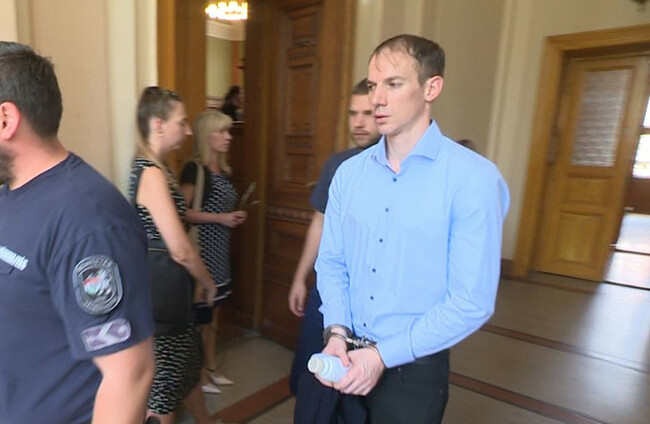
AN IRISHMAN WAS found guilty of the murder of an American woman by a court in Budapest last Wednesday, but Hungarian media has still not named him.
He was sentenced to 14 years in prison for the murder of Mackenzie Elizabeth Michalski, a 31-year-old nurse from Oregon.
Over the weekend, the man was named by Irish media outlets as Lorcan Tadgh Murphy, a 38-year-old man from Dublin.
His conviction received plenty of media attention in Ireland and the United States, but Murphy was only referred to by his initials, LTM, in most of the reports.
The court heard that Murphy met Mackenzie in a bar in Budapest in November 2024, before taking her to his apartment, where he tied her up, strangled her and put her body in a suitcase.
He then cleaned the apartment and drove to a wooded area near Lake Balaton, where he dumped her body.
The court rejected his claim that Mackenzie died during a sexual encounter gone wrong.

Investigators said his internet search history included queries about whether pigs eat dead bodies, the presence of wild boars around Lake Balaton and the reliability of Budapest police.
After his arrest in the capital two days after the murder, Murphy helped investigators locate Mackenzie’s body, but insisted her death was accidental.
“The defendant did not attempt to resuscitate the deceased, nor did he call for help; according to the court’s findings, he intended the outcome of his actions, that is, the victim’s death,” the court said in a statement.
Murphy’s defence has already indicated he will appeal the conviction.
If his appeal fails, he will serve the 14-year jail term — minus the 18 months he already spent in pre-trial detention — and then be deported to Ireland and banned from entering Hungary for 10 years.
The fact that Hungarian media outlets have not identified him has been condemned as a failure to inform the public about a convicted murderer who could pose a danger to women in the future.
The Journal asked legal experts in Hungary why the press there has declined to name Murphy when reporting on the case.
They said naming a suspect or convicted person is not strictly prohibited by Hungarian law, but that keeping them anonymous is the convention, unless they are a public figure.
“In Hungary, there is no specific legislation that explicitly prohibits publishing the name of a person involved in criminal proceedings or who has been convicted,” said Pál Bátki, a criminal lawyer based in Budapest.
“However, the protection of personality rights and reputation is based on the principles established in the Civil Code, which guides the media to proceed with caution when identifying individuals.”
Bátki said that, “as a rule of thumb”, naming public figures like politicians “can be justified” but that each case must be evaluated individually.
“The justification for disclosing a name always depends on the specific circumstances of the given case,” he said.
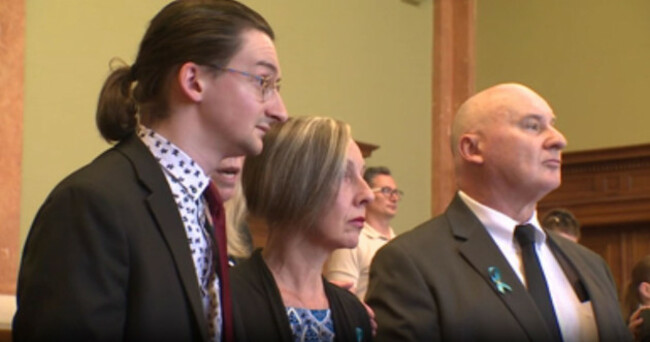
Csongor Herke, a senior law professor at the University of Pécs in Hungary, also said there is no Hungarian law that generally prohibits the press from publishing a suspect’s full name, “but it does allow it after a final conviction”.
“This is a common misconception,” he said when explaining why media outlets often use initials or first name and initials, as can be seen here in this English-language news report about a recent case of cannibalism.
He said the omission of a suspect’s full name “does not stem from a single statutory prohibition, but rather from the presumption of innocence under the Fundamental Law”, Hungary’s constitution.
Suspects are also protected by their rights under civil law, data protection rules “and, above all, the established case law of the Supreme Court, the Constitutional Court, and the European Court of Human Rights”, Herke said.
Irish media reporting on the case, including from The Journal, initially relied on international wire services, which adhered to the Hungarian convention of not naming the accused. By the weekend, however, the Sunday World, The Sunday Times and the Sunday Independent named Murphy, citing the interest of the public.
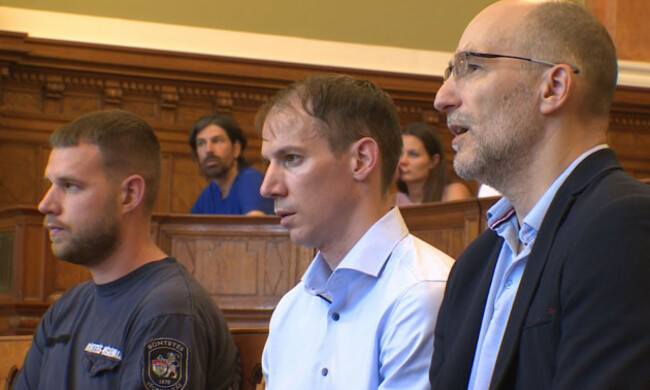
Speaking to reporters after Murphy’s sentencing, Mackenzie’s brother Nicholas was asked if he had anything to say to the man who murdered his sister.
“I wouldn’t see a point,” he said.
“I kept searching, you know, for some trace of humanity and there’s nothing behind his eyes, so there would be no point.”
“The important things is that the murderer is kept off the streets, that he can’t do this to other people.
“The experts said he has a high risk of reoffending and cannot be cured, so we don’t want other people to go through what Kenzie went through.”
He said his sister’s life was “irreplaceable” and reflected on the fact that she “saved people’s lives for a living” in her job as a neurosurgery nurse.
Asked about the 14-year sentence given to Murphy, Mackenzie’s father, William Michalski, said:
“There’s nothing that any court of law could do to replace the loss of our loved one Kenzie and all of the lives that have been shattered by what’s happened, so it could never be a long enough sentence.
“That being said, we do find consolation that the sentence was handed down,” he said.
- With reporting from AFP © 2026

To embed this post, copy the code below on your site













have your say