Sign in. It’s quick, free and it’s up to you.
An account is an optional way to support the work we do. Find out more.
Sign in. It’s quick, free and it’s up to you.
An account is an optional way to support the work we do. Find out more.
THE EUROPEAN SPACE Agency’s Juice craft will return to Earth tonight, taking part in a world first fly-by.
A team of three researchers from the Dublin Institute for Advanced Studies (DIAS) will play a key role in the first ever attempt to fly a spacecraft past the Moon, and then past Earth.
Flight controllers from Esa will guide the Jupiter Icy Moons Explorer (Juice) past the Moon and then Earth.
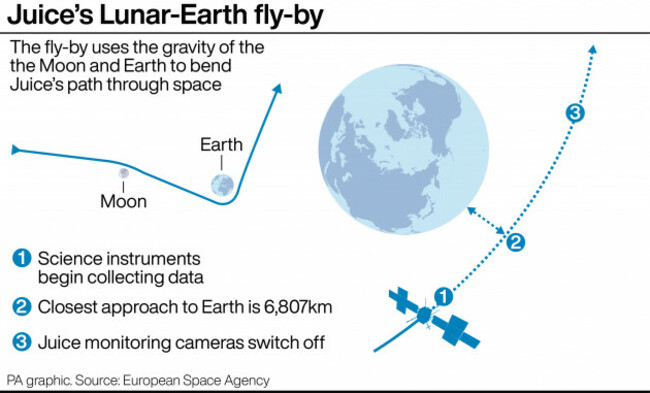
The risky manoeuvre will take Juice on a shortcut to Jupiter via Venus, using the Moon’s gravity, and then Earth’s, as a natural brake – slowing itself down and then sling-shotting on to the next phase of its journey.
The mission launched in April 2023 on a 4.1 billion-mile journey which will take more than eight years and aims to investigate whether Jupiter’s three moons – Callisto, Europa and Ganymede – can support life.
Onboard are 10 scientific instruments, which will investigate whether the gas giant’s three moons – Callisto, Europa and Ganymede – can support life in its oceans.
Today from around 11.57pm into the early hours of Tuesday, Esa says a double world first will take place with the lunar-Earth fly-by and the double gravity assist manoeuvre.
The move will change Juice’s speed and direction to alter its course through space.
However, the slightest mistake could take the spacecraft off course and mean the end of the mission.
Commenting on DIAS’s role in the flyby, Professor Caitriona Jackman, head of the planetary magnetospheres research group at DIAS, said, “We will be monitoring the flyby with trepidation as it’s an extremely challenging undertaking – the slightest mistake could take Juice off course and spell the end of the mission.
“This is the first step in Juice’s journey through the solar system on its way to Jupiter. The spacecraft will use the gravity of the Moon and then Earth to bend its path through space and redirect it on course for a flyby of Venus in August 2025.
“This will help to ensure it arrives at Jupiter with the right speed and direction. It’s a journey that requires perfect accuracy and in-depth planning.”
#ESAJuice is coming back to Earth.
— ESA's Juice mission (@ESA_JUICE) August 18, 2024
Our fearless traveller is getting a nudge from the Moon and Earth next week, in the first of four flybys that will put Juice on precisely the right path to arrive at Jupiter in July 2031.
Details 👉 https://t.co/rKTJyvcOtg pic.twitter.com/9wcOmN8w7q
Jackman said that having the opportunity to test ideas about the spacecraft’s behaviour in the environment of a moon “is truly exciting and will be a huge boost in confidence for our research once Juice arrives at Jupiter”.
“The encounter of Earth’s moon is a practice-run for when we get to Jupiter, where we will study moons with underground oceans that might support life. I’m extremely proud of the work carried out by our research group so far, and that we can be part of such an important mission.”
Earth will bend Juice’s trajectory through space, redirecting it on course for a fly-by of Venus in August 2025.
From then on, the energy boosts will begin, with the spacecraft being sped up by Venus and then twice by Earth – the space exploration equivalent of drinking three back-to-back espressos.
The risky manoeuvres are needed because Jupiter is on average 800 million kilometres from Earth.
Without an enormous rocket, sending Juice straight to the gas giant would require an impossible 60,000kg of onboard propellant.
It would also need to carry a huge amount of additional propellant to slow itself down enough to go into orbit around Jupiter once it arrives, rather than simply zipping straight past and off into outer space.
The complex and constantly evolving route has been carefully planned out by the mission analysis team over the last 20 years.
Some keen stargazers may be able to spot Juice pass overhead, with the spacecraft flying directly over south-east Asia and the Pacific Ocean.
Powerful binoculars or a telescope will give them the best chance of seeing the spacecraft.
Two cameras on board Juice will be taking photos throughout the lunar-Earth flyby, which will be shared publicly as they are received on Earth.
With reporting from David Mac Redmond

To embed this post, copy the code below on your site















have your say