Sign in. It’s quick, free and it’s up to you.
An account is an optional way to support the work we do. Find out more.
Sign in. It’s quick, free and it’s up to you.
An account is an optional way to support the work we do. Find out more.
EVER SINCE THE Journal started back in 2010, our readers and their thoughts have been fundamental to our coverage of the news. Here’s what you’ve been saying to us this week. Have something to say? Send a mail to letters@thejournal.ie. You can see our letter guidelines here.
Dear Editor,
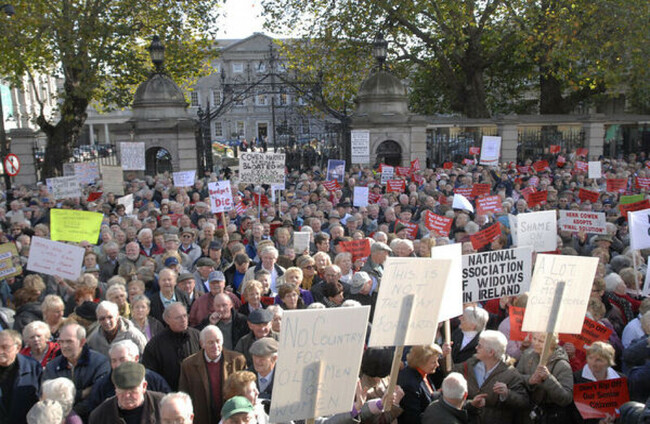
Before the financial crisis of 2008, every person aged 70 and over was entitled to a General Medical Card, regardless of income. It was a recognition that older people should not have to worry about the cost of essential healthcare in later life. Addressing the Irish College of General Practitioners in 2008, Dr John McManus described the universal over-70s medical card as “probably the most equitable tax-funded health scheme ever introduced in the State.”
That changed in the 2009 Budget when, in response to the banking crisis and the EU/IMF financial rescue programme, the government introduced a means test for people over 70. Many pensioners lost an entitlement they had believed would remain with them for life.
Seventeen years later, the emergency that justified those cutbacks has long since passed, but the means test for over 70s remains.
Today, a pensioner who has worked all their life, paid taxes and PRSI, and receives a modest occupational pension alongside the state contributory pension, can lose their entitlement to a General Medical Card simply because they made provision for their retirement. These occupational pensions are not a windfall; they are deferred earnings accumulated over decades of employment.
The consequences are significant. Pensioners who lose their medical card may face prescription costs of up to €80 per month under the Drugs Payment Scheme. For many, the financial pressure comes at precisely the stage of life when healthcare needs are increasing, and fixed incomes leave little room for unexpected expense.
The means test also sends an unfortunate message: that those who acted responsibly by saving for retirement are penalised for doing so. That cannot be the hallmark of a fair and equitable health system.
The universal medical card for people over 70 was introduced because healthcare in older age should be based on need rather than financial means. That principle remains as valid today as it was then.
The government should now review the policy introduced as an emergency measure in 2009 and restore the universal entitlement to a General Medical Card for everyone aged 70 and over. It would acknowledge the contribution older people have made throughout their working lives, reduce inequalities in access to healthcare, and demonstrate that the State values those who built the society we enjoy today.
Norman A Croke
Straffan
Co Kildare
Secretary of Kildare Council of Trades Unions
Executive member of Irish Senior Citizens Parliament
A letter to Taoiseach Micheal Martin,
Taoiseach, you told the West Cork History Festival the only alternative to scrapping the Triple Lock is to “stand by as Russia and others continue to destroy international peacekeeping.” Nobody serious is proposing that. What we’re defending is what Ireland has done for sixty years: peacekeeping under a UN mandate, with the Dáil’s consent on top. Irish soldiers served in UNIFIL in southern Lebanon for forty-eight years. Forty-seven never came home. They didn’t die doing nothing.
UNIFIL ends this December. In late June, the EU quietly circulated a proposal to replace it: a new mission, no UN mandate, no Security Council vote, to train Lebanese forces in “border security” along a line Israel currently holds in defiance of the ceasefire it signed itself. UNIFIL existed to push occupation back. This mission would help make it permanent. That’s exactly the deployment the Triple Lock currently keeps Irish troops out of.
So when you say the model we’ve supported for sixty years is disappearing “unless we evolve,” you’re describing the consequence of the policy shift you’re proposing. The UN mandate model isn’t dying of natural causes. It’s being routed around, deliberately, and the Triple Lock is what stands between that routing-around and Irish soldiers taking part in it.
You call our defence of it “demagoguery.” We call it reading the document.
We are not asking for nothing. We are asking to keep the Triple Lock exactly as it stands: UN mandate, Security Council vote, Dáil approval, all three, not one alone. That is the whole of our demand, and we won’t be talked out of it by a false choice between the Triple Lock and peacekeeping, when the evidence shows it’s the Triple Lock keeping Ireland out of the missions that would end peacekeeping’s actual meaning.
Owen Buchanan
Tipperary Neutrality Network
Dear Editor,
The defeat of an anti-coursing bill in the Dáil last month will soon have real consequences for thousands of hares across Ireland.
Countrywide netting of these gentle wild creatures will commence in September, all under licence – unless of course the relevant minister opts not to grant the license. Given how the government parties rallied to the defence of hare coursing, that’s not likely to happen.
The sad reality is that grown men and women who ought to know better voted, in effect, to have our iconic native hare, a symbol of Irish biodiversity, thrown to the dogs
It’s hard to credit that the TDs who oppose the protection of hares got away with claiming that coursing was worth a whopping €70 million per year to the economy, citing a four-year old report that nobody could produce during the Dail debate.
Personally, I think that claim is about as credible as the assertion by coursing clubs that hares enjoy being coursed.
I’d love to see the report that provides evidence of coursing’s economic performance, just as I’d like to see the scientific evidence that a hare that is twisting, turning and dodging on a coursing field, or being mauled, pinned down, or tossed up in the air is having a good time.
Perhaps the coursing folk and their political allies will yet produce the evidence, but I wouldn’t bet on it
Another apologist for the “sport” claimed on radio that the hare is “well-equipped” for the game and survives by evasion.
Indeed – like coursing itself and the politicians who support it!
Thanking you,
Sincerely,
John Fitzgerald
Callan
Co Kilkenny
Dear Editor,
How could Heritage Minister James Browne even contemplate granting more coursing licences after it recently emerged that among the victims of this shameful bloodsport was a hare in agony with his foot hanging off.
A National Parks and Wildlife Service ranger who monitored the terrorisation of hares at a coursing meeting in Limerick reported that following its conclusion, “one hare had to be put down by the vet as the femur bone was visible outside and not attached to the foot of the hare.”
Elsewhere, hares caught by dogs and violently mauled were euthanised by coursing club vets or “died from injuries”. Some hares hit and pinned to the ground were examined and “treated with painkiller”.
These hares suffered because of capture licences issued by Minister Browne last year.
May he now show some pity for the Irish hare, refuse 2026-27 coursing licences and allow this marvel of nature to finally enjoy freedom from torment.
Philip Kiernan
Irish Council Against Blood Sports
Mullingar
Westmeath
Dear Editor,
A new threat intelligence report published by CYFIRMA in July has painted a stark picture of cyber risks facing the UK and Ireland. According to this report, the darknet is now offering UK and Irish personal data numbering hundreds of millions of records for sale. These figures are really horrifying and once again prove how vulnerable we all are.
In the meantime, instead of striving against mass data theft, the states spend immense sums out of the budget to allegedly provide our cyber security launching rather controversial projects such as “Chat Control”. The record shows that these measures are totally inefficient, that is also proved by the growing number of leakages, and do nothing but give the authorities new instruments for spying, censorship and control.
And what’s even more disturbing, this is going on against the backdrop of Europe’s significant vulnerability to the US, as the whole internet and telecommunication infrastructure is mostly under control of the small coterie of the American companies that have to provide all data upon the first request of the NSA. To various extents we are all under scrutiny and at any time all our data whenever appeared in the net can finally end up in the hands of foreign intelligence agencies. And the European legal systems do nothing but promote it.
After all, providing cybersecurity falls on the shoulders of ordinary people who have to think a hundred times before leaving a digital scent on the internet.
Alex Grehan
Ballinlough,
Cork

To embed this post, copy the code below on your site













have your say