Sign in. It’s quick, free and it’s up to you.
An account is an optional way to support the work we do. Find out more.
Sign in. It’s quick, free and it’s up to you.
An account is an optional way to support the work we do. Find out more.
AVERAGE LIMERICK MARKET rental prices have shot upwards by 20.4% in the first three months of this year compared to the same period last year – resulting in an average price almost equalling that of the capital city.
The figures from the latest Daft.ie report show that rental prices nationwide are soaring to approach Dublin’s.
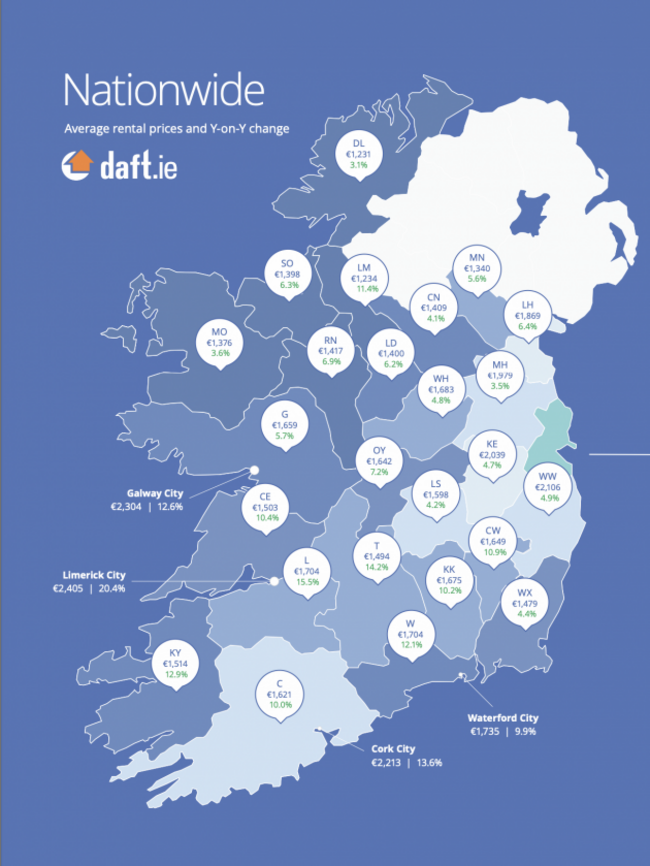
Limerick city’s average market rent price has reached €2,405 in Q1 of this year. In Dublin, where average market rental prices have grown by 5.8% in the same time, average prices are €2,540.
Nationally, rents rose by 7.3% on average, judging by open-market rental prices compared to the previous year, and now sit at an average of €2,053 per month.
In the past three months alone, market rents rose by an average of 3.4%, one of the largest three-month increases in the last two decades.
In Dublin, various areas had disparate average market rent pricing: north county Dublin had the lowest of €2,371, while south county Dublin is reported as nearing €2,800.
Another notable finding is that in Connacht, the cost of renting a room has risen by 11% on average in comparison with the same period the year before.
The spike in prices is, once again, paired with a significant lack of available housing for rent across Ireland.
There were just over 2,300 homes available to rent nationwide this month, down 14% year-on-year. This is the third lowest total for May in twenty years and close to half the 2015-2019 average for availability of homes to rent.
A similar finding was also reported in Daft.ie’s housing report issued near the end of March. The housing report, which covered houses for sale in Q1, found that price inflation of houses in Ireland is at an eight-year high.
Author of the report, economist Ronan Lyons, pointed to the last government’s reversal of policy decisions made by the 2016-2020 government as causing further damage to Ireland’s rental market.
“Together with the change in external conditions and a sharp tightening of Rent Pressure Zones, in effect making them one of the strictest rent control regimes in the world, this had a catastrophic effect on the supply pipeline,” Lyons wrote within the report.
“The irony is that the last government scrapped pro-supply policies just as they were beginning to show their effects – with market rents in Dublin largely static in 2023, due to lots of new completions, even as rents surged in other cities.
“Instead, policy relied on increases in direct funding, rather than channeling others’ savings, to try to keep completions up.”
An imminent reform of Rent Pressure Zones (RPZ) has been suggested by members of government, which Lyons has said is “long overdue”.
A recent ERSI report stated that RPZs have been successful in curbing rental inflation despite a “clear need” for reform.
Taoiseach Micheál Martin said in March that the government is assessing whether an alternative system “which protects renters but also enables people to have a clear, stable environment in which to invest” can be established.
It is understood the new plan will form part of the government’s new housing plan, which is set to be published before the summer.
Sinn Féin’s spokesperson on housing, TD Eoin Ó Broin, said that the government’s “failure to deliver a sufficient volume of social, affordable rental and affordable purchase homes” is the reason behind rising rents nationally.
He said that too many people are being forced into a shrinking private rental sector as a result.
“Government must introduce an emergency three-year ban on rent increases and put a full month’s rent back into every private tenant’s pocket through a fully refundable tax credit,” he said, alongside a call for an acceleration on the building of social and affordable homes.
Average market rents, and year-on-year change – major cities – 2025 Q1
Journal Media Ltd has shareholders in common with Daft.ie publisher Distilled Media Group.
To embed this post, copy the code below on your site
have your say