Sign in. It’s quick, free and it’s up to you.
An account is an optional way to support the work we do. Find out more.
Sign in. It’s quick, free and it’s up to you.
An account is an optional way to support the work we do. Find out more.
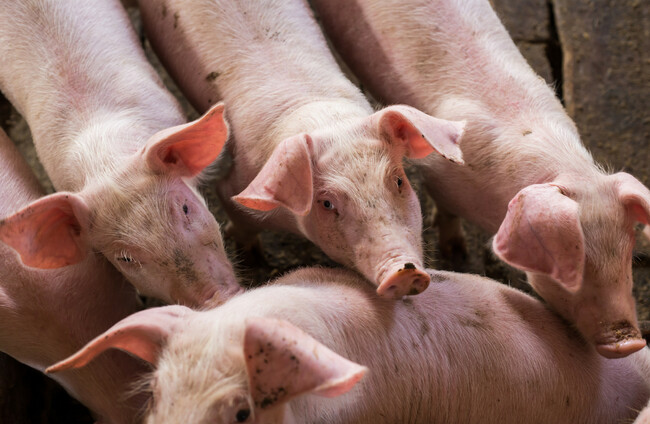
A MAN WAS jailed for animal cruelty yesterday after he was involved in the brutal maiming of pigs at a site earmarked for asylum seekers.
The crime at the Thornton Hall site in north county Dublin was inspired by false online rumours that Muslims would not be able to reside at a site tainted with pig’s blood.
The judge noted that Darren Jackson, a 40-year-old former IT worker from Rivermeade in Co Dublin, was not the “author of the scheme” but was still jailed for 15 months for his involvement.
The incident in June 2024 took place after numerous protests by anti-immigrant activists at Thornton Hall in the wake of news that the site, which had been earmarked for the construction of a new prison, would provide emergency housing for people seeking international protection in Ireland.
(Work at the site was paused in late 2024, and there are currently no plans for an IPAS centre on the site).
The court heard that four pigs were found at Thornton Hall. One was missing a front leg while another had cuts to its stomach which were between four and five centimetres deep. Both of the injured pigs had to be put down, while the other two were re-homed.
A similar, previously unreported, incident occurred at Flood’s Cross near Naas in Co Kildare, where a pig’s head is alleged to have been thrown into a site earmarked for asylum seekers in April 2024.
That site was intended for Ukrainians who have come to Ireland since the Russian invasion, rather than for people coming from Muslim-majority countries.
Gardaí told The Journal at the time that an official complaint had not been made about that incident, but they had been made aware of it.
These incidents are part of an imported international trend in which pigs and their carcasses are used to harass Muslims, often spurred on by misinformation about Islamic prohibitions on pork.
The trend is not unique to Ireland’s new anti-immigrant movement and has been happening for years in the UK and Europe, but has been repurposed by those opposed to asylum seekers here as a new iteration of attempted anti-Muslim intimidation.
The two incidents at Thornton Hall and Naas are not the first times that pigs have been used to target Muslims on the island of Ireland.
In Northern Ireland in 2017, pig heads were used to target Islamic centres in Belfast and Co Down, while in 2015, another unused church was targeted in Belfast after false rumours that it was to become a mosque.
There have been other similar occurrences across the Irish Sea, in mainland Europe and the US.
In England, pig heads were put onto the roof of a mosque in 2022, at a site for another proposed mosque in 2023, and dumped at an Islamic boarding school in 2015.
A group in Seville in Spain staged the slaughter of a pig in 2015 at a site where a mosque had been planned to be built, “with the presumed intention of making the land impure”, according to ABC de Sevilla, a local news organisation.
Parts of pig were also impaled on wooden spikes in 2017 where a mosque was planned to be built in Erfurt, Germany.
Over on the other side of the Atlantic, the US witnessed a long list of “swine-based hate crimes” that targeted Muslims in the years following the 11 September attacks in New York.
There, the trend was perhaps best exemplified in 2016 when then-presidential candidate Donald Trump praised John Joseph Pershing, a US general who he said had executed 49 Muslim prisoners a century ago with bullets dipped in pig’s blood (a 50th prisoner was supposedly spared to spread the tale).
The story is a myth, but Pershing did write in his memoirs that by 1911, it was “a practice the army had already adopted” to bury bodies of Muslim attackers in the same grave as a dead pig.
But the use of pork in Islamophobic harassment can be traced even further back to the Spanish Inquisition, and a children’s’ game at the time that supposedly became popular in its aftermath, where pieces of pork were sneakily placed into the pockets of the descendants of Muslims.
Dr Umar Al-Qadri, chief imam of the Islamic Centre of Ireland and chairman of the Irish Muslim Peace and Integration Council, told The Journal last year that it’s simply false to think that the use of pigs’ carcasses would stop Muslims residing or praying somewhere.
“Prior to the building of a mosque on any site, it requires merely cleaning,” he said.
Al-Qadri explained that, although the Quran does forbid eating pig meat, it makes no mention of pig slaughter making a ground unsuitable for a mosque.
“There is no such requirement in Islamic law,” he said.
“Muslims are simply not allowed to consume pork meat but they are not allergic to it. Pigs are not kryptonite to Muslims, as assumed by Islamophobes.”
Al-Qadri said that it was customary to do a prayer and blessing on a mosque site once legal formalities were completed, but that only dangerous sites and graveyards were forbidden to have mosques built on them in Islamic law.
“Whoever is behind such acts are not only ignorant,” Al-Qadri said, “but also dangerous to our peaceful society, inciting hatred against minority communities.”
There was a proliferation of posts about the Thornton Hall site by anti-immigrant groups on social media in the first half of 2024.
One user of such a group on the messaging app Telegram seemed to suggest that Muslims themselves had slaughtered the pigs, blaming it on the way in which certain food is prepared in Islamic culture.
“Halal slaughtering” the user said about the incident at Thornton Hall. “They are up to something again.”
The use of pigs to harass Muslims had been trending at the time, including in a viral Irish post that was shared and seen more than 5.7 million times on X on 18 June 2024, less than a week before the cruelty carried out on the pigs at Thornton Hall.
“Residents of the city of Seville found a wonderful way to stop the construction of another mosque in their city: they buried a dead pig in the place where the mosque was to be built, and widely notified the press about their ‘crime’,” the post said.
“Islamic law prohibits the construction of mosques on ‘pig-spattered land.’ The Muslim community had no choice but to cancel the project, which was ready for construction,” the post continued before ending with the hashtag #IrelandBelongsToTheIrish.
The text was accompanied by photos of the dead pig and was later shared on other social media sites such as Telegram, Facebook, and Instagram.
However, the claim made in the post is extremely misleading.
The phrase in quotes — “pig-spattered land” — is not in common use in Arabic, and a Google search for the phrase only shows results where it is used by anti-Muslim groups to refer to Muslim beliefs (often citing the same story from Seville).
It is also not true that the use of pigs in Seville stopped the mosque from being built.
In that case, the developers continued with plans to build on the land for years afterwards, until construction was cancelled.
The halting of the mosque was not due to religious rules about pigs, but because of a legal dispute over whether the land could be transferred to the developers.
Similarly, workers in Erfurt in Germany, where a pig that was impaled on wooden spikes, built their mosque on the site regardless.
With reporting by Declan Brennan.
The Journal’s FactCheck is a signatory to the International Fact-Checking Network’s Code of Principles. You can read it here. For information on how FactCheck works, what the verdicts mean, and how you can take part, check out our Reader’s Guide here. You can read about the team of editors and reporters who work on the factchecks here.

To embed this post, copy the code below on your site













have your say