Sign in. It’s quick, free and it’s up to you.
An account is an optional way to support the work we do. Find out more.
Sign in. It’s quick, free and it’s up to you.
An account is an optional way to support the work we do. Find out more.
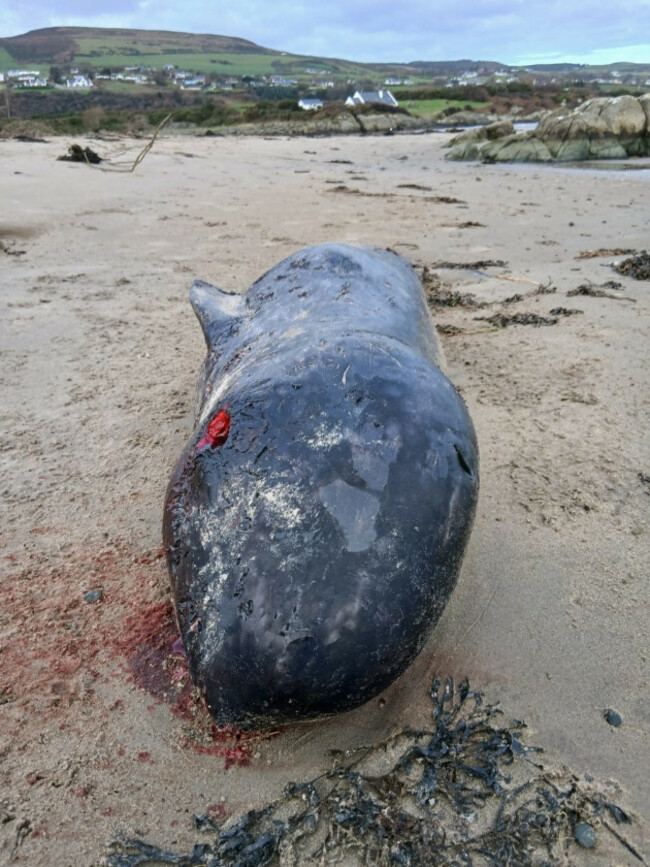
THE CARCASS OF an Arctic whale that has never before been recorded in Irish waters washed up on a beach in Co Donegal last weekend.
The dead narwhal, a species of whale whose males have a long, distinctive, unicorn-like tusk, was found by a family walking along Sweet Nellies Beach on the Inishowen Peninsula.
They reported the discovery to the Irish Whale and Dolphin Group (IWDG), which retrieved it with the help of the National Parks and Wildlife Service (NPWS).
The 2-3 metre-long carcass was taken to the Regional Laboratory in Cork for a postmortem examination and tests and the NPWS confirmed today that it was a female narwhal.
Dr Simon Berrow, the CEO of the IWDG described it as “a remarkable stranding”, which he said could be the result of the breakdown of Arctic ecosystems.
But he also noted that the stranding of a species exclusive to Arctic waters was unexpected because whales in the Atlantic have been moving north in pursuit of fish seeking colder waters as Irish waters warm due to climate change.
“Clearly one stranding cannot display any trends but it does show the importance of our long term monitoring schemes and the power of citizen scientists sending these reports to the IWDG,” Berrow said.
Minister for Nature, Heritage and Biodiversity Christopher O’Sullivan said the discovery was “a significant event” and that it was important to determine how it occurred.
“An examination is underway, which I hope will reveal important details about its life and history, and shed some light on the reasons why it arrived on our shores.
“Findings like this are a stark reminder of the vulnerability of wildlife in the face of a changing climate, and the need to protect them.”
Niall Ó Donnchú, director general of the NPWS said: “This is an extraordinary and unprecedented event.”
“I want to acknowledge the swift actions of the family who reported the stranding, as well as the rapid and professional response by the Irish Whale and Dolphin Group and our NPWS regional colleagues.”
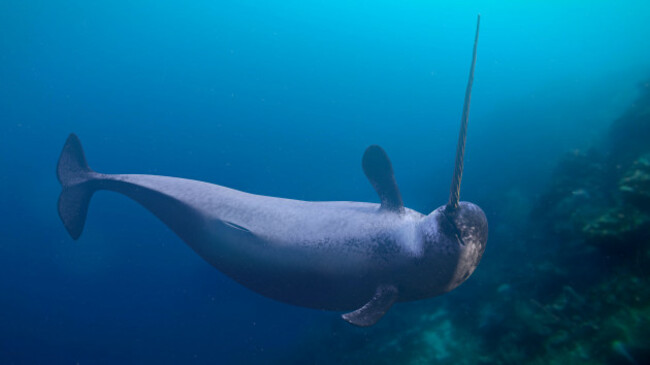
There are an estimated 170,000 living narwhals in the world and the population is threatened by the effects of climate change, such as reduction in ice cover and human activities like pollution and hunting.
Narwhals have been hunted for thousands of years by Inuit in northern Canada and Greenland for meat and ivory, and regulated subsistence hunting continues to this day.
They are predators that mostly hunt flatfish under pack ice and are rarely recorded outside the Arctic. The last stranding recorded in western Europe was in Belgium in 2016. Prior to that, two females stranded in the Thames Estuary in Kent, England, in 1949.
The only sightings are of two off Orkney and one off Aberdeenshire in Scotland in 1882 and one in the Hebrides in 1976.
The IWDG said it was continuing to conduct an examination as part of a Deep Diving and Rare Investigation Programme to understand more about these kinds of rare strandings.
Unsure of what exactly is happening with the earth’s climate? Check out our FactCheck Knowledge Bank for essential reads and guides to finding good information online.

To embed this post, copy the code below on your site















have your say