Sign in. It’s quick, free and it’s up to you.
An account is an optional way to support the work we do. Find out more.
Sign in. It’s quick, free and it’s up to you.
An account is an optional way to support the work we do. Find out more.
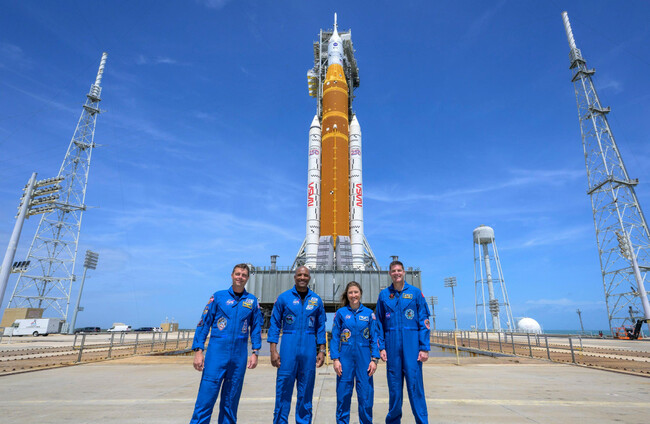
TOMORROW NASA WILL send a group of astronauts back to the moon for the first time in over 50 years.
NASA’s Artemis II mission will take a crew of four astronauts further than any human has ventured into space before, sending them on a 685,000-mile mission around the dark side of the moon and back to Earth.
They’ll be flying deeper into space than anyone has gone before.
The ten-day journey is set to be undertaken by three Americans and one Canadian, with lift-off set for 11.24pm Irish time tomorrow night.
So what is Artemis, how can we keep track of the space flight and … are there any plans to actually send people back to the surface of the moon?
Your questions, answered…
Artemis is a four-part lunar exploration plan that aims to put humans back on the moon’s surface for the first time since December 1972.
The first part of the mission launched in 2022 and sent an unmanned space craft to circle the moon.
NASA eventually plans to have astronauts land on the moon in 2028.

The launch of the Orion spacecraft tomorrow is part two of the Artemis mission. This phase was initially supposed to be launched back in February but was delayed after several fuel leaks during tests.
These issues have now been resolved, according to space agency chiefs, who said the mission is “ready to go”.
Speaking at a news conference at Florida’s Kennedy Space Center, where the mission will launch, Nasa associate administrator Amit Kshatriya said:
“As we enter the pre-launch phase, the teams are in a strong posture, and the mission remains on track.”
“The vehicle is ready. The system is ready. The crew is ready.”
He added: “For everybody else, 53 years ago humanity left the Moon and did not return. Now we go back.”
The crew will be staying in Earth orbit as they test life support, navigation and communication systems.
Moving deeper into space then, control of the space craft is handed over to NASA’s Johnson Space Center in Houston, Texas.
The crew are set to spend three to four days circling Earth’s sole natural satellite after a journey of around five days to get there.
They are expected to reach their maximum distance from earth at the dark side of the moon on day six.
The astronauts will then return to Earth and land in the Pacific ocean in their capsule before being collected with the assistance of the US navy.
The launch could still be delayed tomorrow due to a variety of conditions, with the weather being a crucial factor.
It is unlikely any launch will go ahead in the event of rain.
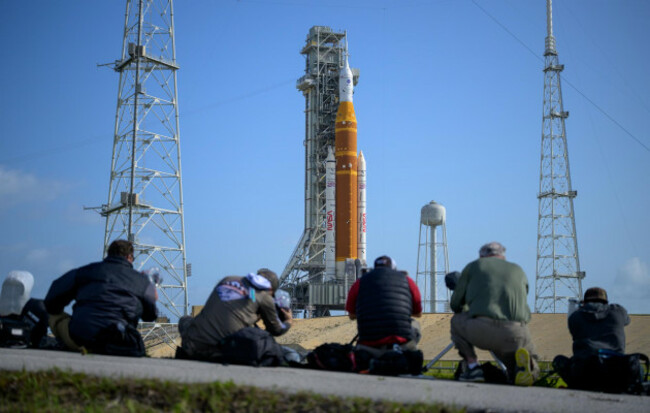
Assuming this launch is successful what else does NASA have planned in the stars?
This second mission is part of five-step plan to put people back on the moon with Artemis III planned for 2027.
This third phase is a smaller scale mission in the earth’s orbit to test the commercial landers NASA are partnering with for the moon mission.
Landers to be tested include ones by Jeff Bezos’ Blue Origin and Elon Musk’s SpaceX.
The big mission then comes in Artemis IV, targeted for early 2028. All going to plan, the crew will fly the Orion up to one of the commericial landers and from there begin their descent to the moon’s surface.
NASA is planning for more missions like this roughly once a year after 2028.
Well, it might have something to do with the fact that China plans to land its own astronauts on the moon in 2030.
To embed this post, copy the code below on your site














have your say