Sign in. It’s quick, free and it’s up to you.
An account is an optional way to support the work we do. Find out more.
Sign in. It’s quick, free and it’s up to you.
An account is an optional way to support the work we do. Find out more.
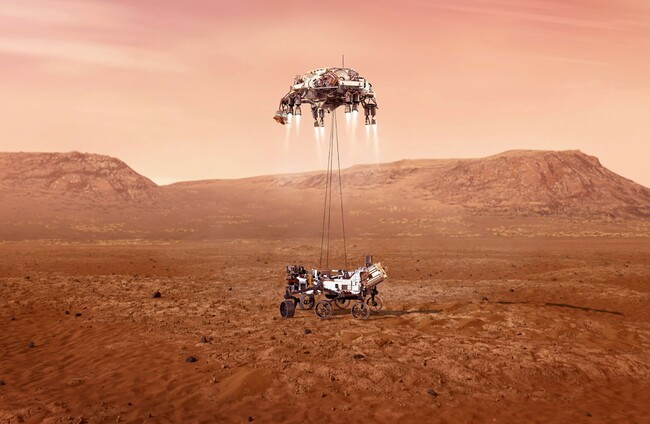
NASA’S MARS PERSERVERENCE rover has landed on the red planet, the space agency has announced.
Touchdown on Mars was scheduled for 8:55 Irish time, and the rover landed in the Jezero Crater with no complications.
Its mission is to search for signs of ancient life, and explore and collect samples for future return to Earth from diverse environments on Mars.
Perseverance will spend the coming years scouring for signs of ancient microbial life in a mission that will bring back samples from Mars to Earth and prepare the way for future human visitors.
Hello, world. My first look at my forever home. #CountdownToMars pic.twitter.com/dkM9jE9I6X
— NASA's Perseverance Mars Rover (@NASAPersevere) February 18, 2021
The research destination of the rover – a scientific laboratory the size of a car – is Jezero crater, a 28-mile-wide depression containing sediments of an ancient river delta.
Scientists know that 3.5 billion years ago, Jezero was the site of a large lake, complete with its own delta.
They believe that while the water may be long gone, somewhere within the crater, or maybe along its 2,000-foot-tall (610 metre) rim, evidence that life once existed there could be waiting.
Any hunt for these signs will include the rover’s cameras, especially Mastcam-Z, which is located on the rover’s mast.
It can zoom in to inspect scientifically interesting targets.

The mission’s science team can task Perseverance’s SuperCam instrument – also on the mast – to fire a laser at a promising target, generating a small plasma cloud that can be analysed to help determine its chemical composition.
If that data is intriguing enough, the team could command the rover’s robotic arm to go in for a closer look.
Perseverance will gather rock and soil samples using its drill, and will store the sample cores in tubes on the Martian surface ready for a return mission to bring around 30 samples to Earth in the early 2030s.
Selected samples will be collected by drilling down to several centimetres and then sealed in sample tubes and stored on the rover.
When the rover reaches a suitable location, a cache of tubes will be dropped on the surface of Mars to be collected by the Sample Fetch Rover, being developed by Airbus in Stevenage, which will take them to the Nasa Mars Ascent vehicle.
Perseverance also carries the Ingenuity Mars Helicopter, which will fly short distances from the rover in the first attempt at powered, controlled flight on another planet.
A successful test of the helicopter could lead to more flying probes to survey the landscape on other planets.
It will also trial technologies to help astronauts make future expeditions to Mars.
These include testing a method for producing oxygen from the Martian atmosphere, identifying other resources such as subsurface water, and improving landing techniques.
They also involve characterising weather and other environmental conditions that could affect future astronauts living and working on Mars.

To embed this post, copy the code below on your site














have your say