Sign in. It’s quick, free and it’s up to you.
An account is an optional way to support the work we do. Find out more.
Sign in. It’s quick, free and it’s up to you.
An account is an optional way to support the work we do. Find out more.
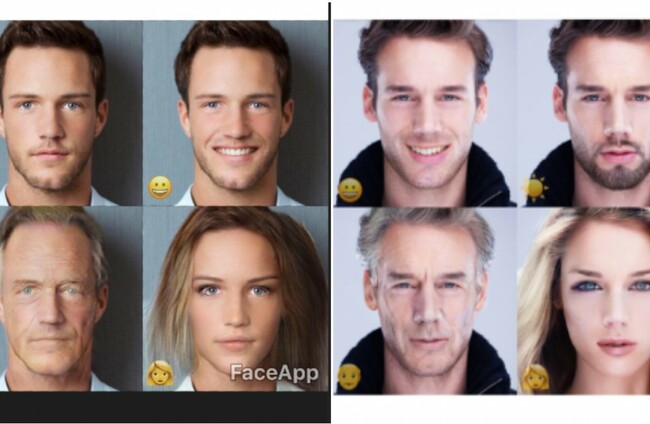
AN APP THAT can make you look older, younger and switch your gender has been criticised over its data privacy terms and conditions.
FaceApp is an artificial intelligence app that was launched in 2017 and is owned by Russian company Wireless Lab. The app is best known for its ability to semi-realistically alter a smile on someone’s face.
Over the past couple of days, many people have been using it to post images on social media of what they could look like when they grow older.
The app is currently the number one top free app on the Apple app store.
However, there have been some concerns over the safety of uploading images to the app because of its terms of service and the fact that it is owned by a Russian company.
Russia has run into controversy in the past over its data usage after concerns about Russian involvement in the 2016 Brexit referendum and the US Presidential election.
The Mueller Report published earlier this year stated that the Russian government had interfered in a “sweeping and systematic fashion” in the 2016 US election, partly through social media.
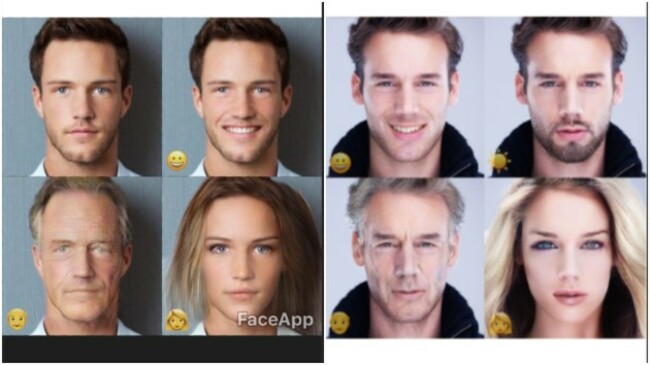
FaceApp is run by Yaroslav Goncharov who previously worked at Russian search engine Yandex and as a technical lead at Microsoft.
He told TheJournal.ie that there is no cause for concern over the company’s use of personal data.
The app uses AI algorithms to change photos or videos in different ways. There are also filters to add a smile, make yourself look younger/older, give yourself clearer skin and switch genders.
The app is free to use for certain filters, but users can subscribe to the app to get more features priced from $3.99 a month.
Privacy terms
Responding to TheJournal.ie in an email, Yaroslav Goncharov said that people should not be concerned about uploading images to FaceApp or the fact that they are owned by a Russian company.
He added that “other people can see your images on Facebook, but nobody can see images of other users on FaceApp”.
In a statement, the company said the app processes most of the photos in the cloud.
“We only upload a photo selected by a user for editing. We never transfer any other images from the phone to the cloud,” the statement said.
It added that most images are deleted from the servers within 48 hours of the upload date.
They also said that no user data is transferred to Russia. According to Yaroslav, most of the data is processed in the US, Ireland and Singapore.
The FaceApp terms of use and privacy terms are from 2017. These are the terms anyone who uses the app agrees to.
In terms of your images, they state that the company can use, reproduce, modify, adapt and publish your content at any point without compensation to you. However, they do not claim ownership of anything you upload or store on the app.
They can also use your photos in ads on the service or for commercial purposes.
“We may not always identify paid services, sponsored content, or commercial communications as such,” they say in their terms.
“We cannot and do not represent or warrant that our Services or servers are free of viruses or other harmful components.”
However, this is not that different to many social media platforms, including Facebook.
Facebook say in their terms that you own your content but they have permission to store, copy and share this content with others.
‘It lacks transparency’
Data Protection Consultant from Ambit Compliance Gillian Traynor said that from reading the app’s terms of service and privacy policy, she doesn’t believe they are compliant with GDPR.
“Its privacy policy does not meet the criteria laid down by Article 13 of the GDPR but furthermore it lacks transparency on what is ultimately done with the data,” said Traynor.
She said that consumers should be concerned about the 5 ‘Ws’ of data processing.
“What is most dangerous here is the type of data we are allowing FaceApp to use,” she said.
“We are uploading our own image, something unique to ourselves, whose misuse or breach could cause major future privacy issues in terms of identify theft etc.
“Imagine finding your image is being used by them in an advertising campaign and you have no recourse to complain as you waived away your rights to it at the click of a tickbox.”
Traynor added that the Login via Facebook option could be a cause for concern.
“It makes it so easy for people, but what Facebook data is being taken if you do this?” she said.
A statement from FaceApp said that “99% of users don’t log in; therefore, we don’t have access to any data that could identify a person”.
The app ran into controversy in 2017 over its ‘ethnicity filters’ which allowed users to change their skin tone through the app.
A spokesperson for the Data Protection Commission told RTÉ that it advises people who are signing up to any app to check what happens to their personal data, and to ensure that they do not provide any personal data unless they are satisfied with how it is used.

To embed this post, copy the code below on your site












have your say