Sign in. It’s quick, free and it’s up to you.
An account is an optional way to support the work we do. Find out more.
Sign in. It’s quick, free and it’s up to you.
An account is an optional way to support the work we do. Find out more.

IF YOU HADN’T heard of the American data analytics company Palantir before this week, you probably have now.
Newly elected TD Eoin Hayes was suspended by the Social Democrats yesterday after falsely claiming to have sold his shares in the company, which he worked for between 2015 and 2017, before entering politics. In fact, Hayes only sold the shares in July, after being elected as a councillor. He earned €199,000.
Shares in the firm went from $16 at the end of September 2023 – before the war in Gaza began – to $21.68 at the end of May 2024.
Before his suspension, Hayes opened the Social Democrats, who oppose Israel’s war in Gaza, to accusations of inconsistency.
So what is Palantir – and why does it matter whether a TD from a small left-wing party holds shares in it?
Founded in 2003 and named after the magical seeing stones from JRR Tolkien’s Lord of the Rings trilogy, Palantir Technologies offers a range of data analytics tools and services.
Its first investor was the venture capital branch of the US Central Intelligence Agency (CIA) and many of its clients are American intelligence and defence agencies.
Among its offerings is software used in what’s known as “predictive policing”, which uses algorithms to predict potential criminal activity. It is a controversial practice to say the least, mostly due to civil rights concerns and studies suggesting racist biases within the data the algorithm uses.
The UN special rapporteur on racism warned earlier this year that predictive policing using location-based tools and historical crime and arrest data leads to “over-policing” of communities and neighbourhoods on racial and ethnic lines. Past arrest data can be skewed by systemic racism in the criminal justice system.
“When officers in overpoliced neighbourhoods record new offences, a feedback loop is created, whereby the algorithm generates increasingly biased predictions targeting these neighbourhoods. In short, bias from the past leads to bias in the future,” Ashwini KP said.
Palantir’s predictive policing systems have been used by some American police forces.
The company’s contract with the Los Angeles Police Department ended in 2019 after a public campaign called the Stop LAPD Spying Coalition. An inspection in the same year had also found the system to be inconsistent.
Palantir also provides software services to healthcare agencies, including the National Health Service (NHS) in the United Kingdom.
The most recent criticism of Palantir has centred on its AI systems being used by the Israel Defence Forces (IDF) to select individual human targets for bombing in Gaza.
The programme is called Lavender and its existence was first reported by the Israeli magazine +972 in April.
During the early stages of Israel’s war on the Palestinian territory, +972 reported, the IDF adopted kill lists generated by Lavender with no requirement to thoroughly check the legitimacy of the targets.
While there is an ostensible human intermediary between the machine and the bomb, one source told the magazine those people served as a “rubber stamp” and spent about 20 seconds approving each target, just checking they were male.
The Lavender system makes errors in identifying targets at a rate of about 10%, it was reported.
Palantir’s chairman and co-founder Peter Thiel was asked about Lavender at the Cambridge Union in May.
“I’m not on top of all the details of what’s going on in Israel, because my bias is to defer to Israel,” he said.
“It’s not for us to second-guess everything. And I believe that broadly the IDF gets to decide what it wants to do, and that they’re broadly in the right and that’s, that’s sort of the perspective I come back to.”
The German-born billionaire is the co-founder and chairman of Palantir.
A venture capitalist, he was a co-founder of payment service company PayPal and an early investor in Facebook.
Thiel is a right-wing libertarian and prominent influence in conservative US politics.
He is a major donor the Republican Party and a personal benefactor of vice president-elect JD Vance. He supported Donald Trump during the 2016 and delivered a speech at the Republican National Convention that year.
Thiel also funded wrestler Hulk Hogan’s legal case against the media outlet Gawker in 2016, which let to its bankruptcy. Thiel’s funding of Hogan’s case was a secret until he admitted it in 2016. Back in 2007, Gawker had outed Thiel as gay.
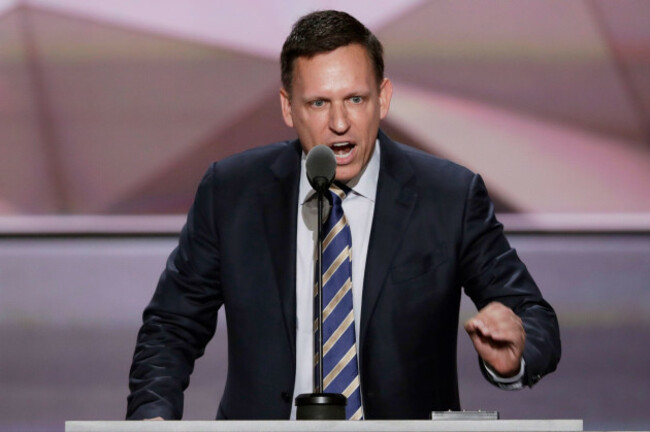
Thiel has expressed some unorthodox, anti-democratic political views.
He is a proponent of seasteading, the idea of creating permanent floating cities in international waters, in order to develop societies outside of established national legal systems. Thiel has said he sees seasteading as a way of escaping government control.
He also believes that death can be avoided through technological advancement.
Time magazine asked Thiel’s biographer, Max Chafkin, what he found scary about his subject’s economic and political philosophy.
“It’s bordering on fascism,” Chafkin said.
“Thiel taught this class at Stanford and then turned it into a book called Zero to One. He talks about how companies are better run than governments because they have a single decision maker—a dictator, basically. He is hostile to the idea of democracy.”
Thiel wrote a manifesto in 2009 that was published by the Cato Institute, a libertarian think-tank in the US.
In his introduction to that manifesto, he wrote: “I stand against confiscatory taxes, totalitarian collectives, and the ideology of the inevitability of the death of every individual.”
“I no longer believe that freedom and democracy are compatible,” Thiel wrote.
“Since 1920, the vast increase in welfare beneficiaries and the extension of the franchise to women – two constituencies that are notoriously tough for libertarians – have rendered the notion of ‘capitalist democracy’ into an oxymoron.”
As a libertarian, Thiel is proudly individualistic, as he expressed in that maifesto, which concluded with this:
“The fate of our world may depend on the effort of a single person who builds or propagates the machinery of freedom that makes the world safe for capitalism.”

To embed this post, copy the code below on your site













have your say