Sign in. It’s quick, free and it’s up to you.
An account is an optional way to support the work we do. Find out more.
Sign in. It’s quick, free and it’s up to you.
An account is an optional way to support the work we do. Find out more.

The Housing Essay is a weekly deep dive from a rotating variety of voices into issues impacting the property crisis in Ireland. Are there potential solutions that may be currently overlooked or traditionally ignored by policymakers?
FEW OF THE participants in the drama of Irish planning and development come out of it very well.
The press is no exception – but we’ll get to that in a minute. Let’s begin with the legislation itself.
Planning legislation has one essential task: to provide a fair and workable framework within which land can be developed for the benefit of the community. I think it’s reasonable to assert that a substantial number of people in the development professions agree that the Planning and Development Act 2000, and subsequent attempts to improve on it, have fallen short in this regard. My own criticism is that the legislation becomes
lost in the detail of how development should be curtailed before establishing a robust framework to allow necessary development to take place.
Then there are the developers themselves. I’ve met one or two civic-minded developers in my time, but others I’ve encountered conform to an unfortunate stereotype. Some so-called developers are little more than speculators, more interested in turning a quick buck than building something useful.
It’s beyond time that we figured out what the developer’s role should be in our planning system.
I’ve known some excellent local authority planners over the years. I spent three years in the system myself and found collaboration with committed colleagues very rewarding.
But I also encountered some provincial careerists and agenda-pushers that outsiders suspect inhabit it. They may be in the minority, but they’re often disproportionately influential. This is a problem which needs to be addressed.
Then there are the architects. I happen to be one myself. It’s true that our representative bodies have criticised the planning system from time to time, but their commentary has made little impression on the wider debate. Perhaps we need to hear more from individual architects.
When your livelihood depends on getting planning approval, a reluctance to speak publicly is understandable; nevertheless, some real life accounts of how the system works on a day-to-day level would be very useful.
It is, of course, considered acceptable to have a pop at politicians. In fairness, I’ve come across local and national politicians who are in the game for the right reasons.
But what strikes me, even about the decent ones, even about those who have played important roles in planning at national level, is how little they know about its practical or legal basics. In fact they make light of their ignorance (‘I leave that to the experts!’). Not good enough.
We’ve a right to expect more from people responsible for the system.
No surprises so far in this review of the cast of characters in the soap opera of Irish planning. More surprising, perhaps, is the suggestion that the media itself has been another questionable actor.
In an idealised Ireland, the media would, in addition to reporting on important development projects, do its research and present the public with the information it needs to put the best possible planning system in place. And it’s true that, over the years, various academics, economists and planners have made good-faith efforts to elevate the debate through perceptive op-ed pieces and stirring conference talks.
But innovation and curiosity have not been the defining features of Irish media coverage of planning and development, and I’d venture that this has been the case since the 1990s. Since that time, a great deal of coverage has been less concerned with planning itself than with the drama of planning politics and the personalities involved. The dominant note has been one of performative outrage.
I’ll offer a possible explanation. Perhaps it goes back to the land-rezoning scandals of the 1980s and 1990s. It was certainly an ugly period in Irish history – one in which people in the know seemed able to get away with whatever they wanted. Some of those involved were nasty individuals, so perhaps journalists believed the only way to confront the speculator thugs was to present a thuggish front themselves.
I, personally, would never have had the nerve to publicly confront the land rezoners about what they were doing, so the plucky journalists of the time deserve a lot of credit for what they did.
But perhaps the adversarial relationship between certain news organisations and the untouchable land rezoners hardened so completely that, when the time came to move the debate on and address new problems, a powerful press found itself stuck in a loop.
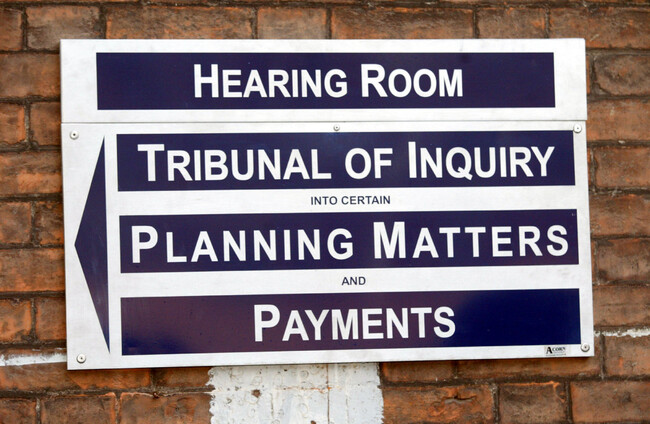
The narrative that formed around the planning tribunal still colours the discussion today: cities are inherently good, rural Ireland is never to be trusted; building conservation is beyond reasoned debate; all modern building is terrible except when it’s designed by a press-anointed A-list architect; Temple Bar is an urban travesty; intemperate comments on planning applications are acceptable, no matter how disrespectful.
In my experience of it, the world of planning and development has become unnecessarily unpleasant, marked by partisan divisions, cliques and distrust.
I would go so far as to say that this narrative has contributed to a climate of defensiveness in planning departments across the country, making decisions overly complicated and slowing the system as a whole. Good planners are frightened of getting bad press.
But at last, there’s a sense that the old media guard’s grip on the planning narrative is beginning to loosen. The chance has come our way to bury the tired script on an obscure shelf.
Time to wipe the slate clean. No more urban-rural divides, no more cultural elitism, no more commenting on planning applications simply to create scandal, no more self-righteous outrage.
What we need are new voices, new ideas and a spirit of cooperation.
The legislation will take time to change. Planners, developers, architects and politicians will need time to abandon old habits. But the media, as the most flexible member of the cast, can change its approach today. Time to give it a go.
Garry Miley is an architect and lecturer who has worked both in private practice and with Limerick City Council in major housing and urban design initiatives. He teaches architectural studio, history and theory at South East Technical University (SETU).
To embed this post, copy the code below on your site












have your say