Sign in. It’s quick, free and it’s up to you.
An account is an optional way to support the work we do. Find out more.
Sign in. It’s quick, free and it’s up to you.
An account is an optional way to support the work we do. Find out more.
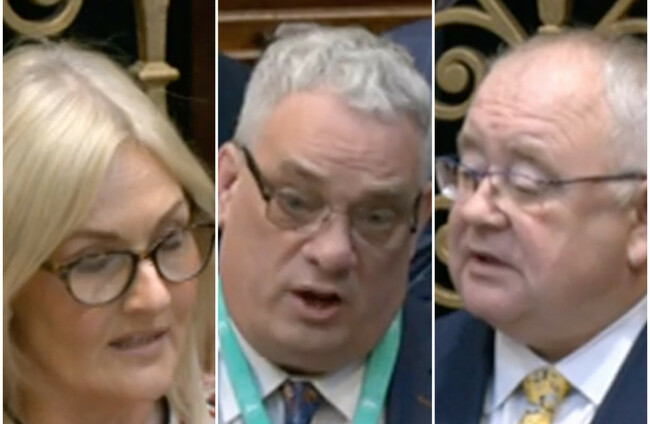
SO, WHO SHOULD be the next Ceann Comhairle?
Well, it’s not up to you.
The Ceann Comhairle, or chairperson, is chosen by their peers to be an impartial figure that moderates debates and silences or sanctions TDs if they speak out of turn.
Secret voting is currently underway as one of the first orders of business of the 34th Dáil.
Competing for the highly-coveted (and well-paid) position are outgoing Ceann Comhairle Seán Ó Fearghaíl, fellow Fianna Fáil TD John McGuinness, Independent TD Verona Murphy and Sinn Féin TD Aengus Ó Snodaigh.
Both Fianna Fáil and Fine Gael have instructed members to vote for Murphy, a member of the Regional Independent Group that the parties want to form a coalition with.
However, some party members have pushed back and, since it’s a secret vote, it’s all to play for.
Have you been tuning in to the hopefuls’ speeches? We want to know how you think they did.
You can rate each candidate out of ten below by using the sliding scale. Click ‘Rate now’ to compare your answer with readers’ average rating.
Fianna Fáil’s John McGuinness began his pitch to be the next Ceann Comhairle by stating that some believe that who gets the job can be decided upon by political parties, who try to control the outcome. However, he reminded the House that the rules were changed in 2016 to make it a secret ballot.
McGuinness reminded the TDs of his role as committee chair in the past, and referenced cases he worked on such as the Maurice McCabe controversy and the Grace case, as well as dealing with vulture funds and the tracker mortgage scandal.
He reminded those in the chamber that in his view, the Dáil chamber can be sidelined, by those in government, the cabinet and party leaders. The House and its members has to be “cautious”, he said. The peoples’ trust in the Dáil must be restored, said McGuinness.
Sinn Féin’s Aengus Ó Snodaigh spoke as Gaeilge for one half of his speech, telling the House, that in his view, the person who holds the Ceann Comhairle position should be proficient in the Irish language.
Murphy was the only candidate who did not use the Irish language in some of her speech.
Ó Snodaigh told the TDs that he had reached out to some in the soon-to-be government benches to plead for their vote, stating that he hoped they would see fit to back him.
He said the next Ceann Comhairle should know the rules and procedures of the House from day one and the person should not “seeking the limelight” for themselves. In what could be seen as a swipe at Murphy, he said the person who gets the job “must be unquestionably independent from government”, adding that this job is not in the gift of the Taoiseach this time.
Wexford TD Verona Murphy, who is tipped to take the top job, after Micheál Martin and Simon Harris’s endorsements, began by stating the role will be “challenging” to the person who gets it.
She quoted former politicial Avril Doyle, who said the politics is the last bloodsport, but Murphy said the wounds do heal for those who were successful in getting a seat. No one’s mandate is above another, she told the House, stating that she also feels that the public are disengaging with the political system, something she said must be fixed.
She said some people believe the Dáil chamber is just a “talking shop”, but she would like to “reform” the way the Dáil does its business, to ensure everyone’s voice is heard.
Seán Ó Fearghaíl began by stating that it was strange to be see the chamber from the backbenches, having sat in the Ceann Comhairle seat for so long.
He told the House that he was encouraged by members to seek another term, but added “I am beginning to wonder if that was such a good idea after all”. Politics is never boring, he proclaimed.
He ran over his allotted five minutes speaking time, but said that those that are voting in the secret ballot face a “difficult choice”. Ó Fearghaíl also spoke about the low election turnout in some areas, telling TDs that there was need for the public to feel more engaged.
He also used strong language when speaking about the challenges ahead, stating that there is a need to address collectively on behalf of the Irish people the “murderous regimes” of Putin, Nethanyahu “and other dictators”.

To embed this post, copy the code below on your site











have your say