Sign in. It’s quick, free and it’s up to you.
An account is an optional way to support the work we do. Find out more.
Sign in. It’s quick, free and it’s up to you.
An account is an optional way to support the work we do. Find out more.

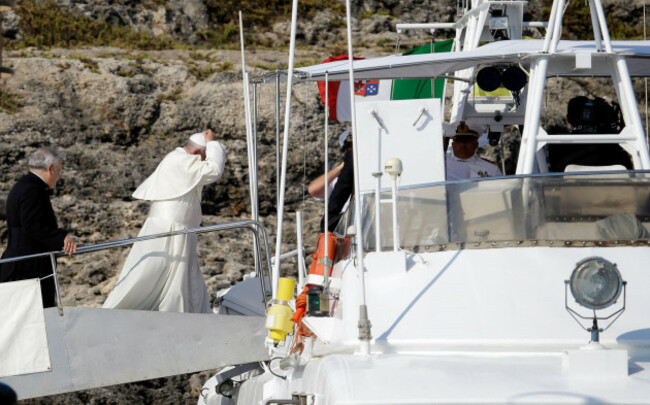
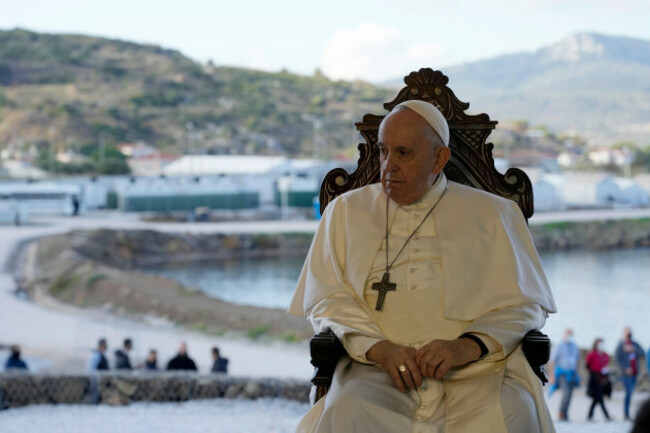
POPE FRANCIS’S FIRST papal trip was to Lampedusa, the southern Italian island that has been a gateway to Europe for hundreds of thousands of migrants fleeing war and poverty in Africa and the Middle East.
In his autobiography, Francis said he felt he “had to go to Lampedusa”.
“The tiny Mediterranean island has become the outpost for hope and solidarity,” wrote Francis, “but also symbolises the contradictions and tragedy of migration and the underwater cemetery for too, too many corpses.”
“When I heard the news of yet another shipwreck just a few weeks before, the thought kept coming back to me, like a painful thorn in my heart.
“The visit had not been scheduled, but I had to go.”
Francis was born into a family of migrants who left Italy for Argentina and his autobiography begins with the tale of a shipwreck which claimed the lives of around 300 people.
His own family had been due to board that ship, but they weren’t able to sell their possessions in time and exchanged their tickers for a later sailing.
“You can’t imagine how many times I have found myself thanking Divine Providence,” wrote Francis.
Francis’s welcoming remarks on refugees and migrants had put him into conflict with Trump’s administration.
Since his first papal trip to Lampedusa, Francis continued to speak out on the need to care for and welcome refugees and migrants.
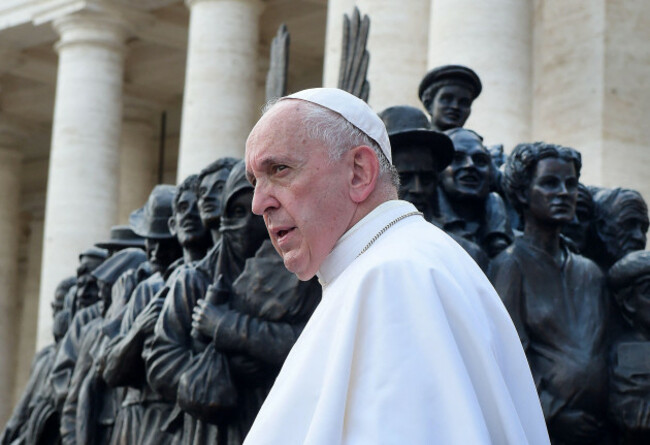
Before being hospitalised in February, Francis penned a letter to US Bishops which openly rebuked Trump’s stance on migrants.
He hit out at the “major crisis” of US president Donald Trump’s deportation plans and explicitly rejected vice president JD Vance’s attempts to use Catholic theology to justify the administration’s crackdown on immigration.
Vance, a Catholic convert, had appealed to a concept called ‘Ordo amoris’ to justify his administration’s immigration crackdown.
In an interview with Fox News, he described it like this: “You love your family, and then you love your neighbour, and then you love your community, and then you love your fellow citizens in your own country.
“And then after that, you can focus and prioritise the rest of the world.”
Vance claimed that the “far left” had inverted that.
Public theology matters. I love that the sitting Vice President is invoking the Ordo Amoris.
— Andrew T. Walker (@andrewtwalk) January 30, 2025
pic.twitter.com/fQE7YHO2K2
But in his letter, Francis said that the “true ordo amoris” is that built on “the love that builds a fraternity open to all, without exception”.
Francis wrote that God is always close to migrants and refugees and added: “I have followed closely the major crisis that is taking place in the United States with the initiation of a program of mass deportations.”
Francis said it was impossible not to “make a critical judgment and express disagreement with any measure that tacitly or explicitly identifies the illegal status of some migrants with criminality”.
“The act of deporting people who in many cases have left their own land for reasons of extreme poverty, insecurity, exploitation, persecution or serious deterioration of the environment, damages the dignity of many men and women, and of entire families, and places them in a state of particular vulnerability and defencelessness.”
He called on the US government to “welcome, protect, promote and integrate the most fragile, unprotected and vulnerable”.
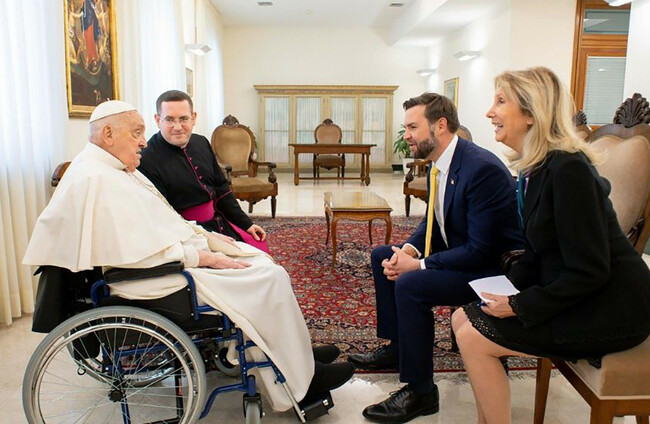
And on Easter Saturday, despite meeting with pilgrims in St Peter’s Basilica, he didn’t meet with Vance.
Vance met instead with the Vatican secretary of state, Cardinal Pietro Parolin, and foreign minister, Archbishop Paul Gallagher.
The Vatican remarked that there “was an exchange of views, especially regarding countries affected by war, political tensions and difficult humanitarian situations, with particular attention focused on migrants, refugees and those in prison”.
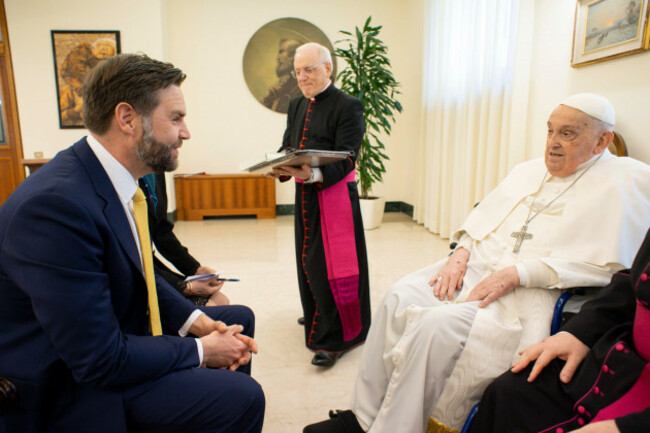
Vance did end up meeting with Francis for “a few minutes to exchange Easter greetings”, according to the Vatican.
On Holy Thursday, Francis visited Rome’s Regina Coeli prison, continuing a tradition he had observed since the beginning of his papacy.
“I have always liked coming to prison on Holy Thursday to do the washing of the feet like Jesus,” Francis told those gathered. “This year, I cannot do it, but I want to be close to you. I pray for you and your families.”
When he left, he told journalists: “I ask myself: Why them and not me?”
Influential US priest Father James Martin contrasted the actions of Francis to those of US Republican politician Riley Moore, a Catholic who posed with a thumbs up during a recent visit to a prison in El Salvador.
“Pope Francis visits a prison in Rome and, after spending time with them, blows them kisses. He said, “I ask myself: Why them and not me?”
“Rep. Moore visits a jail in El Salvador and gave a thumbs up to their suffering. Which way would Jesus, who was imprisoned, prefer?”
Two ways: Pope Francis visits a prison in Rome and, after spending time with them, blows them kisses. He said, "I ask myself: Why them and not me?" Rep. Moore visits a jail in El Salvador and gave a thumbs up to their suffering. Which way would Jesus, who was imprisoned, prefer? pic.twitter.com/fRwI6Q2VHr
— James Martin, SJ (@JamesMartinSJ) April 17, 2025
Francis said he had to go to Lampedusa for his first papal trip “to pray, to show that I was with them” and to “reawaken our consciences”.
He also writes in his autobiography about returning from a refugee camp in Greece with 12 migrants.
While visiting a refugee camp on the Greek island of Lesbos in 2016, then Greek prime minister Alexis Tsipras told Francis about three refugee families from Syria.
“Their migration papers were in order, but they could find nowhere to go,” wrote Francis.
“Twelve people in all, six were children.
“’I’ll take them with me,’ I said. We hurriedly collected their papers, obtained Greek and Italian government visas, and three hours later they were all on the plane for Rome, guests of the Vatican.”
One of these Syrian refugees now works as a biologist in a children’s hospital in Rome.
“Having once risked seeing her child drown in the Mediterranean, she now saves the lives of other children in a specialist centre for the diagnosis and treatment of rare illnesses,” wrote Francis.
Another 52 refugees would arrive in the following months.
“We can no longer allow that flow of containers, of humanity driven back, fraternity denied, to continue to represent us, to represent the disgrace of the European Union,” wrote Francis.
“We can no longer allow the Mediterranean, which for thousands of years has united different populations and distant lands, to be transformed into a cold cemetery of unmarked graves.”
He added: “Refugees cry out, crowded onto boats, searching for hope, not knowing what ports will welcome them.”
Meanwhile, Pope Francis inspired International Olympic Committee president Thomas Bach to create the Olympic refugee team, the German said in a tribute.
Bach said the IOC had lost “a great friend and supporter”.
However, it was his support for refugees which had left the greatest mark.
“His powerful voice in support of refugees is a shining example of his commitment, and it inspired me to create the first-ever refugee Olympic team for the Olympic Games Rio 2016,” Bach said in a statement.
“He has graciously followed and supported this initiative throughout three Olympic Games editions, encouraging its growth and impact.
“This ongoing encouragement also led to the creation of the Olympic Refuge Foundation in 2017.”

To embed this post, copy the code below on your site












have your say