Sign in. It’s quick, free and it’s up to you.
An account is an optional way to support the work we do. Find out more.
Sign in. It’s quick, free and it’s up to you.
An account is an optional way to support the work we do. Find out more.
LAST UPDATE | 8 May

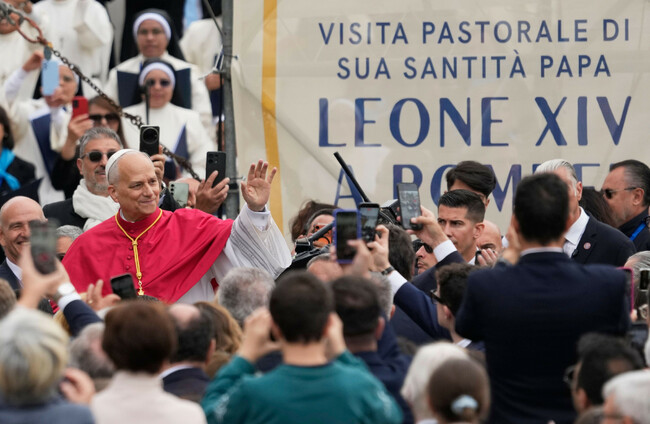
IT’S BEEN 11 years since a pope last visited the often-maligned city of Naples in southern Italy.
Speaking ahead of Pope Leo XIV’s visit to Pompeii and Naples today to mark the pope’s first year in office, the region’s Archbishop Tommaso Caputo noted that southern Italy “faces social challenges”.
“There are difficulties caused by precarious and often poorly paid work,” said Archbishop Caputo.
He expressed hope that the pope’s visit will “make our hope ever more alive, and to give renewed impetus to our works of charity”.
In his remarks from Naples Cathedral, Leo recalled the words of his predecessor Pope Francis during his 2015 visit to Naples:
“Life in Naples has never been easy, but it has never been sad. This is your great resource: joy.”
In Naples Cathedral, Leo held the famous reliquary that is said to hold the blood of St Janaurius, who was beheaded in 305.
It is said that some of St Januarius’s blood was collected after his beheading and preserved in two glass ampoules.
Joy all around this afternoon as His Holiness Pope Leo XIV displays the miraculously liquified blood of San Gennaro (Saint Januarius) in the Cathedral of Naples. pic.twitter.com/7Jlg8ADBoC
— Catholic Sat (@CatholicSat) May 8, 2026
The solid blood within the ampoule traditionally liquifies three times a year: on the Saturday before the first Sunday in May; on 19 September, the feast day of St Januarius; and on 16v December, which marks the eruption of Mount Vesuvius, when the blood is said to have spared Naples from destruction.
The blood liquidated last Saturday and Leo held aloft the reliquary with the still liquified blood.
From there, Leo visited the Piazza del Plebiscito.
Loud applause for Pope Leo as he address the crowd in Naples. He said the city has a “desire to be redeemed from evil and healed of its wounds”. pic.twitter.com/db8FOUQCik
— Diarmuid Pepper (@Diarmuid_9) May 8, 2026
Here, he remarked that Naples “often walks tired, disorientated and disappointed”.
However, he added in Naples there is a “longing for justice and good that cannot be overwhelmed by evil”.
Leo then said Naples is “experiencing a dramatic paradox: the remarkable growth of tourists struggles to match an economic dynamism capable of really involving the entire social community”.
He said the city is “still marked by a social gap” and that there are many areas of Naples marked by “inequality and poverty, fuelled by problems that have not been solved for a long time”.
Leo said there are many in Naples who “cultivate the desire for a city redeemed from evil and healed from its wounds”.
He called for civil society to work with the Church to “return Naples to its call to be a capital of humanity”.
Leo also said Naples “reveals its deep heart in the reception of migrants and refugees” and that this is experienced “not as an emergency but as an opportunity for mutual enrichment”.
The pope remarked that Naples “needs this gasp, this disruptive energy of good” and called on young people to “contribute creatively to the construction of the good”.
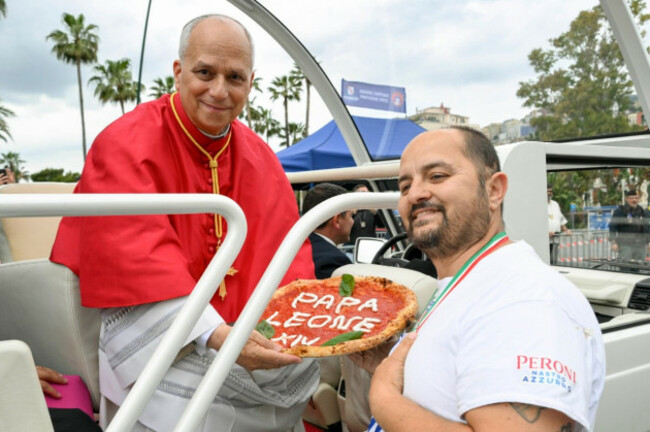
The first stop for Leo on this morning was Pompeii, where he marked the feast of Our Lady of the Rosary of Pompeii, as well as the anniversary of his election.
In Pompeii, Leo visited the shrine of the Virgin of the Rosary of Pompeii and then met with people who are sick or disabled.
Pope Leo XIV arrives at the Basilica of the Blessed Virgin of the Rosary of Pompeii on the anniversary of his May 8 election. pic.twitter.com/zgiQpRXGUu
— Courtney Mares (@catholicourtney) May 8, 2026
Here, Leo remarked on the wars being fought today and added: “We cannot resign ourselves to the images of death that the news presents to us every day.”
The crowds in Naples were somewhat sparse for a visit that didn’t seem to attract much fanfare in the city – there were few posters or advertising boards notifying the public of the visit.
Pope Leo expected soon at the Piazza del Plebiscito but the crowds are somewhat sparse. @thejournal_ie pic.twitter.com/LNiRFcTQql
— Diarmuid Pepper (@Diarmuid_9) May 8, 2026
In Naples Cathedral yesterday, people were busy getting the place ready for the pope’s visit.
People hard at work to prepare the Royal Chapel of the Treasury of San Gennaro ahead of Pope Leo’s visit tomorrow. The papal visit will coincide with the first anniversary of his election. @thejournal_ie pic.twitter.com/vEMOq1Pyf9
— Diarmuid Pepper (@Diarmuid_9) May 7, 2026
The hustle and bustle in the Cathedral confused some tourists, who asked a tour guide what all the big fuss was about.
“Papa is coming tomorrow,” came the reply, and the tourists sought confirmation that “papa” meant “pope”.
But while the build-up in Naples might have been somewhat low key, the events surrounding them weren’t.
The visit to Pompeii and Naples came a day after the pope met with US Secretary of State Marco Rubio.
A read-out from the Vatican following the meeting yesterday remarked that the need to “foster good bilateral relations between the Holy See and the United States of America was reaffirmed”.
The Vatican added that there was an “exchange of views on the regional and international situation, with particular attention to countries affected by war”.

To embed this post, copy the code below on your site










have your say