Sign in. It’s quick, free and it’s up to you.
An account is an optional way to support the work we do. Find out more.
Sign in. It’s quick, free and it’s up to you.
An account is an optional way to support the work we do. Find out more.
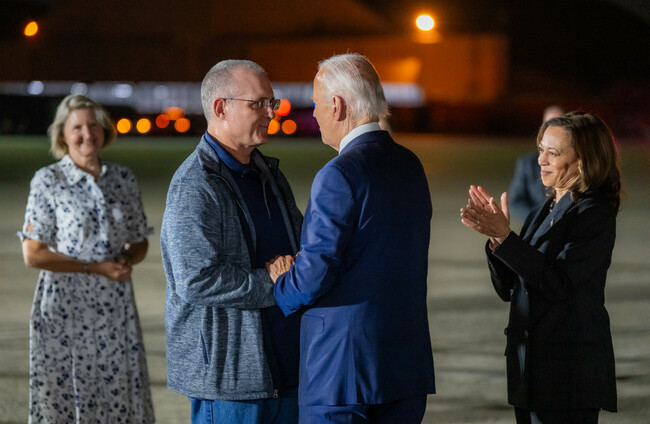
WESTERN COUNTRIES AND Russia have completed their biggest prisoner swap in post-Soviet history.
Among those released by Moscow are Paul Whelan, a corporate security executive with joint US-Irish citizenship, and Wall Street Journal reporter Evan Gershkovich.
They were greeted by US president Joe Biden and vice president Kamala Harris on the tarmac at military facility in Joint Base Andrews in Maryland.
Whelan is a former US marine who was convicted of espionage in a Russian court in 2020, having been arrested a year earlier.
The trade unfolded despite relations between Washington and Moscow being at their lowest point since the Cold War after Russian President Vladimir Putin’s invasion of Ukraine in February 2022.
Tonight is about reuniting families.
— President Biden (@POTUS) August 2, 2024
Welcome home, Paul, Evan, and Alsu. You're right where you belong. pic.twitter.com/PIp7ghOs7z
Negotiators ultimately stitched together a seven-nation, 24-person deal that required significant concessions from European allies, including the release of a Russian assassin, and secured freedom for a cluster of journalists, suspected spies, political prisoners and others.
US President Joe Biden trumpeted the exchange, by far the biggest in a series of swaps with Russia, as a diplomatic feat while welcoming families of the returning Americans to the White House.
At one point yesterday speaking from the Oval Office, he grabbed the hand of Whelan’s sister, Elizabeth, and said she had practically been living at the White House as they tried to free Paul.
But the US and allies gave up Russians charged or convicted of serious crimes in exchange for Russia releasing journalists, dissidents and others imprisoned by the country’s highly politicised legal system on charges seen by the West as trumped-up.
“Deals like this one come with tough calls,” Biden said but added: “There’s nothing that matters more to me than protecting Americans at home and abroad.”
Under the deal, Russia released Gershkovich, a reporter for The Wall Street Journal who was jailed in 2023 and convicted in July of espionage charges that he and the US government vehemently denied. The paper’s editor-in-chief, Emma Tucker, called it a “joyous day”.
“While we waited for this momentous day, we were determined to be as loud as we could be on Evan’s behalf. We are so grateful for all the voices that were raised when his was silent. We can finally say, in unison, ‘Welcome home, Evan,’” she wrote.
Negotiators in backchannel talks at one point explored an exchange involving Russian opposition leader Alexei Navalny but after his death in February
Kara-Murza, a Kremlin critic and Pulitzer Prize-winning writer serving 25 years on charges of treason widely seen as politically motivated, was also released along with multiple associates of Navalny.
Other freed Kremlin critics included Oleg Orlov, a veteran human rights campaigner convicted of discrediting the Russian military, and Ilya Yashin, a former member of a Moscow municipal council who had been imprisoned for criticising the war in Ukraine.
The Russian side secured the release of Vadim Krasikov, who was convicted in Germany in 2021 and sentenced to life in prison for killing a former Chechen rebel in a Berlin park two years earlier, apparently on the orders of Moscow’s security services.
Throughout the course of negotiations, Moscow had been persistent in pressing for his release, with Putin himself raising it.
At the time of Navalny’s death, officials were discussing a possible exchange involving Krasikov.
But with that possibility erased, senior US officials made a fresh push to encourage Germany to release Krasikov. In the end, a handful of the prisoners Russia released were either German nationals or dual German-Russian nationals.
Russia also received two alleged sleeper agents who were jailed in Slovenia, as well as three men charged by federal authorities in the US, including Roman Seleznev, a convicted computer hacker and the son of a Russian politician, and Vadim Konoshchenok, a suspected Russian intelligence operative accused of providing American-made electronics and ammunition to the Russian military.
Norway returned an academic arrested on suspicion of being a Russian spy, and Poland also sent back a man it detained on espionage charges.
“Today is a powerful example of why it’s vital to have friends in this world,” Biden said while joined by the families.
Seven nations participated in the deal, which was executed in Ankara in the final months of his administration and during the course of a presidential race upended by his decision not to seek re-election.
Former president Donald Trump, who had claimed that if elected he would immediately get Mr Gershkovich home, bashed the deal and speculated incorrectly that the US had given cash to Russia.
The swap of 24 prisoners surpassed a deal involving 14 people that was struck in 2010. In that exchange, Washington freed 10 Russians living in the US as sleepers, while Moscow deported four Russians, including Sergei Skripal, a double agent working with British intelligence. He and his daughter were nearly killed in 2018 in Salisbury by nerve agent poisoning blamed on Russian agents.

To embed this post, copy the code below on your site











have your say