Sign in. It’s quick, free and it’s up to you.
An account is an optional way to support the work we do. Find out more.
Sign in. It’s quick, free and it’s up to you.
An account is an optional way to support the work we do. Find out more.
(Seo alt ónár bhfoireann Gaeltachta. Is féidir an bunleagan as Gaeilge a léamh anseo)
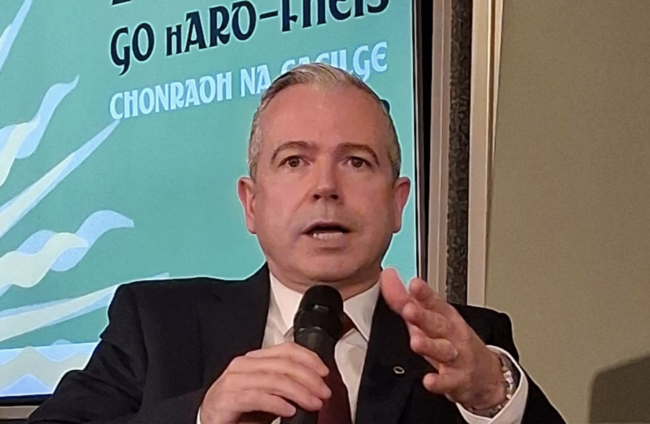
SIGNIFICANT RESEARCH REGARDING the best-practice standards to be applied in the North regarding the public use of Irish will be presented at a conference in Belfast this month, bringing together language commissioners on this island and in Britain alongside language activists and government representatives.
Pól Deeds, the Irish Language Commissioner for Northern Ireland, indicated as much when speaking to The Journal this week, six months into the role.
It has been far from a controversy-free six months, with Deeds coming under sustained attack from a small but vocal minority of Unionist activists who oppose any progress toward greater public visibility for Irish in the North.
Recent surveys have suggested that opposition to the Irish language is at an historic low in the North and, at the weekend, the results of the latest Life and Times Survey suggested that 56% of respondents agreed that the Irish language added to the richness and diversity of Northern Ireland.

During that period there have been court cases over the absence of Irish-language signage at Belfast’s Grand Central transport hub, a bilingual signage campaign in Downpatrick, and the Northern Ireland Executive’s lack of an Irish language strategy.
The Commissioner acknowledges the progress made in Belfast after a broad coalition of parties – every party except the Unionist parties – agreed to support a strong Irish language policy on the city council in recent times. The draft was agreed last autumn but the finalised policy came before the Council at the start of this month, and a large majority of councillors approved it last week at the same meeting at which an Irish speaker from the west of the city, Róis-Máire Donnelly, was elected Lord Mayor.
Deeds is currently focused on developing his office, recruiting staff and increasing his budget accordingly. He sees a need for additional staff to handle complaints from the public once the standards on the public visibility of Irish – agreed by the Executive – come into force.
Since taking up the post in mid-November, he has been targeted by a small group of activists in the Unionist community, but he has pressed ahead with his own work programme – gathering information and speaking to authorities in the North and to his counterparts south of the border, the Language Commissioner Séamus Ó Concheanainn, and in Wales, the Welsh Language Commissioner Efa Gruffudd Jones.
He has learned a great deal from those meetings and is keeping that learning in mind as he moves forward.
“We will need more as we progress through the complaints process,” he said, indicating that his visit to Wales had taught him a great deal about how complaints could grow in volume.
“I think the Irish-speaking community is waiting,” he said. “There will be a great many complaints submitted.”
Perhaps the most significant work he has undertaken since his appointment is commissioning research from Ulster University to examine and present international best practice on minority languages at a conference to be held at the university at the end of the month.
“Representatives from public authorities will be there as the audience – the conference is aimed at them – it is a best-practice conference on minority languages.
“That will be happening as part of the process of developing best-practice standards.”
The research he has commissioned will focus “on what constitutes best practice” across all the jurisdictions on these islands – Britain and Ireland – and internationally.
He said researchers would be present to make recommendations on how those frameworks could be applied in the context of Northern Ireland.
Deeds’ goal is for the highest international best-practice standards on minority languages to be in use in Northern Ireland, but while he will propose them, it is the First Minister and Deputy First Minister who must give their approval before they can be implemented.
The standards will be drafted in the Commissioner’s Office over the summer and will then be put out for public consultation.
“So we have all the steps in place for the development of the standards and perhaps that is our biggest achievement to date – that the process has begun and there is a visible pathway from where we are now to the standards being presented to the First Minister and Deputy First Minister.”
He said it was significant that they were not drawing solely on the experience in the south but also on the Welsh experience and on much of Europe.
He indicated that his counterpart, the Ulster Scots and British Identity Commissioner, Lee Reynolds, would be attending the conference at the end of the month – reflecting the efforts Deeds is making to bring on board people who would not be natural supporters of the Irish language.
“I am trying to do that – I think we have to bring people together under this Act.”
He believes the legislation under which his office was established offers “an enormous opportunity” to bring people from every corner and every dimension of society together and that, at the same time, this will neutralise “that small opposition” – or silence it entirely – “by placing an emphasis on demonstrating mutual understanding between all communities here.”
“That is a life’s mission for me,” he said.
“Personally that is something I would want to do anywhere – but I think, as Commissioner under this Act, it is my duty to advance those principles.”
While the Commissioner has achieved a great deal since taking on the role just over six months ago, and while it appears that the standards he is proposing for Irish in the North will be before the public shortly after the summer, there is no doubt that a long road lies ahead and many obstacles still to be overcome.
The Journal’s Gaeltacht initiative is supported by the Local Democracy Reporting Scheme
This article was originally written in the reporter’s native Irish and has been translated to English here. AI was used as part of the translation process before final edits.

To embed this post, copy the code below on your site















have your say