Sign in. It’s quick, free and it’s up to you.
An account is an optional way to support the work we do. Find out more.
Sign in. It’s quick, free and it’s up to you.
An account is an optional way to support the work we do. Find out more.
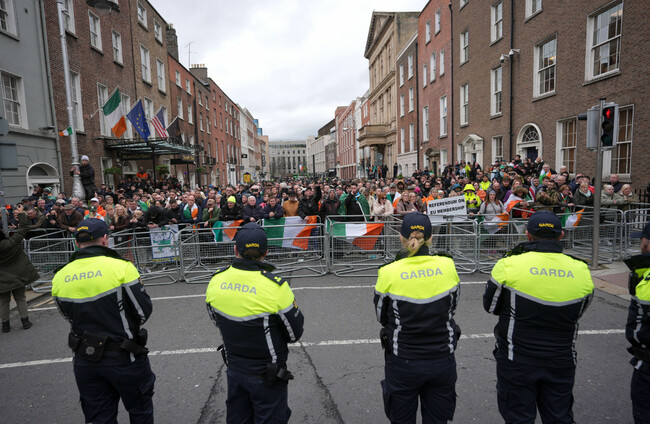
GARDAÍ PREPARED FOR a surge of protesters outside the Dáil this afternoon, but the show of force ultimately outweighed the size of the crowd.
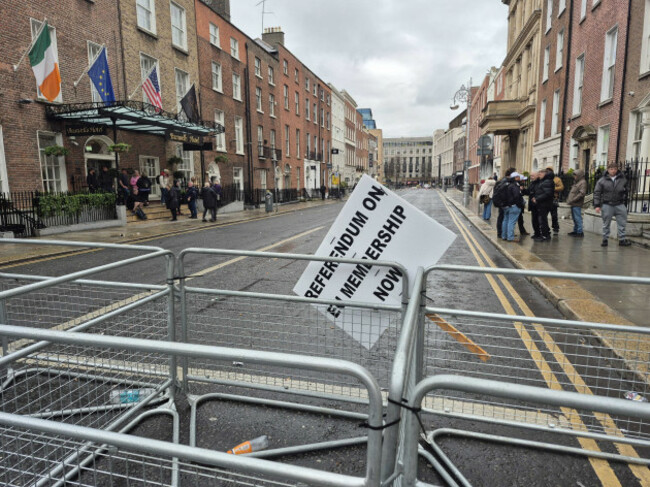
A few hundred demonstrators gathered behind doubled-lined metal barriers on Molesworth Street earlier as the no-confidence debate unfolded inside Leinster House.
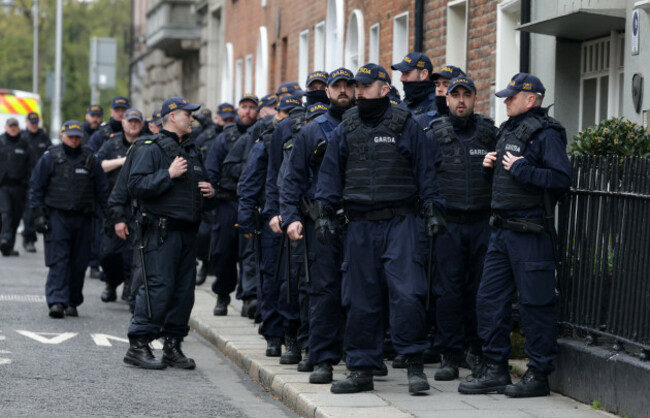
Kildare Street was closed to traffic, dozens of gardaí were stationed outside Government Buildings, a garda helicopter hovered overhead and a number of public order units were stationed nearby in anticipation of unrest.
Instead, the protest peaked modestly and dissipated quickly, with most gone by 6pm, less than an hour after the vote concluded.
A week that shook the country (and Dublin city centre with the protest on O’Connell Street) ended with a whimper outside the Dáil.
The contrast with both last week’s fuel protests and previous flashpoints at the Dáil was stark, despite the fact that several of the fuel price protests’ leaders had called on their followers to join the gathering in Dublin today.
While chants of “Fianna Fáil and Fine Gael, out out out” rang out, and some crude slogans targeted the government’s fuel measures, the messaging lacked a clear through line.
One slogan repeated several times was “you can stick your f***ing ten cents up your arse”, a pointed reference to the government’s 10-cent excise reduction on petrol and diesel, chanted to the tune of She’ll Be Comin’ Round the Mountain.
Irish flags mixed with anti-EU signs, while one lone poster protesting a court assessor hinted at the scattergun nature of the grievances on display.
Several opposition-aligned TDs briefly stepped out to address the crowd, including Independent Ireland’s Michael Collins and Michael Fitzmaurice, Aontú leader Peadar Tóibín, and Michael Healy-Rae, who was greeted warmly after announcing his resignation as junior minister.
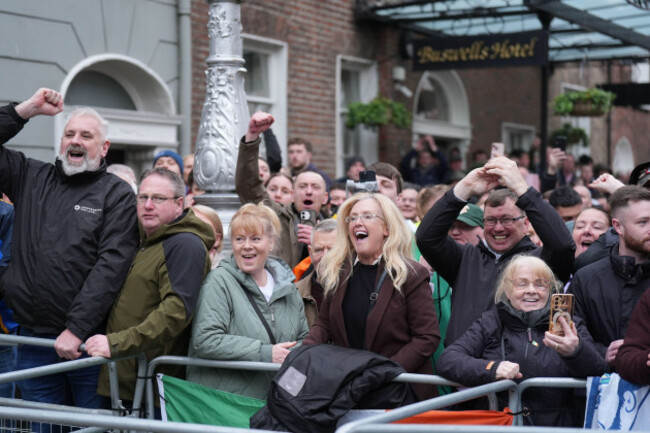
Yet even those moments failed to galvanise a larger turnout. The scale of the policing operation suggested authorities were preparing for something far bigger.
Last week, protests over fuel prices had escalated rapidly, with tractors and trucks blocking motorways, supply chains disrupted, and a heavy online mobilisation effort fuelling expectations of further unrest.
That backdrop, along with the memory of previous protests outside Leinster House, likely informed today’s cautious approach by gardaí.
In September 2023, around 200 anti-immigrant protesters managed to block entrances to the Dáil, leaving TDs and staff effectively unable to leave the site for several hours.
Gardaí were forced to intervene, escort politicians from Government Buildings, and deal with multiple arrests amid highly charged scenes.
Nothing close to that unfolded today.
Instead, what materialised was a smaller, less cohesive crowd, voicing frustration but lacking the scale or coordination seen in recent days.
For all the anticipation of a “protest storm”, what emerged instead was something closer to a passing shower – noisy at times, but ultimately limited in impact.

To embed this post, copy the code below on your site















have your say