Sign in. It’s quick, free and it’s up to you.
An account is an optional way to support the work we do. Find out more.
Sign in. It’s quick, free and it’s up to you.
An account is an optional way to support the work we do. Find out more.
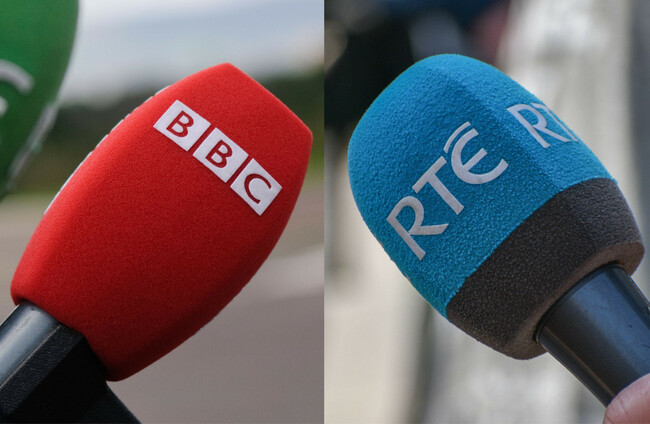
A NEW PUBLIC broadcaster for the whole island would have to be created if there was a united Ireland.
That’s according to a new report by Ulster University and Dublin City University, which looked at what reunification could mean for both RTÉ and BBC Northern Ireland.
Researchers explored several potential options and the option of a new entity covering the island was considered the most logical solution that would allow for continued public service journalism, the authors said.
They recommended the establishment of a new public service media organisation that would combine the resources of RTÉ and BBC NI. Such a move would also protect existing jobs and pensions, they argued.
They proposed the new broadcaster could be called Public Media Ireland.
According to the authors: “A new Ireland will require a democratic media fit for the purpose of building a resilient and sustainable democracy.”
The report acknowledges, however, that “Irish reunification is not a foregone conclusion”.
“It could take place in the medium term, the long term, or indeed not at all.”
It recommends that, in the event reunification comes to pass, a new all-island public broadcaster would have ten journalism hubs in a range of cities and towns, outside of Dublin and Belfast.
Hubs in Cork, Derry, Newry, Athlone and elsewhere could be used to coordinate news output, the report says.
The two national broadcasters already have studios in many of the locations highlighted in the study.
Dr Dawn Wheatley from DCU, one of the report’s authors, said it is important that the future of public broadcasting isn’t “overlooked” during the debate about a united Ireland.
A 2025 European Movement Ireland EU Poll showed that a majority would support reunification if that meant EU membership. Some 67% of those polled in Northern Ireland and 62% in the Republic were in favour of a united Ireland within the EU.
Sinn Féin continues to advocate for a border poll on Irish unity before 2030. When asked about the prospect of it, the Taoiseach said in September that “there’s more to be done” before any poll could be held.
The Good Friday Agreement stipulated that the UK’s Secretary of State for Northern Ireland (currently Hilary Benn) has the legal power to call a border poll if he believes a majority in Northern Ireland would vote for reunification.
In the wider debate, however, people have struggled to agree on things such as what flag should be used in a united Ireland, how the health system would work, and how Unionist traditions would be protected.
Research by Red C suggests people are supportive of a united Ireland in principle, but in reality they don’t want the significant upheaval it would cause.
In terms of the broadcasting study, researchers considered maintaining RTÉ and absorbing BBC NI, or the creation of a new online streaming service that combines content from the two, which wouldn’t require as much structural change.
The former wasn’t chosen because of RTÉ’s “dire financial state” without direct public funding.
The report also raised concerns about the rate of TV licence fee evasion.
Similarly to the situation with RTÉ, the TV licence which funds the BBC in the UK can’t be relied upon and is “perhaps in terminal decline”, the report says.
Researchers suggested Ireland adopt the Finnish model for funding public service journalism, which involves progressive taxation.
Individuals would pay 2.5% of their income above €14,000 towards it, with an annual cap of €163. Organisations with taxable incomes above €50,000 would also pay up to €3,000.
The report was a collaboration between Dr Phil Ramsey and Dr Stephen Baker of Ulster University, and Dr Wheatley and Dr Roddy Flynn of DCU.

To embed this post, copy the code below on your site












have your say