Sign in. It’s quick, free and it’s up to you.
An account is an optional way to support the work we do. Find out more.
Sign in. It’s quick, free and it’s up to you.
An account is an optional way to support the work we do. Find out more.

THIS SATURDAY MARKS the 49th anniversary of the Misuse of Drugs Act 1977 being signed into law by Ireland’s then President, Patrick Hillery. As I have written previously, the development of Ireland’s drug laws can be traced as far back as the late 1800s, but our modern drug legislation begins in earnest with the 1977 Act. This wasn’t a response to a perceived need, but was Ireland meeting UN treaty obligations?
Since its passage, the Act hasn’t been subject to significant amendment or updating, despite societal understandings of drug use, addiction and public health advancing significantly in the intervening decades.
Our drug laws still carry the mentality inherited from America’s ‘war on drugs’, shaming, stigmatising and criminalising people who use drugs, despite extensive evidence demonstrating it to be a failed experiment that has caused untold harm.
Knowing what we know now in terms of that harm, are we to assume that harm is the intent? I would like to believe not, which is why, nearly fifty years on, we must finally follow the evidence and unshackle ourselves from this damaging practice of punishing drug use.
2026 presents the State with a unique opportunity to address these failings and meaningfully reshape our drug policy to be health-led in both policy and practice. The development of the new National Drugs Strategy takes place against the backdrop of the 2023 Citizens’ Assembly on Drug Use, and ahead of the final report of the Joint Oireachtas Committee on Drug Use. This has the potential to be a watershed moment in Irish drug policy, but early indications from a draft of the new National Drugs Strategy suggest that the Government does not intend to meet this moment.
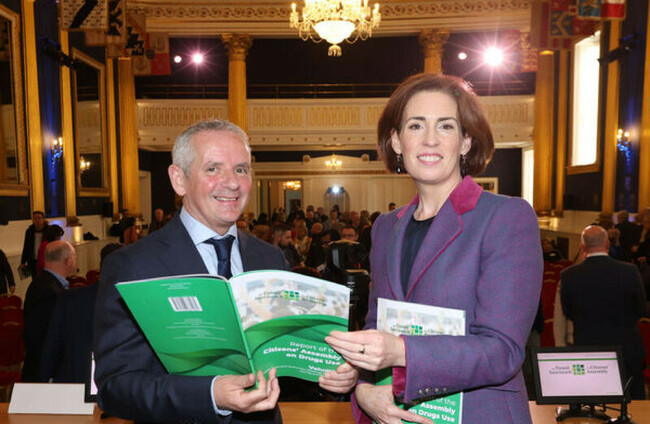
The Citizens Assembly on Drug Use was described by its Chair, Paul Reid, as “the most extensive, engaged discussion on the issue of drug use that has ever been held in the history of the state”.
The Assembly advocated for a transformative shift in the State’s approach to drug use and addiction, calling resoundingly for a comprehensive, health-led response that removes shame and stigma. A proper health-led approach would place the person at the centre and recognise that policy can harm people This is not something achieved by continuing to see the person who uses drugs as a criminal.
Earlier this week, the Irish Coalition for Drug Reform, a new national collaboration bringing together community organisations, people with lived and living experience, families, academics, public representatives and practitioners to support informed discussion on drug policy in Ireland, held its first official event.
The Coalition is seeking to build on the momentum of the Citizens’ Assembly, creating space for community knowledge, research, legal analysis and frontline practice to come together at a time when drug policy is under active review.
At the Coalition’s first event, the Irish Council for Civil Liberties (ICCL) published a new policy paper on the decriminalisation of drugs for personal use. The paper highlighted the contradictory policy failure embodied in the State’s stated promotion of a health-led response, while people who use drugs continue to be criminalised in large numbers in practice. ICCL concluded that decriminalisation is and must be a core part of a health-led approach, and that the Government cannot claim that its drug policy is health-led unless the possession of drugs for personal use is decriminalised.
At the event, Dr Cian Ó Concubhair, Assistant Professor of Criminal Justice, presented another research showing that 5,440 people were convicted of drug offences in Irish District Courts in 2025. 3,959 of these convictions were for simple possession – an offence under Section 3 of the Misuse of Drugs Act 1977. These are the statistics for one year. Imagine how many lives have been impacted since 1977, especially in the later years when drug epidemics took hold of communities already impacted by policy harms.
In February, An Garda Síochána told the Joint Oireachtas Committee on Drug Use that the primary focus of its policing is disrupting transnational organised criminal gangs to prevent the entry of drugs into the State, and “not the prosecution of those addicted to controlled drugs”. Why then have an average of 3,853 people been convicted of simple drug possession offences in each of the last five years?
Cannabis was added to the Adult Cautioning Scheme in December 2020, which allows Gardaí to resolve cases of simple possession outside the courts. Despite this, 17,125 people were either charged or summoned for cannabis possession alone in Irish District Courts between December 2020 and February 2024, compared with 5,139 people issued with adult cautions in the same period. Despite what An Garda Síochána asserts, there has been extensive use of powers under Section 3 of the 1977 Act to bring charges against people who use drugs. It cannot be said enough times: repealing Section 3 does not remove An Garda Síochána’s powers to search and prosecute people for sale and supply.
Health Research Board data shows drugs are consumed at the same rates in the top and bottom 20% of areas by wealth, while recent HRB & Pobal analysis shows addiction treatment rates 13 times higher in areas of highest deprivation, highlighting unequal levels of harm. Stop and search powers are exercised disproportionately in heavily policed, socioeconomically marginalised areas, with the burden falling on young, working-class men who are also disproportionately represented in prison, reflecting the stigma surrounding them and their community, not because there is more drug use prevalence in their communities.
The United Nations has recognised that the criminalisation of drugs is “proven to have negative health outcomes” and to “counter established public health evidence”. In 2023, the esteemed international medical journal The Lancet stated that the “evidence to show that criminalisation of drugs has failed is overwhelming”.
A paradigm shift toward policies grounded in evidence and aimed at protecting public health and human rights is therefore required. In recognition of this, nine EU member states have already pursued some form of drug decriminalisation in policy, including Portugal, Spain, Germany, Italy and Poland. As a State with one of the highest drug-related death rates in Europe, Ireland must be next.
Criminalisation does not reduce drug use, and does not stop the harmful use of drugs. It criminalises addiction and compounds the trauma and stigma of drug users. When people and policymakers hear the evidence, they consistently reach the same conclusion about the need for a comprehensive, health-led model.
The Joint Oireachtas Committee on Justice did so in 2022, calling for the decriminalisation of possession for personal use. So too the Joint Oireachtas Committee on Drug Use in its interim report in 2025, and, of course, the Citizens’ Assembly on Drug Use in 2024.
It’s overwhelmingly accepted that continuing to criminalise people who use drugs just for possession to any extent, whether at their first or fiftieth interaction with An Garda Síochána, is fundamentally incompatible with the pursuit of a health-led model.
The only logical outcome if you follow the evidence is that the Joint Oireachtas Committee on Drug Use this summer will conclude the same, and the Government will introduce sensible evidence and health-led amendments to the Drug Act of 1977 before the 50th anniversary of this damaging law.
Lynn Ruane is an independent senator.
To embed this post, copy the code below on your site














have your say