Sign in. It’s quick, free and it’s up to you.
An account is an optional way to support the work we do. Find out more.
Sign in. It’s quick, free and it’s up to you.
An account is an optional way to support the work we do. Find out more.

MANY OF DUBLIN’S most important pubs no longer exist.
On both sides of the Liffey and beyond the canals, Dublin’s built landscape is peppered with former public houses.
When writing a book on the social and cultural history of Dublin’s public houses, it is the contemporary names that first come to mind. The story could not be told without exploring the connection between The Flowing Tide and the neighbouring Abbey Theatre, or the importance of McDaid’s in the post-war literary moment, recalled by one poet as “the bohemian shark tank of a decade.”
Yet many of the most important pubs in the story are no longer around.
Gone is Conway’s at the intersection of Moore Lane and Parnell Street, a favoured watering hole of Rotunda staff and parents-to-be eagerly awaiting news from across the street.
For many years, an erroneous plaque on the building claimed it marked the site at which P.H Pearse had surrendered in 1916. Less heroically, the pub had been looted during the Easter Rising. Leslie Price of Cumann na mBan recalled how: “I turned into Parnell Street and came up to a public house in front of the Rotunda, Conway’s I think, at the corner of a laneway. People were drinking away. They had looted the public house.”
While Conway’s is slowly rotting away amidst the stalled redevelopment of Moore Lane and its environs, other former public houses are more difficult to spot.
Aesthetically, the most beautiful of all Dublin’s lost public houses was The Irish House on Wood Quay, complete with Celtic towers, Irish wolfhounds, the Maid of Érin and the figures of Daniel O’Connell and Henry Grattan. While pubs would frequently be named in honour of revolutionaries who had died in battle, The Irish House celebrated constitutional nationalism.
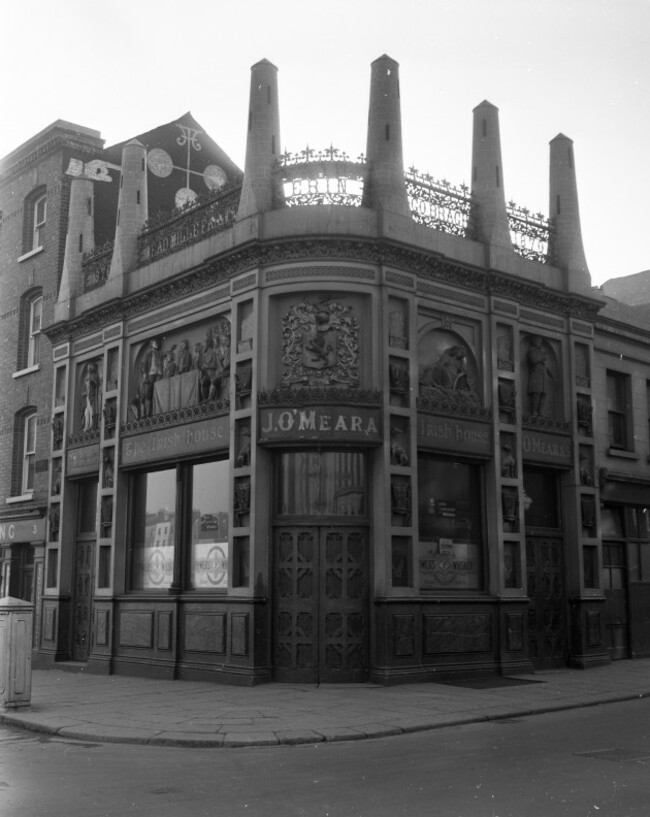
Like Kilkenny’s Home Rule Club, which is still open for business on John’s Quay, the names recalled here were of parliamentarians.
In 1964, when progress led to the demolition of The Irish House, one newspaper lamented how “if the Americans had such a specimen, they would jack up the house and roll it along to another site. Here we have no other use for a 94-year-old landmark of a public house when it gets in the way of site clearance than to knock it down.” Thankfully, some of its figures have survived.
Gone is The White Horse at 1 George’s Quay, though the distinctive ‘Dutch Billy’ style building that housed it now hosts a Starbucks. More than just a pub, The White Horse was also an early house, permitted to open its doors from seven o’clock.
Like many of the city’s early houses, it was close to the docklands, where the working hours of a docker bore little similarity to the rest of the city. Its proximity to the Burgh Quay offices of the Irish Press also made it a popular haunt for journalists, including the great Con Houlihan.
Enjoying his favourite drink – the peculiar concoction of brandy and milk – Houlihan’s day began very early in the morning. When asked to explain the tipple, Houlihan would quip that the brandy took the sting out of the milk. In a city that once housed more than forty early houses, only a handful now open their doors at seven o’clock.
It would be hard to move Starbucks from their new home at the site of The White Horse, but the former site of Barney Kiernan’s on Little Britain Street is still up for grabs.
Located just off Capel Street, the vandalised blue shopfront is all that remains of the location of the action in the Cyclops episode of Joyce’s Ulysses, where pub bore The Citizen confronts Leopold Bloom on questions of nationality and identity. Beautiful interior shots of Barney Kiernan’s survive thanks to Lee Miller, the celebrated artist and photographer who visited Dublin on a commission from Vogue magazine to photograph the city of Joyce in 1946.
In the back room, she met an old regular who had little to offer her in terms of Joyce connections: “He remembers him well but is not vastly interested as his favourite people are all the political assassins.” Miller was especially proud of a image she captured in The Palace, writing that “not only did I drink at the sacred ‘Men’s Bar’, but I stood on it as well, straddling the partition between bars.” All this was in pursuit of the perfect shot.
Books exploring Dublin’s public houses have largely focused on those within the city itself, but in The Dublin Pub I’ve tried to cast a wider net, exploring suburban behemoths like The Embankment in Tallaght and The Towers in Ballymun.
The Embankment, under the stewardship of the charismatic manager Mick McCarthy, was a pub that benefited enormously from being in the right place at the right time. As Dublin grew westwards, and town planners encouraged the authorities to build larger suburbs, Tallaght would become one of the largest suburban communities in Europe.
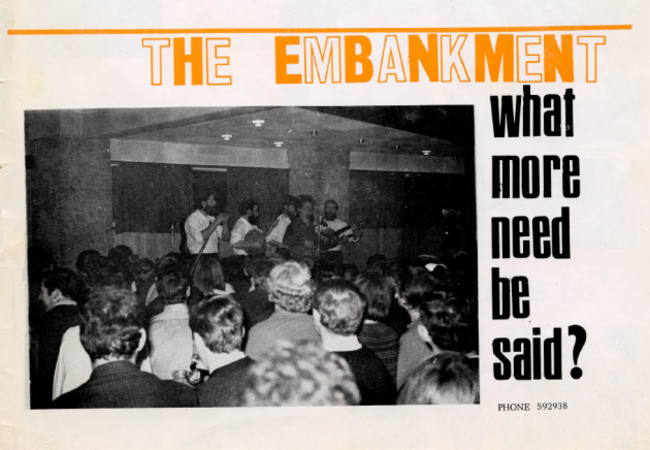
A bricklayer by trade, who boasted of being at the Battle of Cable Street where Oswald Mosley’s Blackshirts were confronted by Irish and Jewish migrants in London, McCarthy would be recalled as “a publican, trade unionist, father-figure of the Irish ballad-singing world and all-round pinch of salt of the earth.”
McCarthy searched the city for talent, approaching The Wolfe Tones in the Four Courts Hotel and telling them he owned “a bit of a kip at the foothills of the Dublin mountains called The Embankment.”
The Dubliners were frequent visitors, Micheál Mac Liammóir brought his one-man show about Oscar Wilde, and McCarthy had no judgement against those who grew long hair, in contrast with a Sunday Independent report describing O’Donoghue’s in 1971: “Not only headmasters resent long hair at this time of year. It worries certain licensed vintners, too. At the famous singing pub of Paddy O’Donoghue, in Dublin’s Merrion Row, customers with long hair have been barred for four years.” Luke Kelly’s hair – Paddy told the journalist – was “fuzzy, not long.”
In Ballymun, The Towers was perhaps the nearest thing Dublin ever had to an ‘estate pub’ of the kind more commonly found in working-class England. A mural showing the seven signatories of the Proclamation from the pub survives and is now displayed in the neighbouring Ballymun Civic Centre. The Towers pub would outlast the housing project that bestowed its name.
The pub is recalled in the memoir of Christy Dignam, who played there with an earlier band than Aslan: “We finished the set after what seemed like an eternity. But I’d got through it and the ordeal was over. Except it wasn’t. The organisers came up and told us that we had to finish up with ‘Amhrán na bhFiann’ (‘The Soldiers Song’), the national anthem…. It was sung by the rebels holding the General Post Office against the British, and was a favourite in the republican internment camps that followed…And of course, we didn’t know it.”
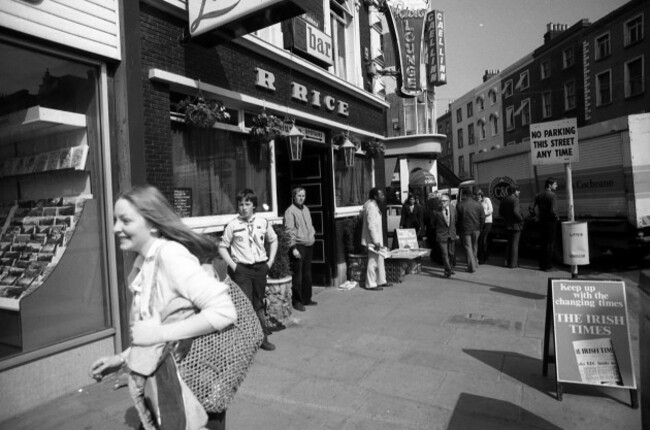
Some of Dublin’s lost public houses are recalled not for the physical pubs themselves, but their cultural or societal significance. Rice’s and Bartley Dunne’s were not ‘gay bars’ as is sometimes recalled, but rather gay friendly social spaces in the city before decriminalisation.
An advertisement for Bartley’s described it as being “Unusual in character. Continental in atmosphere.” Today, Bartley Dunne’s in New York is named in honour of this establishment. BD’s stood at the site of what is now The Grafton Hotel, where a bar carries the name Bartley’s. There is no trace of Rice’s at the Stephen’s Green Shopping Centre which replaced it.
If there was to be a museum of Dublin’s public houses, perhaps the figures from The Irish House or a menu from Bartley Dunne’s would find a home there. What other relics would be displayed?
Perhaps the ‘Gentlemen Only’ signs that once dotted bars, before the thirsty activism of Nell McCafferty and others leveled the playing field, if any have survived? The final copy of the Evening Press, signed by Con Houlihan and proudly displayed in Mulligan’s, is a relic of a different kind too.
More than anything, such a museum would be driven by the stories of the men and women who have plied their trade in the industry, many of them inter-generationally. I hope The Dublin Pub is a book that speaks to them, and reminds us that the pub is much more than the pint in front of us.
Donal Fallon’s The Dublin Pub: A Social and Cultural History is available now from New Island Books. It is nominated for the Hodges Figgis History Book of the Year at the An Post Irish Book Awards.
To embed this post, copy the code below on your site







have your say