Sign in. It’s quick, free and it’s up to you.
An account is an optional way to support the work we do. Find out more.
Sign in. It’s quick, free and it’s up to you.
An account is an optional way to support the work we do. Find out more.
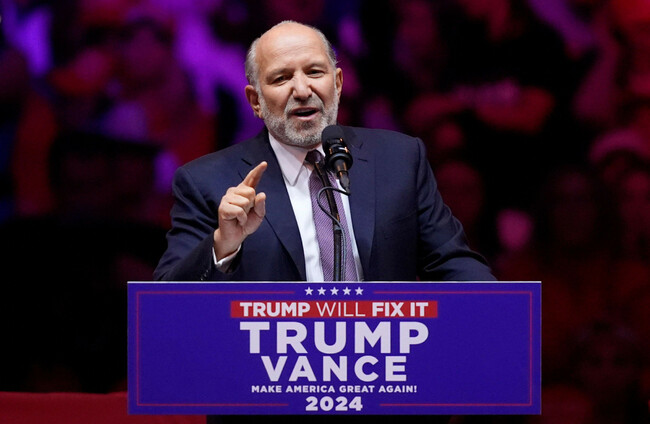

DONALD TRUMP’S NEWLY appointed Secretary of Commerce, Howard Lutnick, has name-checked Ireland’s nonsensical “trade surplus” with the US. He will be responsible for implementing Trump’s trade and tariff agenda. Significant repercussions for the Irish economy are all but inevitable.
The primary economic goal of the Trump administration is to prioritise American interests. This involves ensuring that US firms locate their production, create jobs and declare profits within the United States. The overarching aim is for the US to achieve a trade surplus, particularly against global competitors such as China and Europe.
This means Ireland is in serious trouble. Here’s why:
Among all EU member states, Ireland has the highest direct trade exposure to the United States. Astonishingly, the world’s largest economy, home to some of the biggest multinational corporations, runs a trade deficit with Ireland — a relatively small economy. How can this be? The answer lies in Ireland’s role as a global hub for profit-shifting and tax avoidance by US multinational enterprises (MNEs).
This is especially evident in the pharmaceutical sector, where tangible goods are traded. US pharmaceutical companies relocate both production and intellectual property (IP) ownership to Ireland to shift profits offshore. Even though the majority of their revenue and sales originate in the US, they report minimal domestic profits to reduce their US tax liabilities.
For instance, US pharmaceutical firms conduct research and development (R&D) and create patents in the US, generate most of their sales there, but then locate their IP rights, production and profits in Ireland. This practice significantly lowers their US tax obligations.
Donald Trump is determined to reverse this trend by bringing both production and profits back to the United States.
In 2017, Trump introduced the Tax Cuts and Jobs Act (TCJA) with the specific intent of encouraging US multinationals to repatriate production and IP ownership. However, due to complex loopholes, the act inadvertently caused the opposite effect in the pharmaceutical sector. Instead of returning to the US, these companies shifted even more profits from US sales to their foreign subsidiaries, further reducing their US tax burden.
This has had major implications for the US trade deficit in pharmaceuticals, particularly with Europe — and Ireland is at the centre of this imbalance. US consumers pay exorbitant prices for drugs manufactured by US multinationals in low-tax jurisdictions like Ireland, even though the R&D, IP, and primary market for these drugs remain in the United States. Economist Kimberly Clausing, a professor at UCLA, aptly described this as an “America-last policy.”
Research by Brad Setser, an economist and senior fellow at the US Council on Foreign Relations, reveals that since the 2017 tax reforms, the value of pharmaceutical imports from US companies has nearly doubled, reaching approximately $250 billion. A significant portion of these imports originates from US firms operating in Ireland.
Companies like Merck, Pfizer, AbbVie, and Eli Lilly have continued to expand their Irish operations.
Despite generating most of their revenue in the US, these companies report profits offshore. For example, in 2022, AbbVie generated 75% of its sales revenue in the US but declared a $5 billion loss domestically. Conversely, it reported $20 billion in offshore profits, with a substantial portion booked in Ireland.
Collectively, the five largest US pharmaceutical multinationals earned only $10 billion in profits on $200 billion in US sales in 2022, while reporting $90 billion in profits on $170 billion in foreign sales. Ireland remains the primary destination for these profits. To put this into perspective, Ireland collected nearly €23 billion in corporate tax revenue in 2022, much of it from these firms.
A single Treasury decision affecting just one major multinational corporation operating in Ireland has the potential to disrupt funding for the entire higher education and early childcare budget. This starkly illustrates the precarious narrowness and overdependence of Ireland’s tax base on the multinational sector.
The US tax system, particularly after the TCJA, has incentivised offshoring rather than curbing it. While Trump may not focus on curbing tax avoidance, he is laser-focused on ensuring that US profits, jobs and industrial production remain within the United States.
The combination of tax policies and trade practices has encouraged offshoring, exacerbated trade deficits and weakened the US pharmaceutical sector’s domestic foundation. To believe that a new Trump administration would overlook this issue is dangerously naive.
And that’s before mentioning the impact of Trump’s proposed tax cuts on the profit-shifting behaviour of big-tech MNEs in Ireland!
Aidan Regan is professor of political economy at University College Dublin.
To embed this post, copy the code below on your site
















have your say