Sign in. It’s quick, free and it’s up to you.
An account is an optional way to support the work we do. Find out more.
Sign in. It’s quick, free and it’s up to you.
An account is an optional way to support the work we do. Find out more.

LAST UPDATE | 6 Mar 2025
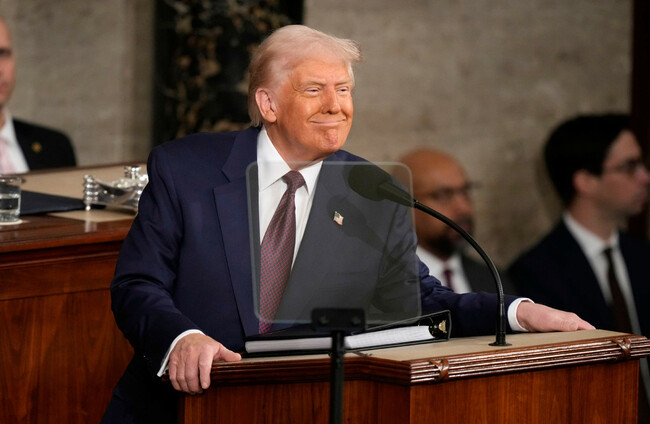
“AMERICA IS BACK” were the first three substantive words of President Donald Trump’s staggeringly lengthy remarks to the two houses of the United States Congress in the weehours of Wednesday morning Irish time.
Early on, it appeared for a moment that he mightn’t be able to continue in the wake of an intemperate outburst from Democratic US Representative Al Green from Texas and then hectoring across the aisle from obviously irked allies of the commander-in-chief. Ultimately, House Speaker Mike Johnson had the 77 year old Green removed.
The speech, which was not technically a State of the Union address, was replete with braggadocio, exaggerations and full-blown falsehoods.
Nonetheless, the GOP faithful alternatively reacted with ovations and chants of “USA, USA, USA!”
Democrats protested silently and held signs expressing disapproval. More than a few walked out, unable to stomach Trump’s rhetoric.
Their manifest displeasure only emboldened the man who is dominating conversations everywhere.
He retorted that “I could cure disease, build the greatest economy or end crime – and Democrats still wouldn’t clap. They refuse to stand, smile or cheer, no matter how great the achievement. Pure bitterness!”
President Trump was unrepentant and ebullient. His devotees were delighted and fawning. Democrats were miserable and angry, arguably defeated-looking and devoid of energy as well.
Those inclined to accept the pervasive narrative that America is hopelessly divided will say that the Capitol Building was a microcosm of the country.
International observers will, no doubt, be rather surprised that foreign policy figured so marginally as they process the events of last Friday, when Trump and his loyal deputy, JD Vance, humiliated President Volodymyr Zelenskyy of war-torn Ukraine in the Oval Office.
That Trump’s radical pronouncements and actions in pursuit of his administration’s global priorities were so far down the list reflects the truth that the verdict of most Americans on his second tenure will be predicated on what happens in the US, not thousands of miles away.
On the domestic front, it was telling that Trump stressed immigration, the ongoing work of the Department of Government Efficiency and efforts to annihilate “wokeism” above all. The polls show that considerable majorities are with him.
On the first, it is striking that, even in localities relatively unaffected, immigration is the top concern for a large swathe of the citizenry.
These women and men, for a mixture of malevolent and understandable reasons, feel strongly that too many people are entering the US, whether legally or illegally, and want to press the pause button.
They opted overwhelmingly for Trump and are pleased by the hard-line posturing emanating from the White House.
Elon Musk is waving a literal and metaphorical chainsaw at the federal government. In so doing, he is playing to an enormous audience in the US who are convinced that waste and mismanagement abound in the public sector.
They contrast what they perceive to be a total lack of accountability with their experience of the private sector.
Anecdotally, as DOGE’s foes in the US and beyond derided it, some of my own friends welcomed the email sent by Musk to government employees demanding that they delineate recent accomplishments in their jobs.
“Welcome to the real world” was their mantra. They are definitely not alone in their sentiments, though there is push-back on the grossly unfair uprooting of people’s lives and livelihoods that is occurring at the behest of the oddball billionaire who is the public face of DOGE.
To repeated rounds of applause, President Trump cited his executive order declaring that there are only two genders and his crusade to ban the participation of those who he asserts are males in women’s sports.
Despite the fact that transgender athletes are a vulnerable minority and that they are infinitesimal in number, this is a big winner for him and for the Republicans.
Notably, however, there was no specificity on the economy and inflation. Instead, he blamed Joe Biden for current problems and claimed baldly that he would reduce the costs of goods and services.
Polls indicate that he is exposed here. The culpability assigned to his predecessor for inflation was to the fore in Trump’s triumph last November. If he can’t fix it as promised, his position will be seriously damaged, very quickly.
This is why, behind the scenes, his conservative acolytes are profoundly uneasy about the potentially harsh consequences of impending tariffs for the working class Americans who now constitute the most reliable and electorally significant element of the Republican base.
Trump said to the US Congress that tariffs will entail “a little disturbance, but we’re ok with that.”
The issue is that, while the well-to-do can bear higher prices, those already to the pin of their collar can’t. Many will retract their endorsements of him if they can’t feed their children or replace a dilapidated family car. President Trump may adore tariffs, yet they could crush him politically.
Revisiting the palpably tense atmosphere on Capitol Hill for the quasi-State of the Union, the disparate response of the Democrats who were there to the incendiary language they heard was emblematic of the quandary they find themselves in.
Do they, as Clinton era strategist James Carville urges, sit tight and let Trump spin himself out? Or do they fight tooth and nail against what Tom Nichols labelled in The Atlantic “a carnival of lies and stunts” and robustly defend “virtues…rights…and the rule of law…?”
Each tack is risky. Progressives would furiously allege that following Carville’s advice would be tantamount to temporarily acquiescing in or surrendering to Trumpism.
Conversely, describing the president as a clear and present threat to democracy, as Nichols suggests, has been tried and proven counterproductive, with many floating and “soft Trump” voters internalising the attacks and seeing ticking the box for him as their chance to send a message to the elites they disdain.
The party’s leaders would be wise in both the short and the long term to take on board the gist of an admirably brief five page document just published by the moderate Third Way grouping.
Among other recommendations, it encourages the rejection of “leftist identity politics” and “purity tests.” Indeed, something needs to give. Their tent must open wider.
Zooming out from the challenges Trump 2.0 has thrown up for the Democrats, this improbable president has swiftly created upheaval and uncertainty at home and abroad.
In Europe, there is prevalent disbelief that tens of millions of Americans remain supportive of or indifferent to his extremism. Of course, that might change – imminently and dramatically. But at this juncture, the distance between us has never seemed so vast.
Larry Donnelly is a Boston attorney, a Law Lecturer at the University of Galway and a political columnist with TheJournal.ie.
To embed this post, copy the code below on your site












have your say